Posts by user

500+ Best Instagram Captions for Selfies, Friends & Travel (2026)

You took the photo. You cropped it perfectly. You picked the filter. And now you are staring at the caption box like it personally offended you.

This is the universal Instagram experience — and it happens because captions are surprisingly hard. The photo does the visual work. The caption does something entirely different: it gives the image a voice, a context, a personality. A great caption can turn a decent photo into a viral post. A bad caption can make a perfect photo feel hollow.

The difference between the two is almost never talent. It is preparation. The people whose captions always seem effortlessly right are not writing them on the spot — they have a mental library they pull from, or they understand something structural about what makes captions land.

This guide gives you 500+ Instagram captions across every category — selfies, friends, travel, couples, birthdays, aesthetic, funny, savage, short, and more. It also gives you the HOOK Formula, the four-part structure that separates captions people scroll past from captions people screenshot, share, and quote back to you three weeks later.

The HOOK Formula: How to Write Captions That Stop the Scroll

Before the captions, the framework. Because even with 500 options below, understanding why a caption works will help you modify any of them to fit your specific photo, your specific voice, and your specific audience. That is always more powerful than copying verbatim.

The HOOK Formula has four parts:

H — Hook (the first line is everything). Instagram truncates captions at roughly 125 characters before showing a “more” link. Everything that matters needs to happen before that cut. Your first line has one job: make them tap “more” or stop scrolling. The most effective first lines are either surprising (“I wasn’t going to post this, but”), specific (“This photo was taken exactly three hours before everything changed”), emotionally direct (“I don’t have the words for how good this day was”), or funny in a way that feels personal. Generic openers — “Living my best life!” or “So grateful!” — are not first lines. They are the thing people scroll past.

O — Observation (what the moment actually meant). After the hook, tell them something real. Not what is visible in the photo — they can see the photo. Tell them what is not visible. The conversation that happened right before the shutter clicked. What you were thinking in that moment. What this place/person/day meant to you. The observation is what separates a caption from a label.

O — Opinion (your take, your voice). The accounts people return to consistently have a point of view. Not controversy for its own sake — just a perspective that is recognizably theirs. A caption that says “sunsets are beautiful” adds nothing. A caption that says “I’ve seen thousands of sunsets and none of them have ever once made me feel like I had enough time” adds everything. State your take. The people who agree will love you for it. The people who don’t will at least remember you.

K — Keep it real (close with something human). End with a question, a self-deprecating joke, a quiet truth, or an invitation. Not a call to action in the marketing sense — a human close. “What’s everyone doing this weekend?” hits differently than “Double tap if you agree!” The goal is to end the caption in a way that feels like you finished a sentence with a friend, not a brand announcement.

Not every caption needs all four elements. Short captions only need the H. Funny captions live in the O-O space. The structure is a guide, not a mandatory template. Use it as your filter: before you post, ask which element is doing the work. If none of them are, rewrite the first line.


Short Instagram Captions

Short captions are not lazy captions. They are the most confident captions. A one-line caption that perfectly matches the energy of the photo outperforms a five-line caption that over-explains it. The rule: if you can say it in six words, don’t use twelve. These work for any photo and any vibe.

Clean & Minimal

  • “And just like that.”
  • “Living, not just existing.”
  • “This one’s for the memories.”
  • “Main character energy.”
  • “Good things take time.”
  • “No bad days.”
  • “Still figuring it out.”
  • “Unbothered.”
  • “Do it for the story.”
  • “Here we go again.”
  • “Worth it.”
  • “Just vibes.”
  • “The best is yet to come.”
  • “Not all who wander are lost.”
  • “In my element.”

Mood-based Short Captions

  • “Soft life era.”
  • “Reset. Recharge. Return.”
  • “Peace was the goal.”
  • “Choose joy. Every single time.”
  • “Grounded but make it glam.”
  • “Healing looks good on me.”
  • “New chapter loading.”
  • “This is my happy place.”
  • “Grateful and glowing.”
  • “Exactly where I’m meant to be.”
  • “Do less. Mean more.”
  • “Quiet confidence.”
  • “Less noise, more magic.”
  • “Showing up anyway.”
  • “Permission to be happy: granted.”

Cute Instagram Captions

Cute captions land when they feel genuine rather than performed. The ones below are warm without being cloying, sweet without losing personality. They work for portraits, lifestyle photos, feel-good moments, and anything where the energy of the photo is light and happy.

  • “Smiling because something good is happening.”
  • “This version of me took a while to get to. Worth it.”
  • “The best days look a lot like this.”
  • “I found my happy and I’m staying here.”
  • “Soft, bright, and figuring it all out.”
  • “She’s a 10 and she’s doing her best.”
  • “Somewhere between perfectly fine and absolutely thriving.”
  • “Doing the most. It’s working.”
  • “You deserve nice things. This is one of them.”
  • “Bloom where you are planted — especially if it’s the good spot.”
  • “Some days are just a gift.”
  • “I am exactly where I need to be.”
  • “Happier than I look in any photo, but this one comes close.”
  • “The light hit different. So did the day.”
  • “This is what full feels like.”
  • “Good energy only from this point forward.”
  • “Choosing happiness like it’s a full-time job.”
  • “Golden hour, golden mood, golden era.”
  • “Too busy being happy to explain it.”
  • “Cute, kind, and absolutely cannot be tamed.”

Funny Instagram Captions

Funny captions are the highest-engagement category on Instagram for one reason: they are shareable. When someone laughs at a caption, their first instinct is to send it to someone. These are written to actually be funny — not “lol relatable” funny, but the kind that makes someone read it twice and send it to their group chat.

Everyday Funny Captions

  • “I’m not lazy. I’m in energy-saving mode.”
  • “Professional overthinker. Open to feedback.”
  • “Currently pretending to have my life together. It’s going okay.”
  • “This was not planned, which makes it significantly better.”
  • “I woke up like this. Eventually. After several alarms.”
  • “My skin is clear, I found parking, and I remembered the reusable bags. Today is my day.”
  • “Emotionally available. Physically somewhere with good lighting.”
  • “I contain multitudes. Mostly snacks.”
  • “Not all heroes wear capes. Some just show up with snacks.”
  • “I’m a lot. I’ve been told this. I’ve decided to keep going.”
  • “Plot twist: the main character is me and she is managing.”
  • “I don’t have it all together. But my caption does.”
  • “Personality type: needs 48 hours’ notice for spontaneous plans.”
  • “Accidentally dressed well today. Took the photo to prove it happened.”
  • “This is not my final form but it’s a solid draft.”

Self-aware Funny Captions

  • “Took 47 versions of this photo. Chose this one. Respect the process.”
  • “No I am not posing I am simply standing here and this is how I look.”
  • “The caption is more work than the photo. Both of us know this.”
  • “I got dressed, went outside, and had a nice time. I’m as surprised as you are.”
  • “Normal amount of photos taken for this caption: 63.”
  • “I thought about this caption for longer than I’ll admit.”
  • “Diet starts Monday. This photo was taken on Saturday. Timeline unclear.”
  • “Yes this is a candid. No I will not be answering further questions.”
  • “My therapist said to go outside. She didn’t say anything about not posting about it.”
  • “Feeling cute, might delete later, definitely won’t delete later.”

Selfie Captions for Instagram

Selfie captions have one job: match the confidence of the photo without sounding like you’re trying too hard to sound confident. The sweet spot is self-assured without being performative, fun without being hollow. These captions are calibrated for that register.

Confident Selfie Captions

  • “Feeling myself, no notes.”
  • “Confidence level: selfie with no filter.”
  • “I am my own muse.”
  • “Self-love is the best love. Also the hardest. But worth it.”
  • “She’s not perfect, she’s real. That’s better.”
  • “Owning it. All of it.”
  • “I’ve been looking for myself and I finally found her here.”
  • “The only validation I need comes from this mirror.”
  • “Be your own biggest fan. Nobody else is going to do it for free.”
  • “This face took years to make peace with. We’re good now.”
  • “I don’t look like this every day. But when I do, I take a photo.”
  • “Flawed and still fully showing up.”

Playful Selfie Captions

  • “This is my ‘I’m doing amazing actually’ face.”
  • “Main character and director of photography.”
  • “Lighting is a form of self-care.”
  • “My camera roll told me to post this.”
  • “Out here minding my business and looking good while doing it.”
  • “The version of me you got today: top tier.”
  • “I came, I saw, I took a selfie.”
  • “Nobody asked, I’m posting anyway.”
  • “Not a phase. This is the whole thing.”
  • “This is my everything-is-fine face. I’m trying to make it true.”

Instagram Captions for Girls

These captions are written for the full range of moods — powerful, soft, funny, reflective, and unbothered. The best captions for girls are not one-dimensional. They match the complexity of the person posting them.

Powerful & Boss Energy

  • “She remembered who she was and the game changed.”
  • “Built different. Styled accordingly.”
  • “She is not behind. She is on her own timeline and it’s perfect.”
  • “Difficult women build interesting lives.”
  • “The glow up is not just physical.”
  • “She decided she was enough. That was the beginning.”
  • “Soft on the outside. Absolutely not on the inside.”
  • “Not waiting for anyone’s permission.”
  • “She who is brave is free.”
  • “Unbothered. Moisturized. Thriving. In my lane. Focused.”

Soft & Feminine Energy

  • “Glowing from the inside out.”
  • “Soft life. Hard boundaries. No compromise.”
  • “She bloomed in a season nobody expected.”
  • “Femininity is not weakness. It’s the whole point.”
  • “Gentle with myself. Fierce about my peace.”
  • “She wore her confidence like a crown — and it looked amazing.”
  • “The prettiest thing she wore was her authenticity.”
  • “Tender heart, strong spine.”
  • “She chose herself. It was the best decision she ever made.”
  • “Living in my feminine era and it is going extremely well.”

Instagram Captions for Friends

The best friend captions feel specific enough that the people in the photo could tell it was written about them — even if the words are universally relatable. They balance celebration with humor, warmth with realness.

Best Friend Captions

  • “The ones who know everything and stayed anyway.”
  • “Found my people. Not letting go.”
  • “We don’t remember the days, we remember the moments.”
  • “The group chat in real life.”
  • “These are the days we’ll talk about when we’re old.”
  • “Chosen family hits different.”
  • “Friends who laugh like this are the ones you keep.”
  • “We didn’t find each other. We were supposed to find each other.”
  • “Somewhere between ‘this is a bad idea’ and ‘worth every second.'”
  • “Good friends make ordinary days extraordinary.”

Funny Friend Captions

  • “We’re the reason they made group therapy.”
  • “Collectively, we are a lot. Individually, also a lot.”
  • “Nobody in this photo has any business looking this good.”
  • “We came, we saw, we spent too much.”
  • “Friends don’t let friends post unflattering photos. Usually.”
  • “This is the photo we agreed to post. There are better ones we will never speak of.”
  • “Started as strangers, ended as each other’s problem.”
  • “We’ve been having the same conversation for 10 years. Still not bored.”
  • “I love these people even when they’re a lot. Especially then.”
  • “The thing about your real friends: they show up. And then they stay too long. And it’s perfect.”

Heartfelt Friend Captions

  • “A good friend knows all your stories. A best friend was there for all of them.”
  • “Thank you for being the kind of friend I didn’t know I needed.”
  • “We grew up. We grew together. Still the same people who’d do anything for each other.”
  • “Not sisters by blood. Sisters by choice. The better kind.”
  • “You’ve seen me at my worst and still chose to stay for the best parts.”

Couple Captions for Instagram

Couple captions are the trickiest category because they can easily tip into either cringe or cliché. The ones that land are the ones that say something specific and true about this particular relationship — not a relationship in general. Use these as starting points, then add one detail that belongs only to you two.

Romantic Couple Captions

  • “Home isn’t a place. It’s a person.”
  • “I’d choose you again in every version of my life.”
  • “The best decision I ever made was saying yes to you.”
  • “Still my favorite adventure.”
  • “Found my person and I’m never letting go.”
  • “With you, ordinary becomes extraordinary every single time.”
  • “Every love song finally makes sense.”
  • “I love you more than yesterday. Less than tomorrow.”
  • “You make every place feel like the right place.”
  • “The rest of my life can’t start soon enough.”

Cute & Playful Couple Captions

  • “Two weirdos who found each other. This is what happiness looks like.”
  • “My favorite person to annoy.”
  • “We make a good team. Even when we argue about directions.”
  • “Relationship status: obsessed with each other.”
  • “He/she laughs at all my jokes. That’s how I knew.”
  • “Together is the best place to be.”
  • “Built-in best friend. I highly recommend it.”
  • “You’re my favorite notification.”
  • “Still choosing each other. Still glad about it.”
  • “We’re in this together. Even the weird parts.”

Anniversary & Milestone Captions

  • “Another year of choosing you. Easy decision every time.”
  • “[X] years in and I’m still the luckiest person in this photo.”
  • “We didn’t just make memories. We built a life.”
  • “Here’s to every year that proved this was the right call.”
  • “From that first day to this one — still the best thing that ever happened to me.”

Planning something special? Our 725+ Date Night Ideas guide has everything from home to travel — and our Anniversary Wishes collection has 250+ messages for the post you write before this one.


Aesthetic Instagram Captions

Aesthetic captions have a specific register: poetic without being pretentious, introspective without being heavy. They match the visual language of moody, artistic, or carefully composed photos. The best ones feel like the first line of something longer — inviting enough that people want to linger.

Soft Aesthetic Captions

  • “She lives in the in-between — too warm for winter, too wild for spring.”
  • “The quiet ones carry the loudest worlds inside them.”
  • “There is beauty in every imperfect moment if you slow down enough to see it.”
  • “She collected moments the way others collect things.”
  • “Somewhere between a memory and a dream.”
  • “Let the soft things be soft. That’s where the magic is.”
  • “She was made of stardust and very good intentions.”
  • “The world looks different from here.”
  • “Quiet mornings, honest thoughts, gentle light.”
  • “This is what healing looks like — not perfect, but alive.”

Dark Aesthetic Captions

  • “She wasn’t dark — she just understood the night better than most.”
  • “Born to stand out. Forced to fit in. Currently in negotiations.”
  • “There’s beauty in the chaos if you stop trying to fix it.”
  • “Not all storms come to destroy. Some come to clear the path.”
  • “She wore her shadows like a crown.”
  • “Complex is just another word for interesting.”
  • “The moon doesn’t apologize for its phases. Neither do I.”
  • “Beautiful things are rarely simple.”
  • “Depth is underrated. I’ll keep mine.”
  • “She burned like the sun. They called her complicated.”

Minimalist Aesthetic Captions

  • “Less, but better.”
  • “This is enough.”
  • “Calm is a superpower.”
  • “Intentional living.”
  • “Space. Light. Peace.”
  • “Simplicity is the highest form of sophistication.”
  • “Slow down. Look around.”
  • “The view from here.”
  • “More of this.”
  • “Everything I need.”

Savage & Attitude Captions

Savage captions have one rule: they should be confident without being bitter. The best attitude captions are empowering rather than reactive — they communicate that you are unbothered because you genuinely are, not because you are trying to look like you are. That distinction is everything.

Classic Savage Captions

  • “Not everyone deserves a seat at my table.”
  • “I’m the girl you wanted but couldn’t handle.”
  • “My standards are high and my patience is low. It’s a lifestyle.”
  • “Know your worth. Then add tax.”
  • “I didn’t change. I grew. Big difference.”
  • “I’m not for everyone. That was always the plan.”
  • “The upgrade was from the inside out.”
  • “Too busy leveling up to look back.”
  • “I stopped explaining myself when I realized not everyone deserves an explanation.”
  • “They said it couldn’t be done. They were not talking about me.”

Unbothered Energy Captions

  • “Peaceful, productive, and pleasantly unavailable.”
  • “My only competition is who I was yesterday.”
  • “Minding my business is a full-time job and the benefits are incredible.”
  • “You had your chance. The window is now closed.”
  • “Not cold. Just selective.”
  • “I don’t chase. I attract. What’s for me will find me.”
  • “Quiet. Focused. Undefeated.”
  • “The glow up continues regardless of who’s watching.”
  • “I don’t have a type. I have standards. Different thing.”
  • “They’re still talking about her. She stopped listening years ago.”

Funny Savage Captions

  • “I’m not a snack. I’m the whole meal, sides included.”
  • “My presence is a present. Not everyone gets it.”
  • “I’d agree with you but then we’d both be wrong.”
  • “I’m not arguing. I’m just explaining why I’m right.”
  • “Not everyone will understand your vision. That’s fine. They don’t need to.”
  • “I’m doing things my way. It’s working.”
  • “Strong opinions, lightly held — except about this.”

Birthday Captions for Instagram

Birthday captions break into two categories: posting a photo of yourself on your birthday, and posting a birthday tribute to someone else. Both have very different energy requirements. The self-birthday caption should radiate celebration without apology. The tribute caption should be specific enough that the person knows you meant every word.

Birthday Captions for Your Own Post

  • “Another year of figuring it out and looking great while doing it.”
  • “[Age] looks like this. I’ll take it.”
  • “Grateful, glowing, and completely unbothered.”
  • “Birthday mode: activated.”
  • “I have survived every difficult day so far. That deserves a cake.”
  • “Another trip around the sun. Still here, still going, still me.”
  • “Today I celebrate the fact that I showed up for every version of myself.”
  • “[Age] feels exactly like [age-1] but more intentional.”
  • “The best is yet to come. I feel it in my bones.”
  • “Less cake, more memories. Just kidding, equal amounts of both.”
  • “I’m not getting older. I’m getting more refined.”
  • “Born this day, blessed every day after.”

Birthday Tribute Captions for Someone Else

  • “Happy birthday to the one who makes every room better just by walking in.”
  • “The world got significantly more interesting the day you arrived in it. Happy birthday.”
  • “Another year of you existing in the world. The rest of us are very grateful.”
  • “Happy birthday to my favorite person to celebrate.”
  • “You deserve a day as good as you make every day around you.”
  • “I’m so lucky I get to be the one who celebrates you. Happy birthday.”
  • “Another year older, still the best one in the room. Happy birthday.”

Writing a longer birthday message to go with your post? Our Birthday Wishes guide has 200+ options across every tone and relationship type.


Travel Captions for Instagram

Travel captions fail when they are generic. “Wanderlust” as a caption on a photo of Paris is not a caption — it is a placeholder. The travel captions that actually get engagement are either funny about the reality of travel or specific enough to make people feel like they were there.

Wanderlust & Adventure Captions

  • “The world is too big to stay in one place.”
  • “Not all who wander are lost. Some of them just have bad data plans.”
  • “Collect moments, not things. Also collect local food.”
  • “I haven’t been everywhere but it’s on the list.”
  • “Travel is the only thing you can buy that makes you richer.”
  • “New place, new version of me — still the same carry-on bag issues.”
  • “Somewhere between the map and the moment.”
  • “The best stories start with a flight.”
  • “Adventure begins where the plan ends.”
  • “Every place I’ve been has left something in me.”

City & Urban Travel Captions

  • “Every city has a heartbeat. This one is speaking my language.”
  • “Lost in the best way possible.”
  • “Cities are just the stories of the people who built them.”
  • “I came for the landmark. I stayed for the side streets.”
  • “The best views aren’t always the ones in the guidebook.”

Funny Travel Captions

  • “My budget said no. My heart said go. My heart won.”
  • “Jet lag is just your body’s way of saying you had a good trip.”
  • “I need six months of vacation twice a year. Non-negotiable.”
  • “Passport: full. Bank account: humbled. Heart: entirely full.”
  • “Spent three hours finding this spot. Would do it again immediately.”
  • “New city. Same problems. Much better backdrop.”
  • “The world is a book. I’ve been aggressively reading it.”

Beach & Summer Captions

Beach and summer captions have a very specific energy: sun-warmed, slightly salt-hazed, and genuinely uncomplicated. The best ones are light without being hollow — they capture what it actually feels like to be exactly there.

Beach Captions

  • “Salt air and not a single care.”
  • “The ocean fixes things. I have data to support this.”
  • “She needed the sea to remind her of what was constant.”
  • “Tan lines and good times.”
  • “Good vibes happen on the tides.”
  • “I’m a mermaid on a budget.”
  • “Beach hair, don’t care — and I mean that sincerely.”
  • “The sea is calling and I must go. I always go.”
  • “Salty, sandy, and exactly where I’m supposed to be.”
  • “Life is short. Buy the beach house. Or at minimum, go to the beach.”

Summer Captions

  • “Summer: officially in my era.”
  • “Chasing sunsets all summer long.”
  • “Main character energy, summer edition.”
  • “Hot girl summer but make it meaningful.”
  • “These are the days we’ll miss when it’s cold.”
  • “Vitamin D and good company. My two requirements.”
  • “Summer loading… 100%.”
  • “Sunburned, happy, not even a little sorry.”
  • “Golden hours and golden memories.”
  • “Summer is a state of mind. I’m choosing to stay in it.”

Nature & Outdoor Captions

  • “Nature doesn’t hurry, yet everything is accomplished.”
  • “In the woods, I finally remember what matters.”
  • “The mountains called. I didn’t hesitate.”
  • “Fresh air is the best therapy and the cheapest.”
  • “Every trail has a view worth the climb.”
  • “Grounded. Literally and figuratively.”
  • “Nature is not a place to visit. It’s home.”
  • “The world is big and I am small and that is exactly what I needed to remember.”
  • “Sunsets out here doing the absolute most.”
  • “There is no WiFi in the forest but I found a better connection.”
  • “Golden hour belongs to whoever shows up for it.”
  • “Sky above, earth below, peace within.”
  • “Good trails lead to good moods.”
  • “The earth has music for those who listen.”
  • “Outside: where thoughts get quiet and things get clear.”

Food & Drinks Captions

Food captions live at the intersection of humor and appreciation. The best ones make people hungry — or make people laugh — or both.

  • “Good food is my love language.”
  • “First, we eat.”
  • “I came for the view. I stayed for the menu.”
  • “Calories consumed in beautiful places don’t count. Scientific fact.”
  • “Honestly I’m here for the food and the rest is a bonus.”
  • “Life is short. Order the dessert.”
  • “What I lack in skills I make up for in snacks.”
  • “Fine dining era. Fine meaning: anything with a nice presentation.”
  • “Eating my way through [place]. No regrets.”
  • “Food is the universal language and I am fluent.”
  • “You had me at the menu.”
  • “Coffee in hand, everything under control.”
  • “Running on caffeine and good intentions.”
  • “This meal deserved a moment of silence and also this photo.”
  • “They said money can’t buy happiness. They hadn’t been to this restaurant.”

Life, Mood & Vibe Captions

These are the catch-all — for the photos that don’t fit a specific category but capture a feeling. Life captions are the most personal because they are the most universal. They work for literally any photo and any moment.

Life Captions

  • “Just living the life I used to dream about.”
  • “Every day is a chance to start fresh. I’m taking it.”
  • “I am not where I thought I’d be. I am better.”
  • “Some chapters write themselves. This is one of them.”
  • “This is the life. The exact, specific life I wanted.”
  • “I’m building something. It takes time. I’m patient.”
  • “The good old days are happening right now.”
  • “This is what it looks like when things are working out.”
  • “Life is not a highlight reel — but when the highlights happen, document them.”
  • “Ten years from now I’ll look back at this and smile.”

Vibe & Mood Captions

  • “Current mood: this photo.”
  • “The energy in this moment: unmatched.”
  • “Vibes are immaculate and I’m riding them.”
  • “If my energy doesn’t match yours, that’s useful information.”
  • “In my good era and fully intending to stay.”
  • “Mood: something good is about to happen.”
  • “Feeling myself and not accepting criticism.”
  • “Today’s vibe: elevated.”
  • “The vibe is right. Don’t overthink it.”
  • “Everything is exactly as it should be.”

Motivational & Inspirational Captions

Motivational captions work when they feel earned — when the photo itself reflects the message, or the person posting has visibly been through something. Generic inspiration falls flat. Grounded, specific motivation resonates because it sounds like it came from experience rather than a poster.

  • “She didn’t wait for someone to open the door. She built her own.”
  • “The comeback is always stronger than the setback.”
  • “Bet on yourself. Aggressively.”
  • “Hard days are just days that test whether you want it.”
  • “The version of you that made it here is the proof.”
  • “Progress is invisible until suddenly it’s everything.”
  • “Do the work. Trust the process. Don’t skip the celebration.”
  • “Your story isn’t over. It’s barely started.”
  • “Slow progress is still movement. Keep moving.”
  • “One decision at a time. One day at a time. One year later: this.”
  • “You are not behind. You are building something that takes longer. That’s different.”
  • “The hardest thing and the right thing are usually the same thing.”
  • “She decided to start before she was ready. It worked.”
  • “What got you here is not what will get you there. Adapt. Grow. Go.”
  • “This is what showing up looks like. It works.”

Instagram Bio Ideas That Actually Work

Your bio has 150 characters to explain who you are to someone who landed on your profile for the first time. Most bios fail not because people don’t know who they are but because they try to list everything instead of saying one specific, memorable thing. The best Instagram bios have a hook, a personality signal, and something that makes people think “I want to follow this person.”

Short & Punchy Instagram Bio Ideas

  • “Living with intention. Posting with no filter.”
  • “Building something. Documenting it here.”
  • “Too many interests, one life. Making it work.”
  • “Soft life enthusiast. Loud opinions. Send coffee.”
  • “[City] | [passion] | [thing that makes you you]”
  • “Professional overthinker. Occasional human.”
  • “Creating the life I want one day at a time.”
  • “Main character of my own story. Finally.”
  • “Making memories and sharing the good ones.”
  • “Here for the stories, the food, and the people.”

Creative Instagram Bio Ideas

  • “If you’re reading this: hi, yes, follow.”
  • “I came. I saw. I took a photo.”
  • “Currently: everywhere. Eventually: somewhere specific.”
  • “Collector of moments, good playlists, and window seats.”
  • “[Current obsession]. Also: [other current obsession]. It’s a lot.”
  • “Doing the thing everyone said wasn’t practical. It’s going well.”
  • “[Profession] by day. [Passion] always.”
  • “Figuring it out and sharing the process.”

Aesthetic Instagram Bio Ideas

  • “She was made of stardust and very good timing.”
  • “Soft girl. Big dreams. Loud laugh.”
  • “Living at the intersection of beauty and chaos.”
  • “Creating something slow and intentional.”
  • “Made of light and complicated feelings.”

7 Rules for Writing Instagram Captions That Get Engagement

Now that you have 500+ captions to pull from, here are the structural rules that make any caption — borrowed or original — perform better.

Rule 1: The first line has to work alone. Instagram cuts your caption at around 125 characters in the feed. If your first line doesn’t stop someone scrolling at full speed, nothing else gets read. Write the first line last. It is the hardest part. Spend the most time on it.

Rule 2: Match the energy of the photo. A moody, dark photo with a cheerful “living my best life!” caption creates cognitive dissonance and neither element lands. The caption and the photo should feel like they belong to each other. If they don’t match, rewrite one of them — usually the caption is easier.

Rule 3: Specificity always beats generality. “Had an amazing time” tells people nothing. “I laughed so hard at dinner that my mascara needs a moment of silence” tells people everything they need to feel something. Specificity is not about word count — it is about detail. One specific detail is worth three generic sentences.

Rule 4: Read it out loud before posting. If it sounds like you wrote it — like you, specifically, in the voice you use in person — post it. If it sounds like you are performing a version of yourself for the internet, rewrite it. The captions people share are always the ones that feel like a real person said them.

Rule 5: Emojis are punctuation, not decoration. Used sparingly and intentionally, an emoji at the end of a line adds rhythm. Used excessively, they make captions look like spam. One or two strategic emojis: good. A row of six at the end because the caption felt incomplete: no.

Rule 6: Ask a question only if you actually want an answer. A question at the end of a caption invites comments, which helps with Instagram’s algorithm. But only ask if the question genuinely invites a response you would find interesting. “What do you think?” after a sunset photo is not a question. “What’s the most unexpectedly beautiful place you’ve ever accidentally ended up?” is.

Rule 7: Hashtags are separate from the caption. The cleanest approach is to either put hashtags at the very end of the caption after a line break, or in the first comment. Hashtags inside a well-written caption interrupt the reading experience and make the whole thing feel more like an SEO exercise than a human expression. Keep them functional and invisible.


FAQ: Instagram Captions Answered

How long should an Instagram caption be?

Instagram allows up to 2,200 characters, but the algorithm typically favors captions between 138–150 characters (about one tight paragraph) or longer narrative captions of 400+ characters for accounts that do storytelling well. The worst length is medium — long enough to need “more” but not long enough to reward clicking it. Either be short and sharp, or be genuinely long and worth reading. The middle is where captions go to die.

How many hashtags should I use?

Instagram’s own data has shifted recommendations over time. In 2026, the consensus from creators with strong organic reach is 5–10 highly relevant hashtags, either at the very end of the caption or in the first comment. The days of stuffing 30 hashtags are over — Instagram has confirmed that keyword-based searchability in captions themselves matters more now than hashtag volume.

What makes a caption go viral?

Viral captions have one of three qualities: they are funny enough to share, they say something true that people felt but couldn’t articulate, or they open with a line so surprising or specific that people stop scrolling to read the rest. The most common trait of viral captions is that they feel accidental — like the person wasn’t trying to go viral, they were just being honest. That quality cannot be faked, but it can be practiced. Write more honestly. Edit less. Leave the weird specific thing in.

Should I write my own captions or use templates?

Both. Templates and lists like this one are starting points — they help you break through blank-page paralysis and give you language to borrow. But the captions that perform best always have one line that is yours: a specific detail, a reference, a piece of your actual voice dropped into the borrowed structure. The goal is to use templates the way you use a recipe — as a framework that you then add your own ingredients to.

Do captions actually affect Instagram reach?

Yes, in two ways. First, Instagram uses caption text as a searchability signal — longer, keyword-rich captions help your content appear in search results for those terms. Second, captions that generate comments (because they are funny, ask a genuine question, or say something that provokes a response) tell the algorithm that the post is generating engagement, which increases distribution. A genuinely engaging caption is not just aesthetics — it is a functional part of how the post performs.

What’s a good caption for a photo with no context?

The best captions for context-free photos are either very short (“Exactly.”) or deliberately mysterious (“I’ll tell you the story behind this one someday”). Trying to explain a confusing photo in the caption usually makes it more confusing. Let the photo breathe. If it needs explanation, the explanation is usually not the caption — it’s a Story or a carousel slide where context fits naturally.


Final Thought: Your Voice Is the Whole Point

Instagram captions are not just text. They are the difference between a photo that gets a quick double-tap and one that gets screenshotted, shared to a story, sent to a best friend, and quoted back to you two weeks later.

The 500+ captions in this guide are a starting library — use them, steal from them, mash them together, and most importantly, add the one specific thing that makes them yours. That detail — the thing only you would include — is always the most powerful line in any caption.

The HOOK Formula keeps you structured. The voice keeps it human. Put them together and you will never stare at an empty caption box the same way again.

For the posts that deserve more than a caption — the surprise parties, the big announcements, the milestone moments worth celebrating in a way that goes beyond a grid post — MessageAR lets you embed a personalized video in an augmented reality card that the recipient scans and experiences in real life. Think of it as the caption that reaches beyond the screen.


Related: 500+ New Year Captions · 300+ Christmas Instagram Captions · Good Morning Messages (300+) · Romantic Messages for Her · Anniversary Wishes (250+)

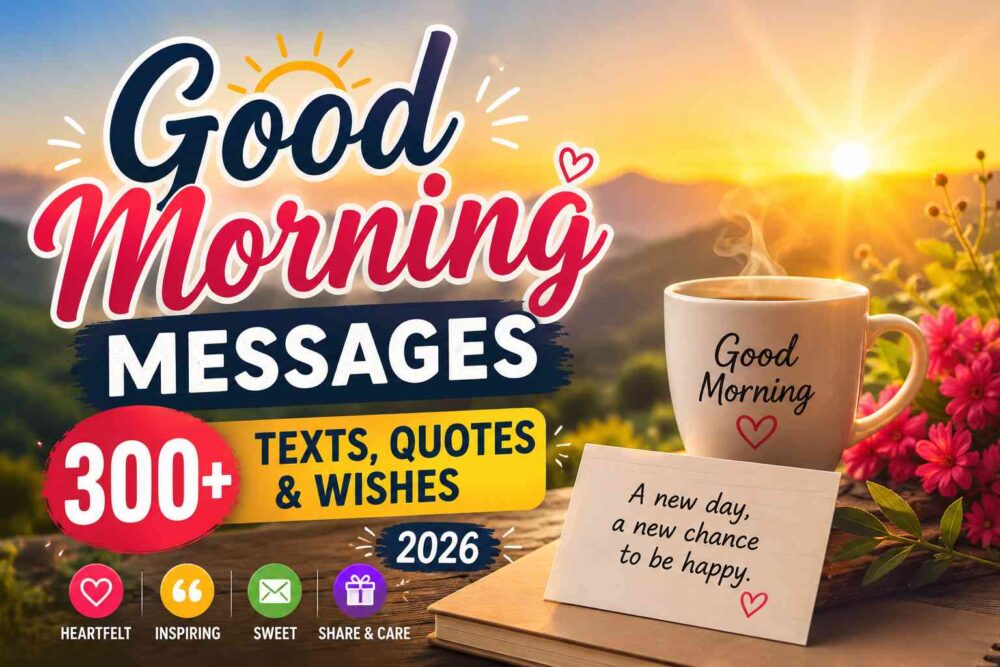
Good Morning Messages: 300+ Texts, Quotes & Wishes (2026)

There are approximately 8 billion people on Earth. Every morning, a significant number of them pick up their phone in the first five minutes of consciousness and check to see if anyone thought about them before the day began.

Good morning messages are how you answer that question before it’s asked.

Not a forward. Not a meme. Not a group chain started by someone’s aunt at 5:47am. A real message — specific, warm, and timed to land at the exact moment someone is deciding what kind of day they’re about to have.

The psychology here is not complicated. The first few minutes after waking are neurologically vulnerable — cortisol is low, emotional receptivity is high, and the framing of the first external input has a measurable effect on mood across the next several hours. A good morning message sent at the right moment to the right person is not just a nice gesture. It is a small but genuinely powerful act of connection.

This guide gives you 300+ good morning messages across every relationship and every tone — romantic, sweet, funny, inspirational, long distance, and more. It also gives you the DAWN Framework, the four-element formula that separates a good morning message that actually lands from one that gets a thumbs-up and immediately forgotten.

Use the table of contents below to jump directly to what you need.


Why Good Morning Messages Are More Powerful Than You Think

Most people underestimate what a good morning message actually does. They think of it as a greeting — a small social nicety, the digital equivalent of a wave. That is a significant underestimation of what happens in the brain of the person receiving it.

The first 10–15 minutes after waking are neurologically distinct from the rest of the day. The prefrontal cortex — the part of the brain responsible for rational decision-making and emotional regulation — is still coming online. Mood in those early minutes is disproportionately influenced by the first emotional stimulus the person encounters. A good morning message sent at exactly the right moment is that stimulus. It shapes the emotional coloring of everything that follows.

Relationships research consistently identifies “small gestures of acknowledgment” as one of the highest-return investments in relationship quality. Not grand gestures — small ones. A text that arrives before 9am saying “I woke up thinking about you” costs you thirty seconds and does work that no anniversary dinner can replicate, because it happens on an ordinary Wednesday with nothing to celebrate except the fact that you thought of them.

There is a second reason good morning messages matter beyond the science: they are surprisingly rare. Despite how easy they are to send, most people send them only occasionally — when they remember, when there is something specific to say, when the mood strikes. The person who sends them consistently, and sends them well, becomes associated in the recipient’s mind with something reliable and warm. That association compounds over time.

The question is not whether to send them. The question is how to send one that actually does something instead of arriving, being read, and disappearing into the morning blur.


The DAWN Framework: 4 Elements of a Morning Message That Lands

The DAWN Framework was built around one insight: most good morning messages fail not because the sender does not care but because they say nothing specific. “GM! ☀️” lands flat because it contains no information about the sender’s actual state of mind. It could have been sent to anyone. It signals that you remembered to send something — not that you thought about the person specifically.

The DAWN Framework fixes this with four simple elements:

D — Detail. The most powerful good morning messages contain one specific detail that proves the sender was thinking about this person, not a generic contact. It could be a reference to something they said yesterday, something you know about their day today, something you observed about them recently, or something you have in common. “Good morning — hope today is better than that meeting you were dreading” is infinitely more impactful than “good morning!” because it tells the recipient they exist in your memory as a specific person, not a contact in a list.

A — Affirmation. A good morning message that only conveys information is half a message. The other half is emotional: saying something that makes the person feel valued, seen, or cared for. This does not need to be dramatic. “I’m glad you exist” is an affirmation. “You’re going to do great today” is an affirmation. “You are one of my favorite people to wake up to” is a powerful affirmation. The key is that it says something about them, not just about the morning.

W — Warmth without pressure. A good morning message is not a summons. It is not the opening move in a conversation the recipient is now obligated to sustain while still half-asleep. The best morning messages are complete in themselves — they do not end with “???” or “you up?” or any signal that a response is required. They are gifts, not invoices. Ending with “have a great day” or “no need to reply, just wanted you to know I was thinking of you” removes any sense of obligation and paradoxically makes the message more likely to get a warm, voluntary response.

N — Natural language. The fastest way to kill a good morning message is to make it sound written. The person receiving your 7am text does not want to read something that feels like it was drafted by a committee. Use the voice you use when you’re slightly tired and genuinely feeling warm about someone — casual, a little unguarded, slightly imperfect. “I was thinking about you before I was even fully awake and thought you should know” sounds like a human. “I awaken with thoughts of you, dear one” does not.

You do not need all four elements every time. For a quick daily text, D and N are enough. For a message that genuinely moves someone, use all four. For a voice note or video — the format that outperforms text for morning messages every single time — the DAWN framework unfolds naturally when you just speak honestly.


Good Morning Messages for Her

Good morning messages for a woman you love — whether she is a girlfriend, wife, partner, or someone you are beginning to fall for — work best when they are specific enough that she knows she was the exact person on your mind, not a category of person you might send this to. Reference something real. Say something that only you would say to only her.

Heartfelt Good Morning Messages for Her

  • “Good morning. I woke up thinking about you and decided that’s a perfectly good way to start a day.”
  • “Good morning to the most beautiful mind I know. I hope today is as good to you as you are to everyone around you.”
  • “Woke up thinking about you. Figured you should know before the day gets loud. Good morning.”
  • “Good morning. You came to mind before coffee did, which tells you something about the hierarchy in my life.”
  • “I hope your morning is as soft and good as you are. Good morning.”
  • “Sending you this before the day gets away from both of us. Good morning — I’m glad you’re in the world.”
  • “Good morning. May your coffee be strong, your wifi be fast, and your day be everything you need it to be.”
  • “Good morning. There are a lot of things I appreciate about you and I don’t say it enough. Today felt like a good morning to start.”
  • “You make ordinary days feel better just by being in them. Good morning.”
  • “I was going to wait until I had something profound to say. Then I realized ‘good morning, I think you’re extraordinary’ is already pretty good.”

Romantic Good Morning Messages for Her

  • “Good morning, beautiful. Every morning that starts with you in it — even just on a screen — is already better than most.”
  • “I woke up reaching for you before I was fully conscious. That’s how I know this is different. Good morning.”
  • “Good morning. You are my favorite thought at the worst hours and the best hours. The morning ones are my favorite.”
  • “I don’t know how to explain what you do to my mornings. But it’s the good kind of unexplainable. Good morning.”
  • “Good morning to the person who makes every ordinary thing feel like it matters.”

Good Morning Messages for Him

Good morning messages for a man — boyfriend, husband, partner — tend to land hardest when they balance warmth with straightforwardness. Men in relationships consistently report that sincere, specific expressions of appreciation from a partner land with outsized emotional impact precisely because they are rarer. A good morning message that says something real and true is one of the highest-return relationship investments available.

Heartfelt Good Morning Messages for Him

  • “Good morning. Just wanted you to know I was thinking about you before the day officially started.”
  • “Good morning. You’re one of the things I like best about my life and I don’t say that enough. Today felt like a good day to say it.”
  • “Woke up with you on my mind. That’s becoming a habit and I’m not trying to stop it. Good morning.”
  • “Good morning. I hope today is good to you. You deserve a good one.”
  • “Good morning. I’m proud of you for the things you’re doing even when it’s hard. Today go easy on yourself.”
  • “I don’t always say it but I notice everything you do. Good morning — I’m lucky to have you.”
  • “Good morning. I was just thinking about how much I like the way you exist. Have a great day.”
  • “Good morning to the person who makes the whole thing feel more manageable.”
  • “You are one of the most solid people I know. Good morning. The world is better with you in it today.”
  • “Good morning. I woke up grateful for you before I was even grateful for coffee, and that is a very specific kind of love.”

Romantic Good Morning Messages for Him

  • “Good morning. I keep thinking about you and I’ve stopped pretending that’s not exactly where I want my thoughts to be.”
  • “Morning. I woke up wanting to tell you that I’m ridiculously happy with you. So there it is. Good morning.”
  • “Good morning to my person. The morning is better knowing you’re in the same world as me.”
  • “I fall asleep thinking about you and wake up doing the same. Good morning — I’d do it all over again.”
  • “Good morning. I keep finding new things to appreciate about you. Today’s reason: everything.”

Good Morning Messages for Your Girlfriend

These messages are calibrated for the particular warmth of early romantic relationships — where every good morning message carries a slightly elevated emotional charge. They are specific enough to feel genuine without being so intense they create pressure. Use the detail (D) and affirmation (A) elements of DAWN most heavily here.

  • “Good morning, you. I was thinking about you before I even opened my eyes properly. That’s how today started.”
  • “Good morning. I like you a lot and I think you should start your day knowing that.”
  • “You make waking up feel like something worth doing. Good morning, babe.”
  • “Good morning. I keep having a really good time with you and I wanted to say that before the day gets in the way.”
  • “I hope your morning is as warm as you are. Good morning.”
  • “Good morning. I was debating whether to send this and then decided: of course I should. Thinking of you.”
  • “Good morning to the person who has been living rent-free in my head since the moment we met. Still not evicting you.”
  • “You are genuinely one of the best parts of my life right now. Good morning.”
  • “Good morning! I have absolutely nothing important to say except that I’m thinking about you and wanted you to know.”
  • “Good morning, girl. I hope today is a ten out of ten. You deserve nothing less.”
  • “I was going to wait until I had something poetic to say. Then I realized: good morning, you make me happy is already pretty good.”
  • “Good morning. I’m a better version of myself around you and mornings like this are a good reminder of that.”

Good Morning Messages for Your Boyfriend

A good morning message for your boyfriend that actually lands is one that is direct without being heavy, affectionate without being performative, and specific enough that he knows it was written for him. Men in relationships consistently underreport how much they value being thought of specifically — a good morning message is one of the simplest ways to demonstrate that.

  • “Good morning. I woke up thinking about how glad I am that you exist in my life. Felt like a solid way to start a text.”
  • “Good morning. I like you a lot. That’s the whole message.”
  • “I was just thinking about you. Figured you should know before the day started. Good morning.”
  • “Good morning, babe. I hope today is exactly as good as you are.”
  • “Good morning. You are one of the easiest things in my life to be grateful for.”
  • “Morning! You’ve been on my mind since I woke up and I’m here for it.”
  • “Good morning to the most annoying, wonderful, impossible-to-stop-thinking-about person I know.”
  • “I keep finding things I like about you. This morning’s thing: all the other things. Good morning.”
  • “Good morning. I don’t say it enough: you make every day easier and better just by being in it.”
  • “Good morning! I’m very glad you’re my person. Just wanted to say.”
  • “You’re the first thing I think about in the morning and honestly? I’ve stopped trying to change that. Good morning.”
  • “Good morning. I hope today gives you what you need. You’ve been working really hard and I see it.”

Good Morning Messages for Your Wife

Long-term partnership creates a particular challenge for morning messages: familiarity. After years together, the impulse to say something genuine can get buried under the noise of routine. A good morning message to your wife that names something specific — something real, recent, and observed — cuts through that familiarity and reminds her that you see her, not just the shared life around her.

  • “Good morning to my favorite person. Today and every day.”
  • “I’ve been waking up next to you for [X] years and I still reach for you first. Good morning.”
  • “Good morning. I notice what you do every day, even when I don’t say it. Today I’m saying it.”
  • “You are the most remarkable person I know and I live with you, which means I get to see it every day. Good morning.”
  • “Good morning. I’m grateful for you in a way that doesn’t shrink with time. If anything, it keeps growing.”
  • “The life we’ve built together is one of the things I’m most proud of. Good morning — thank you for building it with me.”
  • “Good morning to the person who makes our house feel like a home. I don’t say that enough.”
  • “I fell in love with you a long time ago and I keep falling in the same direction. Good morning.”
  • “Good morning. You are still the first thing I want to talk to. After this many years, I don’t take that for granted.”
  • “Good morning, love. Today I just want you to know: I chose you then and I’d choose you again in a heartbeat.”
  • “You carry so much with so much grace. Good morning — I see you and I’m in awe of you.”
  • “Good morning to the only person I’d willingly share my coffee with. Which tells you everything.”

Good Morning Messages for Your Husband

Good morning messages for a husband follow the same principle as for a wife: the longer the relationship, the more a specific, genuine morning message stands out. These land hardest when they reference something real and current rather than general warmth. Tell him what you observed this week. Tell him what you are still grateful for. Tell him something specific about why you chose him and keep choosing him.

  • “Good morning to the person who has been my home for [X] years. Still my favorite place to be.”
  • “Good morning. I see everything you do for this family. I don’t always say it enough. Today I am.”
  • “I’ve been thinking about how lucky I got. Good morning — thanks for being the reason for that.”
  • “Good morning. You are the most reliably good thing in my life and I’m not sure I say that enough.”
  • “I woke up before you and watched you sleep for a second and thought: I really, really love this person. Good morning.”
  • “Good morning to my person. Every day with you is a good reason to be alive.”
  • “You still make me laugh every single day. That is not a small thing. Good morning.”
  • “Good morning. You are a remarkable father and husband and human and I don’t want to wait for an occasion to tell you that.”
  • “I love the life we have. Good morning — I love that we built it together.”
  • “You are the most solid person I know. Good morning. The world is better with you awake in it.”
  • “Good morning. I’m still crazy about you and I hope that never stops being the case.”
  • “Good morning to my best friend who I happen to be married to. Still the best outcome.”

Romantic Good Morning Messages

Romantic good morning messages are the ones people search most often, and the hardest ones to write well — because romantic does not mean overwrought. The most romantic morning messages are vulnerable, specific, and honest rather than florid or poetic. They say something true in plain language. That simplicity is what makes them land.

  • “Good morning. I keep thinking about you at inconvenient hours and the mornings are the best version of that problem.”
  • “I woke up and wanted to tell you that you are one of my very favorite things. Good morning.”
  • “Good morning. You came to mind before I was even fully awake. That’s either a sign or a symptom. Either way, I’m not complaining.”
  • “I love the way you love. Good morning — I hope today shows you some of that love back.”
  • “Good morning. There are a lot of things I want to do in my life. Waking up thinking about you is one I’m particularly attached to.”
  • “The morning feels like it belongs to us, even when we’re not together. Good morning.”
  • “Good morning. I was going to say something clever and then realized the truth is better: I miss you and I’m glad you’re mine.”
  • “You are the thought I return to. Good morning — have the day you deserve.”
  • “Good morning. Everything feels better when you’re in the picture. Today included.”
  • “I woke up wanting to tell you something important and then realized the most important thing is just: good morning, I love you.”
  • “Good morning. The distance between us this morning is the only thing I’d change about today.”
  • “You make the ordinary feel remarkable. Good morning — I hope your day gives you back some of what you give everything.”

Sweet Good Morning Messages

Sweet good morning messages are the middle register between romantic and friendly — warm, genuine, and feel-good without being intense. These work for any relationship where you want to brighten someone’s morning without making it heavy. Use them for partners, close friends, family members, or anyone going through a hard stretch who needs to know someone is thinking of them.

  • “Good morning! I hope today treats you as kindly as you treat everyone around you.”
  • “Sending you good morning energy before the world has a chance to use any of yours up.”
  • “Good morning. Just a little reminder that someone woke up happy you exist.”
  • “Good morning! May your coffee be strong and your Monday be short.”
  • “Good morning, sunshine. I hope your day is as bright as you are.”
  • “Thought about you this morning and decided you deserved to know. Good morning!”
  • “Good morning. You are appreciated more than you probably realize.”
  • “Sending you a good morning because you make my days better and it’s only fair to return the favor.”
  • “Good morning! Go easy on yourself today. The world needs you at your best, which means you need a good start.”
  • “Just wanted your morning to include at least one message from someone who genuinely roots for you. Good morning!”
  • “Good morning. Whatever today throws at you, you’ve handled harder. I believe in you.”
  • “Today is going to be good. Not because everything will be perfect, but because you’re in it. Good morning.”
  • “Good morning! Here’s hoping today gives you a moment that makes the whole thing worth it.”
  • “Wake up. Breathe. You’re doing better than you think. Good morning.”
  • “Good morning! I just wanted you to know there’s at least one person in your corner before 8am.”

Funny Good Morning Messages

Funny good morning messages are one of the most reliable ways to make someone laugh before they’ve had to deal with anything difficult. They work best in relationships where humor is the love language — where a well-timed joke at 7am is more meaningful than any amount of sincerity. The rule for funny morning messages is the same as for all good humor: the joke should feel like it was written specifically for this person, not forwarded from a list.

  • “Good morning! I hope your coffee is as strong as your will to deal with today.”
  • “Good morning. I’m awake. I don’t know why, but I’m awake and thought you should suffer alongside me.”
  • “Good morning! Today is a great day to pretend you’re a morning person.”
  • “It is morning. This is not great news for either of us, and yet here we are. Good morning.”
  • “Good morning. The sun is up, birds are doing their thing, and you have no choice but to participate in another day. Welcome.”
  • “Good morning! I woke up thinking about you, which is objectively adorable and slightly inconvenient.”
  • “Rise and shine! Or just rise. Shining can wait until after coffee.”
  • “Good morning. I would have texted sooner but I was also aggressively unconscious. We’re both here now.”
  • “Good morning! May today be the kind of day where everything goes smoothly, which means probably not a Monday.”
  • “Today is going to be great. (I have no evidence for this. But confidence is free.)”
  • “Good morning! Your mission, should you choose to accept it, is to have the day that you deserve. It self-destructs after 11pm.”
  • “Sending you a good morning text because apparently I think about you at 7am, which is both flattering and slightly embarrassing for me.”
  • “Good morning. Another day, another opportunity to absolutely nail it or spectacularly not. Either way, I’m rooting for you.”
  • “I know you’re not a morning person. I know. And yet. Good morning.”
  • “Good morning! I would have called but I am also not fully functional at this hour.”

Inspirational Good Morning Messages

Inspirational good morning messages work best when they are human rather than aggressively motivational. Nobody wants a productivity manifesto at 7am. They want something that makes them feel capable, seen, and ready — without requiring them to perform enthusiasm they haven’t had coffee for yet. These messages are calibrated for that register: genuinely encouraging rather than cheerleader-loud.

  • “Good morning. Whatever you’re building, you’re further along than you were yesterday. Keep going.”
  • “Good morning. Today is a blank page. You get to decide what goes on it.”
  • “Good morning. You are more capable than yesterday’s version of yourself. This is always the case.”
  • “Start today where you are. Use what you have. Do what you can. That’s already enough. Good morning.”
  • “Good morning. Progress isn’t always visible. But it’s happening, even on the quiet days.”
  • “Every day is a chance to be a slightly better version of who you were yesterday. That’s it. That’s the whole thing. Good morning.”
  • “Good morning. The fact that you’re still trying is not a small thing. Most people stop. You haven’t.”
  • “Today might be hard. That’s okay. Hard days build things that easy days can’t. Good morning.”
  • “Good morning. You’ve survived every difficult day you’ve had so far. Your record is still perfect.”
  • “Good morning. The life you want is being built right now in the choices you make today. Make good ones.”
  • “Good morning. You don’t need to be ready. You just need to start. Ready comes later.”
  • “Good morning. Be kind to yourself today. You are doing something genuinely hard and it deserves acknowledgment.”
  • “The most important thing you can do this morning is decide that today matters. It does. Good morning.”
  • “Good morning. Slow progress is still progress. Rest when you need to. But don’t stop.”
  • “Good morning. I hope today gives you a moment that reminds you why you started.”

Good Morning Messages for Friends

A good morning message to a friend lands differently from one to a romantic partner — but it is not less meaningful. Sending a good morning to a friend with no particular occasion is one of the clearest signals of genuine care, precisely because there is no social obligation driving it. You thought of them. That is the entire message. These work for best friends, close friends going through something hard, and friends you have not talked to in a while but want to reconnect with.

  • “Good morning! I was just thinking about you and thought you should start your day knowing someone is rooting for you.”
  • “Good morning, friend. You came to mind and I decided that was a message worth sending.”
  • “Hey! Good morning. No particular reason for this except that I appreciate you and wanted to say so before the day got busy.”
  • “Good morning! You’re one of my favorite people. Today felt like a good day to say that out loud.”
  • “I woke up thinking about that conversation we had last week and felt grateful for you. Good morning.”
  • “Good morning! You are doing better than you think you are. (I mean this as a genuine observation, not just encouragement.)”
  • “Good morning! I’m thinking of you today. Whatever you’re dealing with, you’ve got this and you’ve got me.”
  • “Good morning to one of the most genuinely good people I know. I hope today reflects that back at you.”
  • “Good morning! We haven’t talked in a while and I just wanted you to know: still rooting for you, still thinking of you.”
  • “Good morning, friend. I hope today is manageable, and if it’s not, I’m here.”
  • “Good morning! You are someone I am very glad to know and today felt like a good day to tell you that directly.”
  • “Good morning! The world is better for having you in it. I hope your day reflects that.”

Good Morning Messages for Long Distance Relationships

In a long distance relationship, the good morning message carries extraordinary weight. It is often the first point of contact in a day where physical presence is not available — the closest thing to waking up next to someone that the distance allows. A good morning message sent consistently and genuinely across distance does more relationship maintenance than almost any other daily habit.

These messages are written for the particular emotional register of long distance: the longing that coexists with love, the specific texture of missing someone in the early morning hours, and the warmth of knowing someone is thinking of you from somewhere far away.

  • “Good morning from here to there. The miles between us are the only thing I’d change about any of this.”
  • “Good morning. I woke up reaching for you and finding empty space, which means I need you to know that I miss you today. And every day.”
  • “Good morning. Different time zone, same first thought: you.”
  • “Good morning! By the time you read this the day will already be different for each of us, but this moment was the same — I was thinking of you.”
  • “Good morning. I’d give a lot for a morning where this message wasn’t necessary because you’d just be here.”
  • “Good morning. We’re waking up miles apart and I’m still the luckiest person I know.”
  • “I know the distance is hard. I know some mornings are harder than others. But I wake up grateful for you every single day. Good morning.”
  • “Good morning. I am currently imagining making you coffee and annoying you before you’re fully awake. Miss you.”
  • “Good morning from [place]. Wishing I could teleport or that you could or that distance was less of a thing. For now, this message.”
  • “Good morning. Every morning message I send is a small proof that distance hasn’t changed anything important.”
  • “Good morning. I am thinking about the last time we were in the same place and already planning the next one.”
  • “Good morning. The best thing about long distance is the reunions. The hardest part is mornings like this one.”

If you’re navigating a long distance relationship, our full guide on Long Distance Relationship Gifts and Virtual Gifts for Long Distance Boyfriend have hundreds of ideas for staying connected across the miles.


Good Morning Quotes Worth Sharing

Sometimes the right morning message is a quote — not because you have nothing to say, but because something someone else said says it better, and sharing it is itself an act of “I thought of you when I read this.” These are quotes calibrated for authenticity: they feel human, not like motivational poster captions.

Good Morning Quotes About New Beginnings

  • “Every morning is a fresh start. Not because yesterday didn’t happen, but because today is still unwritten.”
  • “The morning is proof that no matter how dark it gets, the light always comes back.”
  • “You don’t have to have it all figured out to get started. Just get started. Good morning.”
  • “Each morning we are born again. What we do today matters most.” — Buddha
  • “Morning is the universe’s way of saying: you get another shot at this.”

Good Morning Quotes About Life and Gratitude

  • “Good morning. The fact that you opened your eyes today is already a reason to keep going.”
  • “An early morning walk is a blessing for the whole day.” — Henry David Thoreau
  • “Today’s goals: coffee, kindness, and making it to the end with your integrity intact.”
  • “You’ve been given this day. That is the gift. What you do with it is yours.”
  • “Every morning brings new potential, but if you dwell on the misfortunes of the day before, you tend to overlook tremendous opportunities.” — Harvey Mackay

Good Morning Quotes for Motivation

  • “The secret to getting ahead is getting started.” — Mark Twain
  • “Don’t watch the clock — do what it does. Keep going.” — Sam Levenson
  • “Good morning. You are capable of more than you remember on the hard days.”
  • “The sun himself is weak when he first rises, and gathers strength and courage as the day gets on.” — Charles Dickens
  • “Today’s potential is tomorrow’s story. Make it worth telling.”

Good Morning Quotes About Love

  • “Good morning. Somewhere someone woke up thinking about you specifically. I know because it was me.”
  • “The best thing to hold onto in life is each other.” — Audrey Hepburn
  • “You are the first thought I have in the morning and the last one before I sleep. And all the ones in between.”
  • “Good morning. Being loved the way you love people is something you deserve.”
  • “I love you not only for what you are, but for what I am when I am with you.” — Roy Croft

Short Good Morning Messages (One-Liners)

The best good morning messages are often the shortest ones — because brevity signals confidence. A single true sentence sent at the right moment can accomplish everything a paragraph can, and do it without requiring any particular mood or time from the recipient. These one-liners work as standalone messages or as openers to longer conversations.

  • “Good morning. You were my first thought.”
  • “Woke up thinking about you. Wanted you to know.”
  • “Good morning. I’m glad you exist.”
  • “Today is already better because you’re in it.”
  • “Good morning. You’ve got this.”
  • “Morning. I miss you.”
  • “Good morning! Don’t forget: you are someone’s favorite.”
  • “Good morning. I’m in your corner.”
  • “Thinking of you this morning. No reason. Best reason.”
  • “Good morning to my favorite person. Still you. Still always you.”
  • “Morning. Be kind to yourself today.”
  • “Good morning. I choose you. Every morning.”
  • “Rise and shine — the world needs what you’ve got.”
  • “Good morning. Make it a good one. I believe you can.”
  • “You came to mind. Figured you should know. Good morning.”

Deep & Meaningful Good Morning Messages

These are for the moments when you want to say something more substantial — not just a greeting but a genuine expression of what the person means to you, how they shape your mornings, or what the relationship has meant. They are longer than a quick text but not so long they feel like a letter. They work particularly well as voice notes, where the natural inflection of speech carries the depth better than text can.

  • “Good morning. I’ve been thinking about what it means to have people in your life who make the ordinary feel significant. You are one of those people for me. I don’t say it enough but I feel it every time I wake up and think of you before I think of anything else.”
  • “Good morning. I want you to know that however today goes — whether it’s a good one or a hard one — I’m here. Not in a performative way. In the way where I will actually pick up the phone. You’re not doing any of this alone.”
  • “Good morning. I’ve been thinking about what a strange and wonderful thing it is that two people can find each other in this enormous, noise-filled world and become each other’s person. I’m still amazed it happened.”
  • “Good morning. You’re carrying more than people see. I see it. I also see how well you carry it, and I want you to know that someone notices and someone is genuinely proud of you.”
  • “Good morning. I have been thinking about how much I’ve changed because of you — the ways you’ve made me braver, warmer, more willing to be honest. You’ve shaped me in ways you probably don’t realize. I’m grateful for that every morning.”
  • “Good morning. I don’t know what today looks like for you, but I hope it includes at least one moment where something goes better than you expected. You’ve been working hard and the best mornings are ones where that work starts to pay off.”

How to Send a Good Morning Message That Actually Lands

The messages in this guide are a starting point. What makes any of them actually work — what separates a good morning message that someone reads and immediately feels something from one that gets glanced at and scrolled past — comes down to a few things that have nothing to do with the words themselves.

Timing

A good morning message sent at 11am is not a good morning message. It is a mid-morning message pretending to be a morning message, and the person will notice the difference even if they don’t say so. Aim for the window between 7am and 9am in the recipient’s time zone — the period when they are most likely awake but haven’t yet been fully absorbed by the day. If you genuinely are not a morning person, set a reminder the night before to send it when you wake up, or use your phone’s scheduled message feature.

Consistency over intensity

A perfect good morning message sent once lands as a nice moment. The same quality of message sent consistently over weeks and months lands as a defining characteristic of your relationship. Consistency signals that the thought is real and habitual, not occasional and performative. The recipient stops wondering if you’re thinking of them in the morning because they know you are.

Match the medium to the moment

Text is fine for most good morning messages. But for the moments that matter most — a long distance partner waking up to another week of separation, a person you love going through a genuinely hard stretch, an anniversary morning, a day you know is going to be significant — text is insufficient. It carries words but strips out everything else: tone, expression, the warmth of a face, the sound of a voice.

A 45-second voice note delivered in the morning is more emotionally impactful than any good morning text, because hearing someone’s voice activates entirely different emotional processing than reading their words. A short personalized video is more impactful still. And for occasions where you want the delivery itself to be part of the experience — MessageAR lets you embed a personalized video inside an augmented reality greeting that the recipient unlocks with their phone. Imagine your partner waking up, scanning what looks like an ordinary card on the nightstand, and watching your face appear in augmented reality wishing them a good morning. That is not a text. That is a memory.

Don’t overthink it

The single most common reason good morning messages don’t get sent is that the person thinks they need to have something profound to say before saying anything. They don’t. “I was thinking about you and wanted you to know” is complete. “Good morning — hope today is good to you” is complete. The message does not need to be impressive. It needs to be real and sent.

Use the DAWN framework as your foundation

Before you send any good morning message, run it through the DAWN check: Does it have a Detail that proves this was written for this specific person? Does it Affirm something about them? Does it have Warmth without creating pressure to respond? Does it sound like Natural language rather than something copied from a list? If yes to all four, send it. If not, add one thing — usually the Detail — and send it anyway.


FAQ: Good Morning Messages Answered

How long should a good morning message be?

For a daily good morning text, one to three sentences is ideal. Long enough to feel genuine, short enough not to require effort from someone who is still waking up. For special occasions or particularly meaningful moments, longer is fine — but only if every word is earning its place. Length is never the point. Specificity and warmth are.

Is it okay to send a good morning message every day?

Yes — with the caveat that consistency should serve the relationship rather than become a habit that loses meaning. The solution is not to skip days to seem less eager. The solution is to keep the messages genuine. A daily good morning text that contains one specific real thought will never feel like spam. A daily “GM ☀️” will start to feel like one after about a week. The frequency is not the problem. The specificity is what keeps it fresh.

What if they don’t respond to my good morning messages?

Non-response does not necessarily mean non-receipt or non-appreciation. Many people receive a morning message, feel genuinely warmed by it, and then get absorbed in the day before they’ve had a chance to reply. The DAWN framework specifically builds messages that do not demand a response — they are complete in themselves. If non-response becomes a pattern and you are uncertain how the messages are landing, the solution is a direct conversation, not withholding morning messages to see what happens.

What is a good morning message for someone who is going through something hard?

For someone navigating grief, illness, job loss, or any genuinely difficult season, a good morning message should be stripped of forced optimism and replaced with simple, honest presence. “Good morning. I’m thinking of you. Today doesn’t have to be good — just survivable. I’m here” is infinitely more useful than “Good morning! Today is going to be your day!” The person going through something hard needs to know they are not alone in the morning — not that they are being cheered into feeling better before they are ready.

Should I send a good morning message first or wait for them to?

Send it first. Waiting for the other person to initiate is the conversational equivalent of waiting for someone to introduce themselves at a party rather than walking over. In relationships of any kind — romantic, friendly, professional — the person who initiates genuine connection regularly is the one the relationship depends on. Being the one who sends the first good morning message is a small act of leadership. Take it.

What is the most romantic good morning message?

The most romantic good morning message is the most specific one. Not the most poetic, not the most elaborate — the one that makes the recipient feel that you were thinking about them, specifically, in the quiet before the day started. “Good morning. I woke up and my first thought was you. That keeps happening and I’ve decided to stop questioning it” beats every pre-written romantic quote because it is unambiguously about this person in this moment. Specificity is romance.


Final Thought: The Two Minutes That Change a Day

A good morning message costs two minutes to write and thirty seconds to send. It arrives at the most neurologically receptive moment in a person’s day. It says, before anything else has been said, that you thought of them before you thought of anything else.

Most people mean to do this more than they actually do it. The gap between intention and execution is where connection goes to die. The DAWN Framework — Detail, Affirmation, Warmth without pressure, Natural language — closes that gap by giving you a structure that takes the thinking out of it. You still bring the feeling. The framework just makes sure the feeling gets expressed instead of drifting away into the morning routine.

Pick one person. Think of one specific thing. Send it before 9am.

That’s it. That’s the whole practice.

For the mornings that deserve more than a text — the long distance reunion morning, the anniversary, the day someone you love really needs to feel seen — give them something they will remember. MessageAR lets you send a personalized video embedded in an augmented reality greeting. It is the kind of morning message that becomes a story someone tells. That is worth two more minutes.


Related reading: Romantic Messages for Her · Long Distance Relationship Gifts · 725+ Date Night Ideas · Thank You Messages · Anniversary Wishes


Top AI Tools for Every Task in 2026: Free, Paid and Everything in Between

Introduction: Why AI Tools Matter in 2026

Artificial intelligence has moved from a futuristic curiosity to an everyday companion. In 2026, AI powers the tools that help us write, design, code, edit videos, compose music and even run businesses. The shift is profound – AI is no longer just a chatbot answering questions. Agentic systems and automation platforms enable individuals to build systems that handle research, outreach, content creation and product development. According to insights from KDnuggets, people are earning money by building small AI‑driven services and products, proving that AI is now a practical income stream.

This article explores the best AI tools across key tasks. For each tool we note whether it is free, paid or freemium (a basic free tier with paid upgrades). Our focus is practicality: we look at how these tools can save time, improve quality and even generate income. We also include real‑world uses and tips to get started.

By the end of this guide, you will know which AI tools are right for your needs, whether you are a content creator, designer, programmer, marketer or student. Let’s begin!

Writing & Content Creation

Why AI Writing Tools?

Writing tools powered by AI can brainstorm ideas, draft articles, correct grammar and refine tone. They speed up workflows and allow people to focus on strategy rather than typing. Many professionals use AI to improve their copywriting and deliver higher‑quality outcomes.

Top Tools

1. ChatGPT (OpenAI)

  • Type: Freemium (free basic usage with limitations; paid plans for higher volume and advanced features)
  • What it does: ChatGPT is a conversational AI that can draft blog posts, summarize articles, generate social media content, provide coding help and brainstorm ideas.
  • Key features: real‑time conversation, advanced reasoning, customizable tone, integration with external data (via plug‑ins or APIs on paid plans).
  • Use case: a blogger can use ChatGPT to draft an outline, expand sections and refine language. With proper fact‑checking, it becomes a powerful writing partner.
  • Tip: always verify facts and add personal insights to avoid generic content.

2. Jasper

  • Type: Paid (free trial available)
  • What it does: Jasper (formerly Jarvis) is designed for marketing copy, blog posts, emails and ad copy. It offers templates for content types and has a strong focus on brand voice.
  • Key features: brand voice training, SEO integration, collaboration features, art generation add‑on.
  • Use case: marketing teams use Jasper to draft product descriptions and email campaigns that align with their brand voice.
  • Note: while there is a free trial, full functionality requires a subscription.

3. Writesonic

  • Type: Freemium
  • What it does: Offers AI writing assistance for blogs, landing pages and ads. It integrates with SurferSEO for keyword optimization.
  • Key features: multiple languages, integration with SEO, content rephrasing, AI chat.
  • Use case: small businesses can generate high‑quality marketing copy and headlines quickly.
  • Free tier: limited monthly credits; paid plans offer higher volume and premium features.

4. GrammarlyGO

  • Type: Freemium
  • What it does: GrammarlyGO is an AI assistant within the popular Grammarly grammar checker. It rewrites text, suggests improvements and offers tone adjustments.
  • Key features: grammar and spell check, tone rewrites, context‑aware suggestions.
  • Use case: students and professionals can quickly polish emails and essays.

5. Copy.ai

  • Type: Freemium
  • What it does: Copy.ai specializes in marketing copy, sales letters and brainstorming. It offers dozens of templates and supports multiple languages.
  • Key features: tone options (friendly, professional, witty), content rewrites, brainstorming mode.
  • Use case: entrepreneurs use it to generate product descriptions and website copy quickly.

Tips for Using AI Writing Tools

  1. Combine AI and human creativity: AI accelerates drafting but should not replace human insight. Add personal stories, examples and unique data.
  2. Fact‑check and cite sources: AI sometimes invents details. Check facts and provide citations from reliable sources.
  3. Train the AI to your voice: Many tools allow brand voice training. Feed examples of your writing to maintain consistency.
  4. Optimize for SEO: Tools like SurferSEO or content editors within Jasper help align content with search intent.

Graphic Design & Image Generation

Why AI Design Tools?

Graphic design has traditionally required professional skills and expensive software. AI tools democratize design by offering templates, automatic formatting and image generation. They are ideal for social media graphics, logos, presentations and brand assets.

Top Tools

1. Canva

  • Type: Freemium
  • What it does: Canva is a popular design platform offering templates for social media posts, flyers, presentations and more. Its AI features include a Magic Design assistant and text‑to‑image generation.
  • Key features: drag‑and‑drop editor, brand kits, stock photos, video editing, Magic Resize for different social platforms.
  • Use case: small businesses can design professional graphics without hiring a designer.
  • Free tier: offers many templates and basic features; paid “Pro” unlocks premium assets and advanced tools.

2. Adobe Express (formerly Spark)

  • Type: Freemium
  • What it does: Adobe Express provides templates, one‑click branding and design assets. It integrates with Creative Cloud and uses AI to suggest layouts.
  • Key features: quick actions (resize, remove background), design templates, stock photos, video templates.
  • Use case: marketers can create on‑brand social media posts quickly.
  • Note: the free plan has limited premium templates; full features require a subscription.

3. DALL‑E 3

  • Type: Paid (via OpenAI API or integrated in ChatGPT Plus)
  • What it does: DALL‑E 3 generates images from text descriptions with high fidelity. Users can specify style, composition and details.
  • Key features: high‑quality generation, style control, ability to edit existing images.
  • Use case: designers can create concept art, album covers or unique illustrations.
  • Cost: usage is billed per generated image through OpenAI’s API or included in ChatGPT Plus subscription.

4. Midjourney

  • Type: Paid
  • What it does: Midjourney is an art generator that runs on Discord. It excels at painterly and cinematic visuals.
  • Key features: style prompts, iterative generation (version 6 improves photorealism), community gallery.
  • Use case: digital artists and brand designers looking for abstract or stylized art.
  • Cost: monthly subscription; no free plan.

5. Figma Designer with AI Add‑ons

  • Type: Freemium (Figma Starter plan is free; AI plugins may cost extra)
  • What it does: Figma is a collaborative design tool for UI/UX work. Numerous AI add‑ons automate tasks like layout generation, color palette suggestions and icon creation.
  • Key features: real‑time collaboration, vector editing, plugin ecosystem with AI design assistants.
  • Use case: product teams design interfaces and prototypes more efficiently.

Tips for AI Design Tools

  1. Start with templates: Many tools offer templates for specific platforms (Instagram stories, YouTube thumbnails). Use them to save time.
  2. Customize with brand guidelines: Upload your logo and choose brand colors to ensure consistency.
  3. Use text‑to‑image tools for unique visuals: DALL‑E and Midjourney are great for one‑of‑a‑kind images. Combine them with Canva to create polished designs.
  4. Optimize file sizes: compressed images load faster on websites and social platforms.

Video Creation & Editing

Why AI Video Tools?

Videos dominate social media and marketing. AI tools simplify production by generating scripts, creating voice‑overs, editing clips and resizing for different platforms. They reduce the time and cost required for professional results.

Top Tools

1. Descript

  • Type: Freemium
  • What it does: Descript is an all‑in‑one video and podcast editor. Its AI “Studio Sound” cleans up audio, and its video editor lets you edit by editing the transcript.
  • Key features: text‑based editing, overdub (AI voice cloning), screen recording, filler‑word removal, green screen.
  • Use case: YouTubers and podcasters can edit content quickly by cutting words instead of video frames.
  • Free tier: limited exports and watermark; paid plans remove watermarks and add features.

2. Pictory

  • Type: Paid (free trial available)
  • What it does: Pictory converts long‑form content (blog posts, articles) into short videos using AI. It automatically extracts key points and pairs them with stock footage and music.
  • Key features: text‑to‑video, voice‑over options, subtitles, video summarization.
  • Use case: marketers can repurpose blog posts into social videos for YouTube, Instagram and TikTok.

3. InVideo

  • Type: Freemium
  • What it does: InVideo offers templates for ads, promo videos, presentations and social media. It includes text‑to‑speech and automated video creation from scripts.
  • Key features: AI voice overs, text‑to‑video, 5,000+ templates, stock media library.
  • Use case: small business owners create professional ads without a production team.
  • Free tier: access to basic templates; watermarked exports; paid plans remove watermarks and unlock premium assets.

4. Runway

  • Type: Paid (limited free credits)
  • What it does: Runway is a creative suite with AI video editing, background removal, motion tracking and generative tools like Gen‑1 and Gen‑2 for turning text into videos.
  • Key features: multi‑model editing (text‑to‑video, image‑to‑video), style transfer, instant rotoscoping.
  • Use case: filmmakers and visual artists create experimental visuals and special effects.
  • Cost: free trial offers limited credits; subscription required for extended use.

5. Fliki

  • Type: Freemium
  • What it does: Fliki turns scripts or blog posts into videos using realistic AI voices and a large media library.
  • Key features: natural‑sounding voices in multiple languages, automated visuals, text highlighting.
  • Use case: educators create explainer videos quickly.
  • Free tier: limited minutes of video creation per month; paid plans expand capacity.

Tips for AI Video Tools

  1. Script before generating: even with AI, good videos start with a clear script and structure.
  2. Use natural voices: choose AI voices that match your brand tone or record your own voice and use tools like Descript’s overdub for corrections.
  3. Add captions: accessibility increases reach; many tools automatically generate captions.
  4. Resize for platforms: tools like InVideo and Runway help convert a video to different aspect ratios for YouTube, Instagram or TikTok.

Audio & Music Production

Why AI Audio Tools?

AI audio tools help creators produce podcasts, audiobooks and music without the need for expensive equipment. They include voice cloning, noise reduction, music composition and mastering.

Top Tools

1. Adobe Podcast (formerly Project Shasta)

  • Type: Freemium
  • What it does: Adobe Podcast offers AI‑powered enhancements like noise removal, speech enhancement and automatic leveling.
  • Key features: Studio Sound (removes background noise), script‑based editing, automatic transcription.
  • Use case: podcasters clean up audio quickly and edit via text.

2. AIVA

  • Type: Freemium
  • What it does: AIVA composes music in various genres using AI. Users can adjust style, tempo and instrumentation.
  • Key features: music composition, sheet music export, genre selection, editable arrangements.
  • Use case: filmmakers or game developers need custom background music.
  • Free tier: limited downloads and non‑commercial usage; paid plans offer higher quality and commercial rights.

3. LALAL.AI

  • Type: Freemium
  • What it does: LALAL.AI separates vocals and instrumentals from audio files using stem splitting technology.
  • Key features: high‑quality stem extraction, batch processing, voice cleaner.
  • Use case: remixing songs or creating karaoke tracks.
  • Free tier: limited sample length; paid tiers provide longer processing and better quality.

4. Soundraw

  • Type: Paid (trial available)
  • What it does: Soundraw generates original music based on mood, genre and length. Users can edit individual instruments and structure.
  • Key features: customizable music, adaptive length, AI composer with human editing.
  • Use case: YouTube creators and advertisers needing unique background music.

5. MusicLM (experimental)

  • Type: Experimental/free (access via Google AI Test Kitchen)
  • What it does: MusicLM, from Google, can generate music from textual descriptions, similar to text‑to‑image models.
  • Key features: style and instrument control, extended compositions.
  • Use case: experimental music projects, concept tracks for films or games.

Tips for AI Audio Tools

  1. Define your mood: specify genre and mood to get better compositions.
  2. Experiment with voice cloning responsibly: ensure you have legal rights when cloning voices.
  3. Use noise reduction: tools like Adobe Podcast improve clarity and reduce editing time.
  4. Mix human and AI editing: AI can generate drafts; human producers can refine structure and mastering.

Coding & Developer Assistance

<a id=”coding”></a>

Why AI Coding Tools?

Developers increasingly rely on AI to boost productivity. Coding assistants can suggest code snippets, debug errors, generate unit tests and automate documentation. According to KDnuggets, micro‑tools and small SaaS products built using automation are a lucrative avenue for earning with AI.

Top Tools

1. GitHub Copilot

  • Type: Paid (free trial for verified students)
  • What it does: Copilot suggests code completions, entire functions and tests based on context. It supports major programming languages.
  • Key features: integration with Visual Studio Code and JetBrains IDEs, contextual suggestions, code explanations.
  • Use case: reduces boilerplate and accelerates development for professionals and learners.

2. Replit Ghostwriter

  • Type: Paid (some free features)
  • What it does: Replit’s Ghostwriter helps you write code, fix bugs and deploy applications in the browser. It also suggests projects and code improvements.
  • Key features: AI‑assisted coding, chat interface, code explanations, built‑in deployment.
  • Use case: beginners learning to code or building prototypes quickly.

3. Tabnine

  • Type: Freemium
  • What it does: Tabnine provides AI code completion and suggestions across languages. It runs locally for privacy and integrates with popular IDEs.
  • Key features: local inference, team training, pair programming mode.
  • Use case: teams needing private code suggestions and autopilot for repetitive tasks.

4. Codeium

  • Type: Freemium
  • What it does: Codeium offers free AI code completion with unlimited usage. It supports multiple languages and integrates with major IDEs.
  • Key features: high‑quality suggestions, minimal configuration, continuous updates.
  • Use case: students and developers wanting a free alternative to Copilot.

5. Cursor

  • Type: Freemium
  • What it does: Cursor is an AI‑first IDE built on Visual Studio Code. It can explain code, generate functions, search within codebases and help refactor.
  • Key features: integrated AI chat, built‑in search, code generation.
  • Use case: exploring codebases and onboarding quickly.

Tips for AI Coding Tools

  1. Understand suggestions: treat AI outputs as suggestions; verify their correctness and security.
  2. Use version control: always commit before testing AI‑generated code to easily revert changes.
  3. Combine tools: use Copilot for completions, Replit for rapid prototyping and GitHub Codespaces for cloud environments.
  4. Build micro‑tools: apply automation to solve small problems and monetize them, as recommended by KDnuggets.

Research & Data Analysis

Why AI Research Tools?

The explosion of information requires tools that can search, summarize and analyze data quickly. AI research assistants help gather insights and make sense of complex topics.

Top Tools

1. Perplexity AI

  • Type: Freemium
  • What it does: Perplexity is an AI search engine and answer engine. It provides concise answers with citations and allows follow‑up questions.
  • Key features: citation of sources, conversation memory, support for code execution and document search.
  • Use case: researchers gather quick summaries and drill down into sources.

2. Elicit by Ought

  • Type: Free
  • What it does: Elicit helps researchers find papers, summarize findings and brainstorm hypotheses. It uses AI to extract key information from academic papers.
  • Key features: literature review support, question answering, data extraction.
  • Use case: academics writing literature reviews or exploring new research areas.

3. IntelliRef

  • Type: Paid (trial available)
  • What it does: IntelliRef leverages AI to summarize books, research articles and videos. It creates outlines, highlights themes and suggests questions.
  • Key features: multi‑format summarization, content extraction, knowledge maps.
  • Use case: students or professionals needing deeper comprehension.

4. DataRobot

  • Type: Paid (enterprise software with trial)
  • What it does: DataRobot automates machine learning model building and deployment. It handles data preprocessing, feature engineering and model selection.
  • Key features: AutoML, time series forecasting, model explanations, deployment pipelines.
  • Use case: data scientists accelerate model development.

5. Wolfram Alpha

  • Type: Freemium (Pro subscription for advanced features)
  • What it does: Wolfram Alpha answers mathematical and computational queries. It computes integrals, solves equations, plots graphs and analyzes statistics.
  • Key features: knowledge engine, step‑by‑step solutions, interactive widgets.
  • Use case: students, engineers and analysts solve complex calculations.

Tips for AI Research Tools

  1. Verify citations: even if a tool provides sources, always cross‑check the information.
  2. Combine search and summarization: use Perplexity to find sources, then Elicit to summarize multiple papers.
  3. Use AI for brainstorming: AI can suggest directions for research or alternative hypotheses.
  4. Automate data analysis: platforms like DataRobot free data scientists from repetitive tasks, enabling them to focus on interpretation and strategy.

Customer Support & Chatbots

Why AI Support Tools?

AI chatbots have evolved into sophisticated support agents, handling simple queries, triaging customer issues and even personalizing responses. By automating routine conversations, businesses save time and deliver faster service.

Top Tools

1. Intercom Fin

  • Type: Paid (usage‑based pricing)
  • What it does: Intercom Fin is an AI agent integrated into the Intercom customer support platform. It uses large language models to answer questions based on your knowledge base and can hand off to human agents.
  • Key features: conversation summarization, automatic ticket creation, tone control.
  • Use case: SaaS companies reduce support load by letting Fin handle common queries.

2. Freshdesk Copilot

  • Type: Paid (part of Freshdesk suite)
  • What it does: Freshdesk’s Copilot suggests responses, creates knowledge base articles and summarizes conversations.
  • Key features: agent assist, response drafting, knowledge base suggestions.
  • Use case: support teams respond faster and maintain knowledge base articles.

3. Drift Conversational AI

  • Type: Paid
  • What it does: Drift’s AI powers chatbots for marketing and sales. It engages website visitors, qualifies leads and schedules calls.
  • Key features: conversation flows, lead routing, personalization, Slack integration.
  • Use case: B2B companies convert website traffic into qualified leads.

4. Chatbase

  • Type: Freemium
  • What it does: Chatbase lets you train custom chatbots on your data (PDFs, docs) and deploy them on websites.
  • Key features: knowledge import, no‑code configuration, multi‑channel deployment.
  • Use case: small businesses create self‑service support without coding.
  • Free tier: limited chat sessions; paid plans expand usage.

5. Tidio AI

  • Type: Freemium
  • What it does: Tidio provides chatbots for customer support and sales. Its AI features include intent recognition and order tracking.
  • Key features: multichannel support (live chat, email, messenger), analytics, chatbot templates.
  • Use case: e‑commerce stores manage customer inquiries and upsell products.

Tips for AI Support Tools

  1. Train bots with accurate data: provide clear answers and update your knowledge base regularly.
  2. Use human takeover: ensure customers can reach a human when issues are complex.
  3. Personalize interactions: integrate with CRM data to tailor responses.
  4. Monitor performance: analyze chat logs to improve AI responses and customer satisfaction.

Productivity & Automation

Why Productivity & Automation Tools?

Automating repetitive tasks frees up time for creative and strategic work. According to KDnuggets, building simple workflows and micro‑tools can even become a business model.

Top Tools

1. Zapier & Make (formerly Integromat)

  • Type: Freemium
  • What they do: Zapier and Make automate workflows by connecting apps. They move data between services, trigger notifications and run multi‑step processes.
  • Key features: thousands of app integrations, no‑code builder, scheduling, conditional logic.
  • Use case: automatically send Slack alerts when new leads arrive or add form responses to a spreadsheet.

2. n8n

  • Type: Open source (self‑hosted) & Paid cloud version
  • What it does: n8n allows more complex workflows with code blocks, loops and data transformations. It can run on your own server or n8n’s cloud.
  • Key features: unlimited workflows, advanced logic, custom nodes.
  • Use case: build data pipelines, integrate internal tools, automate marketing.
  • Monetization: some users charge businesses for building and maintaining n8n workflows.

3. Otter.ai

  • Type: Freemium
  • What it does: Otter transcribes meetings, generates summaries and provides real‑time captions. It integrates with Zoom, Google Meet and Teams.
  • Key features: live transcription, summary keywords, automated meeting notes.
  • Use case: teams capture meeting details and follow‑up tasks automatically.

4. Notion AI

  • Type: Freemium (Notion Plus with AI add‑on)
  • What it does: Notion AI assists with writing notes, summarizing pages and generating action items within Notion. It also offers AI spreadsheets and database querying.
  • Key features: page summarization, translation, content generation, Q&A on databases.
  • Use case: teams maintain knowledge bases and plan projects efficiently.

5. Microsoft Copilot for Office

  • Type: Paid (Microsoft 365 subscription)
  • What it does: Copilot brings generative AI into Word, Excel, PowerPoint and Outlook. It drafts emails, analyzes data and creates presentations based on prompts.
  • Key features: data analysis in Excel, slide generation, meeting recap in Teams.
  • Use case: knowledge workers accelerate document creation and data insights.

Tips for Productivity Tools

  1. Start small: automate simple tasks like sending daily reports or updating spreadsheets.
  2. Monitor automations: ensure your workflows run correctly and handle errors gracefully.
  3. Document processes: write instructions so others can maintain the automations.
  4. Charge for expertise: if you master tools like n8n, consider offering automation services as a side hustle.

Marketing & SEO Tools

Why AI Marketing Tools?

Marketing and SEO require understanding search intent, optimizing content and running ads efficiently. AI tools help analyze keywords, generate optimized content and manage campaigns.

Top Tools

1. Semrush

  • Type: Paid (free trial available)
  • What it does: Semrush is an all‑in‑one marketing platform for keyword research, competitor analysis, backlink audits and site health checks.
  • Key features: keyword magic tool, on‑page SEO checker, backlink analysis, advertising research.
  • Use case: SEO specialists plan content strategies and monitor website performance.

2. SurferSEO

  • Type: Paid (free trial available)
  • What it does: SurferSEO analyzes top‑ranking pages and suggests keyword usage, headings and content length. It integrates with Google Docs and Jasper.
  • Key features: content editor, SERP analyzer, keyword research, SEO audit.
  • Use case: content teams optimize articles for search engine ranking.

3. RankMath

  • Type: Freemium
  • What it does: RankMath is a WordPress SEO plugin that helps optimize titles, meta descriptions, schema and keywords.
  • Key features: on‑page SEO analysis, schema markup, integration with Google Search Console.
  • Use case: bloggers ensure technical SEO best practices.
  • Free tier: includes basic features; paid version adds advanced schema and AI suggestions.

4. HubSpot AI Content Assistant

  • Type: Free (with HubSpot account)
  • What it does: Generates blog ideas, outlines and social posts. It integrates with HubSpot’s CRM and marketing tools.
  • Key features: topic suggestions, content generation, email personalization.
  • Use case: small businesses create content marketing plans quickly.

5. AdCreative.ai

  • Type: Paid (trial available)
  • What it does: AdCreative.ai designs ad creatives using AI. It generates images and ad copy optimized for conversions.
  • Key features: image and text generation, performance prediction, integration with ad platforms.
  • Use case: advertisers test multiple creative variations without a design team.

Tips for AI Marketing Tools

  1. Do keyword research first: tools like Semrush and SurferSEO help you target high‑value keywords.
  2. Optimize meta tags: plugins like RankMath ensure your titles and descriptions are search‑friendly.
  3. Monitor performance: track ranking changes and adjust strategies accordingly.
  4. Test ad variations: AI‑generated ads are only the starting point; run A/B tests to find winners.

Education & Personal Learning

Why AI Education Tools?

AI can personalize learning experiences, provide instant feedback and help learners stay motivated. From language learning to programming, AI tools adapt to individual needs and pace.

Top Tools

1. Khanmigo (Khan Academy)

  • Type: Free (Donations encouraged; currently in beta)
  • What it does: Khanmigo is an AI tutor integrated with Khan Academy. It helps students solve math problems, understand concepts and practice coding.
  • Key features: step‑by‑step explanations, interactive quizzes, personalized hints.
  • Use case: students get instant help on homework and practice problems.

2. Quizlet Q‑Chat

  • Type: Freemium
  • What it does: Quizlet’s Q‑Chat is an AI study partner that quizzes users, explains answers and generates practice questions based on flashcards.
  • Key features: conversation‑style learning, spaced repetition, answer explanations.
  • Use case: language learners and exam prep students reinforce knowledge.
  • Free tier: basic flashcards and practice; paid tiers unlock Q‑Chat and advanced features.

3. Duolingo Max (AI‑Powered)

  • Type: Paid (subscription)
  • What it does: Duolingo Max offers advanced AI features like “Explain My Answer” and role‑play conversations with characters powered by GPT‑4.
  • Key features: interactive role‑plays, immediate error explanations, personalized practice.
  • Use case: language learners deepen conversation skills.

4. Coursera Coach (experimental)

  • Type: Included with courses (beta)
  • What it does: Coursera Coach uses AI to help learners understand course material, answer questions and plan study schedules.
  • Key features: contextual Q&A, summarization of lecture videos, study reminders.
  • Use case: online students maintain momentum and comprehension.

5. Photomath (now integrated with ChatGPT)

  • Type: Freemium
  • What it does: Photomath allows students to scan math problems with their phone and see step‑by‑step solutions.
  • Key features: problem scanning, interactive graphing, detailed explanations.
  • Use case: solving algebra, calculus and statistics problems quickly.

Tips for AI Education Tools

  1. Focus on understanding: use AI to explain concepts, not just give answers.
  2. Practice regularly: spaced repetition and active recall are key for retention.
  3. Combine resources: AI tutors complement textbooks and teacher guidance.
  4. Set goals: track progress and celebrate milestones to stay motivated.

Conclusion: Building Your AI Toolkit

The rapid evolution of AI tools has transformed how we create, learn, automate and grow businesses. From writing and design to coding and customer support, AI empowers individuals to accomplish more in less time. It also opens new income opportunities: building micro‑tools, offering workflow automation services and selling AI‑assisted content can generate recurring revenue.

When adopting AI tools, remember these principles:

  • Be strategic: Choose tools that solve your specific problems and integrate well with your workflow.
  • Verify outputs: AI is powerful but not infallible; always verify facts, check code and refine designs.
  • Balance free and paid: Many tools offer free tiers for experimentation. Upgrade when you need advanced features or higher volume.
  • Stay human‑centered: AI should augment your creativity, not replace it. Use it to free time for higher‑level thinking and personal connection.

By building a thoughtful AI toolkit, you can harness technology to accelerate your career, streamline your work and even create new sources of income. Happy exploring!

Thank You Messages: 300+ Heartfelt, Funny & Professional Notes for Every Situation (2026)

Thank you messages are the single most underestimated form of communication in modern life. Everyone agrees they matter. Almost nobody writes one that actually lands.

We default to “thanks so much!” or a thumbs-up emoji, and then wonder why gratitude has started to feel like a transaction. The person who gave you a birthday gift, flew in for your graduation, stayed up late helping you prep for a job interview, or sent flowers when you were grieving — they deserve better than three words copy-pasted from a template.

This guide gives you 300+ real thank you messages for every occasion and every tone. But more than that, it gives you the SEEN Framework — a simple structure that transforms a routine acknowledgment into something people actually remember. We also cover the one format that outperforms every typed message in emotional impact.


Why Most Thank You Messages Fail (And What to Do Instead)

There is a reason people dread writing thank you notes even when they genuinely feel grateful. It is not laziness. It is the uncomfortable gap between what you feel and what the generic templates can express. “Thank you so much for the lovely gift” covers zero emotional ground. It tells the recipient nothing about why you are grateful, what the gesture meant to you, or how it affected your life. It is the verbal equivalent of a placeholder.

Research on gratitude expression consistently shows that the person expressing thanks benefits almost as much as the person receiving it — but only when the expression is specific. Vague gratitude is emotionally neutral. Specific gratitude is bonding. The difference between “thanks for coming to my graduation” and “the fact that you drove four hours to be in that audience is something I will carry for a long time” is not about word count. It is about whether the message makes the recipient feel genuinely seen.

The second reason most thank you messages fail is timing. A thank you sent three weeks late with ten apologies for being late is not really a thank you anymore. It is a guilt note. Aim to send within 48 hours for digital messages and within a week for handwritten notes. Anything beyond two weeks needs a brief, non-groveling acknowledgment of the delay — and then get right into the actual gratitude.

The third failure mode is the wrong medium. Texting a thank you for something that genuinely mattered — a major gift, a job reference, a moment of real support — is like sending a birthday card with no signature. It arrives, but it does not land. Match the weight of the gesture to the weight of the medium. A quick favor can get a text. A life-changing moment deserves something with more presence — a handwritten note, a video message, or at minimum a long and sincere voice note.


The SEEN Framework: A 4-Part Formula That Works Every Time

The SEEN Framework was built around one simple insight: people do not feel thanked for what they gave. They feel thanked for what they meant. Most generic thank you messages get stuck on the “what” — the gift, the gesture, the time. The SEEN framework moves you past that into emotional territory that actually resonates.

SEEN stands for:

S — Specific Action. Name exactly what the person did. Not “thank you for the gift” — “thank you for the handmade photo album you built from scratch.” Not “thanks for being there” — “thanks for staying on the phone with me for two hours on Thursday night when everything felt impossible.” Specificity tells someone you actually noticed and remembered what they did.

E — Emotional Impact. Describe how it made you feel. This is the step most people skip because it feels vulnerable. But “it made me feel so seen when you…” or “I ugly-cried in the best way when I opened…” or “I genuinely did not expect that and it stopped me cold” — these phrases do work that no generic phrase can do. Emotion is contagious. When you describe yours, the reader feels it too.

E — Effect on Your Life. Say what changed because of what they did. “I wore that jacket to my first big client meeting and got the contract.” “The advice you gave me that night is literally hanging above my desk now.” “I keep the card in my wallet.” “Every time I use it, I think of you.” This is what transforms a moment into a memory. It tells the person that their gesture had lasting consequence — that it was worth something beyond the occasion itself.

N — Next Step or Forward Feeling. End with a sentence that looks forward rather than backward. “I hope I get to return this kind of support to you one day.” “I cannot wait for the next chapter — and I’m glad you’re in it.” “You are one of those rare people who make big days feel even bigger. Thank you for being that.” This closing elevates the thank you from a transaction to a relationship affirmation.

You do not need to use every element every time. For a short text, pick S and E. For a longer written note, use all four. For a video message, the framework unfolds naturally in spoken form. The point is to move from acknowledgment to connection.


Thank You Messages for Birthday Wishes & Gifts

Birthday thank you messages sit in an unusual spot. They need to feel personal and warm, but you may be writing them for 30 different people in one sitting. The solution is the same as always: a few specific details go a long way. Reference the actual message they sent, the gift they chose, or a memory you share. Even one line of specificity turns a template into something that feels written for them alone.

These messages work for birthday cards, texts, social media replies, and the opening of a video message.

Heartfelt Birthday Thank You Messages

  • “Waking up to your message on my birthday felt like the best kind of alarm clock. Thank you for remembering me and for taking the time to write something real.”
  • “The fact that you called — not texted, actually called — meant everything to me. Thank you for treating my birthday like it mattered.”
  • “I’ve been carrying your words with me all week. That’s the thing about a truly thoughtful message — it stays. Thank you.”
  • “You always know how to make a birthday feel like a real occasion rather than just a day. I don’t take that lightly.”
  • “I got so many birthday messages this year, but yours is the one I screenshot and saved. You have a gift for saying exactly the right thing.”
  • “Thank you for showing up in person. In a world where everyone else just hit ‘like’ on my post, you drove across town. That will not be forgotten.”
  • “The candle you chose smells exactly like our college apartment and now I can’t stop crying (in a good way). Incredibly thoughtful gift. You know me too well.”
  • “I know it sounds dramatic, but your birthday message genuinely made my year feel like it was starting on the right foot. Thank you for that.”

Thank You Messages for Birthday Gifts

  • “I’ve been looking at this for three months and talked myself out of it every time. You somehow knew. I still don’t know how. Thank you — this is the most thoughtful thing I’ve received in years.”
  • “You didn’t have to go this far. But you did, and it’s going to be used every single day. Thank you for the thought that clearly went into this.”
  • “This is so specifically me that I’m a little suspicious you read my mind. Thank you — I love it and I love you.”
  • “The gift was already perfect. Then I found the handwritten note tucked inside, and that’s what actually broke me. In the best way. Thank you.”
  • “I’m not a crier. I cried. You win. Thank you for this incredibly generous and completely unexpected gift.”
  • “I already used it this morning. It’s already my favorite thing I own. How did you manage that? Thank you so much.”
  • “I appreciate every birthday message I get, but there’s something about receiving an actual tangible gift that still hits differently. This one hit perfectly.”

Short Birthday Thank You Messages (for texts and social media)

  • “Your wish genuinely made my birthday. Thank you.”
  • “You remembered AND you showed up. I don’t forget things like that. Thank you.”
  • “Birthday message received, screenshot saved, heart full. Thank you.”
  • “That message may have been the highlight of the whole day. Thank you.”
  • “Still smiling. Thank you.”
  • “You made 30 feel like something worth celebrating. Thank you for that.”

Looking for more birthday content? Our guide on Happy Birthday Wishes has 200+ message examples for every relationship and tone.


Thank You Messages for Wedding Gifts & Attendance

Wedding thank you notes carry the highest social weight of any thank you format — and also carry the most anxiety for newly married couples who face writing 80 of them in one go. The key is that personalization does not need to be elaborate. One sentence that references something specific about the person — their relationship to you, their gift, or a moment from the wedding — does more work than three paragraphs of polished but vague warmth.

If you are sending a joint thank you from both partners, use “we” throughout rather than alternating voices. If the gift was money or a registry item, be specific about what you plan to use it for rather than vaguely promising to “put it to good use.”

Wedding Thank You Messages for Guests

  • “Having you in that room changed the energy of the whole ceremony. We could feel you there, and it meant more than we can say. Thank you for making the trip.”
  • “We’ve seen a lot of weddings, and we always promised ours would feel like us. Knowing you were there to see it made that feeling complete. Thank you.”
  • “We’re still living off the high of that day, and you were a significant part of why. Thank you for celebrating with us.”
  • “The photos came back and the one we keep coming back to is the one with you in the background, dancing absolutely shamelessly. We love you for that.”
  • “Thank you for coming all the way from [city]. The fact that you made that journey just to be present for 6 hours is something we will hold for the rest of our marriage.”

Wedding Thank You Messages for Gifts

  • “We have been cooking with that set every single night. We think of you every time. Thank you for a gift that’s already woven into our daily life together.”
  • “We opened your envelope after almost everyone had left and we both just sat there quietly for a moment. Your generosity genuinely moved us. We are putting it toward [specific use] and it could not feel more meaningful.”
  • “The [item] is already in its perfect spot in our home. Every person who visits comments on it. We think that says it all. Thank you.”
  • “We didn’t register for this — you just chose it — and it’s already our favorite thing we received. That instinct is a gift in itself.”
  • “We will be using this for the next 40 years, and that is not a small thing. Thank you for contributing to a life we are just beginning to build.”

Wedding Thank You for People Who Helped Plan

  • “You didn’t have to take on what you took on. Nobody asked you to spend your weekends driving across the city for table runners. You did it because you love us, and we felt every bit of that love on the day itself. Thank you.”
  • “You are the reason the flowers looked the way they looked, the timeline held, and nobody saw us stress once. You absorbed it all so we could enjoy our day. That is a profound act of love.”

If you’re in the middle of wedding planning, our complete guide to Wedding Wishes covers the other side — what to say when you’re the guest writing in a card.


Thank You Messages for Graduation Gifts & Support

Graduation thank you messages walk a line between excitement and genuine recognition. The people who show up for your graduation — physically or financially — are often doing so after watching you go through something hard. The thank you note that acknowledges the journey, not just the ceremony, is the one that means something.

Graduation Thank You Messages for Gifts

  • “You remembered this day even from across the country. That says everything about the kind of person you are. Thank you so much — this is going toward [specific use] and I’m already excited.”
  • “I have been saying for four years that I was going to graduate, and you never doubted it once. Your gift feels like a vote of confidence on top of a celebration, and I will carry both.”
  • “You’ve been in my corner through every semester. The gift is incredibly generous. But the consistent support that led to this moment? That’s what I’m really thankful for.”
  • “This was the finish line I’ve been staring at for years. Having you celebrate it with me — and with this incredibly thoughtful gift — made crossing it feel real. Thank you.”
  • “I’m going to do something good with this. Thank you for investing in whatever comes next.”

Graduation Thank You Messages for Attendance & Emotional Support

  • “Walking across that stage, I looked for you in the crowd first. And there you were. Thank you for being exactly where I needed you.”
  • “You talked me off the ledge more than once during those four years. This diploma has your fingerprints on it. Thank you for never letting me quit.”
  • “The ones who show up for the hard middle chapters are the ones who make the final chapter feel worth it. Thank you for being a middle-chapter person.”
  • “You drove four hours to sit in a gymnasium for two hours and watch my name get called. I love you for that. Thank you.”

For every message for the graduate themselves, our Graduation Wishes guide has 150+ options across every tone and relationship type.


Thank You Messages for Baby Shower Gifts

Baby shower thank you messages are often written while sleep-deprived and emotionally overwhelmed, which is exactly why having a reliable set of ready-to-go templates matters. The most effective ones go beyond the gift itself to acknowledge the community of support being built around the new baby.

  • “The onesie already has a debut date — [baby’s name] is wearing it for their first visitors. Thank you for thinking of us in such a specific and perfect way.”
  • “I teared up opening this. Something about a gift for a person who hasn’t arrived yet makes it feel incredibly meaningful. Thank you for already loving this little one.”
  • “We are building a community around this baby, and you are already in it. Thank you for being someone our child will hear stories about.”
  • “I was worried about having enough of the practical things. Your gift solved about six problems at once. Thank you — you are officially the most prepared person in my life.”
  • “Every time I use this, I will think of the person who gave it. I hope [baby’s name] grows up knowing they came into the world with this kind of love around them.”
  • “You didn’t have to come all the way to that shower. But you showed up, ate bad quiche with us, and played exactly one (1) baby shower game. That’s love. Thank you.”
  • “This nursery is slowly becoming the coziest room in the house, and your gift contributed to that in a real way. Thank you for helping us build the space our baby will come home to.”

Professional Thank You Messages (Work, Boss, Colleagues, Mentors)

Professional thank you messages require a slightly different calculus. You want to be specific and genuine without crossing into territory that feels overly familiar or performatively emotional. The goal is to make the recipient feel that their effort was noticed and valued — not to turn the workplace into a feelings seminar.

The best professional thank you messages are prompt, precise, and forward-looking. They reference the specific thing the person did, say clearly why it mattered to your work or growth, and leave the relationship in a better place than it found itself.

Thank You Messages for a Job Interview

  • “Thank you for the time and thoughtfulness you brought to today’s conversation. The way [specific topic discussed] was framed has genuinely changed how I’m thinking about this role. I left the meeting more interested than when I arrived — and more confident about what I could bring to your team.”
  • “I appreciated the candor in today’s conversation. It told me something important about the culture here. Thank you for giving me a real window into how your team operates.”
  • “I realize your time is limited and you see a lot of candidates. I want you to know I didn’t take the conversation lightly. Thank you for the quality of engagement — I’m genuinely energized by this opportunity.”

Thank You Messages for a Mentor or Manager

  • “You gave me advice six months ago that I have thought about almost every week since. I don’t know if you realize how much weight your perspective carries for me, but I wanted you to know.”
  • “I got the outcome I was hoping for, and I can trace a direct line from your feedback to that result. Thank you — this kind of specific, honest input is rare and I’m genuinely grateful.”
  • “You have never made me feel like I was asking a question I should already know the answer to. That has made me a better learner and a braver one. Thank you for being that kind of leader.”
  • “I know you are busy. That makes the time you took for me even more meaningful. Thank you.”
  • “You championed me in a room I wasn’t in. That is one of the most generous professional gestures a person can make. I will not forget it.”

Thank You Messages for Colleagues

  • “You picked up more than your share during that sprint and you never complained once. I noticed, and I want to make sure you know I did. Thank you.”
  • “You stayed two hours late to help me get that deck ready. That’s not in your job description. I genuinely appreciate that kind of collegiality — and you.”
  • “I could not have landed that client without your input on the proposal. Your instinct was right. Thank you for pushing back when I was too close to it.”
  • “Working alongside you makes me better at my job. That’s not a small thing. Thank you.”

Thank You for a Job Reference or Recommendation

  • “I got the role. I genuinely believe your reference made a difference, and I wanted you to hear that directly. Thank you for the time you put into advocating for me.”
  • “Writing a reference takes real time and real thought. I want you to know that yours mattered — and so does your continued faith in me. Thank you.”
  • “I will pay this forward. When someone comes to me asking for a reference one day, I will remember what you modeled. Thank you for setting that bar.”

Thank You Messages for Friends (For Being There)

These are arguably the hardest thank you messages to write, because the people who are most consistently there for us are the ones we most often forget to thank explicitly. We absorb their presence as a given — which is exactly backward. Friends who show up deserve to hear exactly why they matter.

  • “I don’t say it enough, but you are one of the people who makes my life a genuinely better thing. Thank you for being consistently, reliably, inimitably you.”
  • “Last week was hard. You made it less hard without even trying. That’s the thing about you — you show up without being asked. Thank you.”
  • “You have been my person through multiple chapters of my life, and somehow you make each one feel important. Thank you for being someone worth growing up alongside.”
  • “I know you were just ‘being you,’ but what you did last month was one of the most generous things anyone has done for me. I wanted to say that out loud.”
  • “You kept the secret, drove the car, held my bag, and pretended you weren’t bored for two hours. You are an incredible friend and I owe you many coffees. Thank you.”
  • “The thing about having a friend like you is that I feel braver than I am. You make me think I can do harder things. Thank you for that.”
  • “We don’t talk every day. We don’t need to. But every time we do, I leave that conversation feeling more like myself. Thank you for being that kind of steady in my life.”
  • “You came to the thing. You stayed for the whole thing. You helped me process the whole thing afterward. You are an excellent human and I’m very lucky you’re mine.”
  • “I have been in lower places than that, and you have been in lower places than that. The fact that we’ve pulled each other out every time is something I’m grateful for every day. Thank you for always reaching back.”

Thank You Messages for Parents

Writing a thank you message for your parents is an exercise in compression. There is usually too much to say and no good starting point. The SEEN Framework works especially well here — pick one specific thing rather than trying to summarize a lifetime of support. One specific memory, one specific moment, one specific thing they did that you still carry. That is worth more than a sweeping paragraph about everything they’ve ever done.

  • “I’ve been thinking about something you did when I was sixteen, and I realized I never actually said thank you for it. So: thank you. That decision changed my life in ways I don’t think you know.”
  • “You showed up to every single one of my things. Every school play, every graduation, every nervous presentation. I don’t know how you managed it, but it built something in me. Thank you.”
  • “I’m only the kind of person who can navigate hard situations because I watched you navigate hard situations with grace. Thank you for modeling that.”
  • “This gift was wildly generous. But I want you to know that the decades of smaller gestures that came before it matter just as much. You have always made me feel cared for. Thank you.”
  • “Thank you for never making me feel like a burden even on the days when I absolutely was one. I see that clearly now and I will not forget it.”
  • “I know I don’t say this enough: thank you for everything. Not the vague everything. The actual everything — the 3am calls, the financial help during that rough year, the advice I didn’t take and then wished I had.”
  • “You are the reason I believe kindness is possible at scale. Thank you for raising me around it and in it.”
  • “I called you crying last month and you didn’t ask why before you said ‘I’m on my way.’ That is everything. Thank you.”

Funny Thank You Messages

Not every thank you needs to be a therapy session. Some of the best thank you messages are the ones that make the recipient laugh — especially when the relationship has always been playful. Funny thank yous work best when they open with the joke and close with a single genuine line so the person knows the gratitude under the humor is real.

  • “Thank you for this gift, which I did not deserve and will absolutely not be returning.”
  • “You are, objectively, my favorite person. This is entirely due to the gift. The relationship was previously tenuous.”
  • “I can’t believe you got me exactly what I wanted when I haven’t spoken to you in six months. Please explain your methods.”
  • “Thank you for attending my birthday party. Your presence raised the collective attractiveness of the room by a measurable amount.”
  • “This is so thoughtful that I’m now concerned I’ve been underestimating you our entire friendship. Thank you. I will be reassessing.”
  • “Thank you for the gift card. I’ve already spent it on something deeply irresponsible and I feel great about it.”
  • “I said I didn’t want anything for my birthday. You correctly identified this as a lie. Thank you for knowing me better than I know myself.”
  • “You helped me move. That is the most intimate act of friendship short of organ donation. Thank you. You will never be asked to do it again.”
  • “I was going to write you a long, heartfelt thank you message. Then I got lazy. So: thank you. It meant a lot. You’re the best. Etc.”
  • “Technically speaking, I owe you a kidney and two weekend favors. For now, please accept this thank you note and my undying loyalty.”

Short Thank You Messages (One-Liners & Quick Notes)

Sometimes brevity is the right call. A short thank you that says exactly one true thing is always better than a long one that says nothing in particular. These work well as texts, captions, replies, or the final line of a longer note.

  • “I noticed. I remember. Thank you.”
  • “This meant more than you know.”
  • “That was exactly what I needed and I don’t know how you knew.”
  • “I’m genuinely grateful for you.”
  • “You didn’t have to. You did. That’s the whole thing.”
  • “I will remember this.”
  • “Thank you for showing up.”
  • “You are the kind of person the world needs more of.”
  • “This landed at the exact right moment. Thank you.”
  • “No one else would have done that. You did. Thank you.”
  • “I feel genuinely, specifically, gratefully lucky to know you.”
  • “Some people just make life better. You are one of those people.”
  • “Thank you — sincerely, specifically, completely.”
  • “That was the nicest thing anyone has done for me in a long time.”
  • “You came through, and I won’t forget it.”

Thank You Messages for Support During Hard Times

When someone supports you through grief, illness, loss, job loss, a breakup, or any of the harder seasons of life, the thank you message that follows carries different weight. People often feel unsure whether to acknowledge what they went through at all, or whether the thank you should pretend everything is fine now. Neither erasure nor dramatic replay of the hard time is ideal. The best messages acknowledge the weight of what happened, honor the support specifically, and move toward something warmer.

  • “You sat with me in that without trying to fix it. I cannot overstate how much that mattered. Not everyone can do that. You can. Thank you.”
  • “You checked in every few days for months without ever making me feel like a burden. That kind of sustained, quiet support is incredibly rare. Thank you.”
  • “I don’t fully have words for what your presence through that period meant to me. But I wanted to try to say it, even imperfectly: thank you.”
  • “You brought food. You didn’t ask if you should. You just brought it. That practical, instinctive act of love helped more than you know.”
  • “I was not easy to be around during that stretch, and you stayed anyway. That tells me something about you that I will not forget.”
  • “The message you sent on the worst day of that week was the thing that got me up the next morning. I’ve reread it many times. Thank you.”
  • “You didn’t pretend everything was fine. You didn’t try to fix it. You just made yourself available. That is the hardest thing to do and the most important.”
  • “I am on the other side of it now, and I can look back and trace the moments where I would have collapsed without you. Thank you for holding me up then.”
  • “I know this was hard for you to witness too. Thank you for carrying some of that weight with me even when you had your own.”

Thank You Messages for Teachers & Mentors

Teacher and mentor appreciation messages are among the most powerful thank you notes you can write — and among the rarest. Most educators go entire careers without hearing in specific terms what their work meant to a student. A single detailed thank you note can shape how a teacher thinks about their work for years. Do not underestimate the impact of writing one.

  • “I’m in [career/field] now, and I trace a direct line from something you said in 2026 to how I think about

    today. You probably don’t remember saying it. I have never forgotten it.”
  • “You made me feel like my ideas were worth taking seriously before I believed that myself. That is an extraordinary thing to give a young person.”
  • “I was going to drop the class. You talked me out of it in about four minutes. That conversation changed my entire academic trajectory. Thank you.”
  • “You set a standard for rigor and care that I have been chasing in my own work ever since. Thank you for raising the bar rather than lowering it.”
  • “I know you see a lot of students pass through. I wanted you to know that you are one of the ones that stayed. Your influence is embedded in how I work and think. Thank you.”
  • “Thank you for being honest with me when honesty was more useful than encouragement. That distinction is a skill not everyone has.”
  • “You made [subject] feel like something that belonged to me, not something I was supposed to tolerate until the grade appeared. That’s a gift I carry every day.”
  • “I have had a lot of teachers. I remember specific things from a handful of them. You are one of those few.”

The Format That Beats Every Text: Video Thank You Messages

There is a limit to what text can do. Every format in this guide — the careful word choices, the specific details, the SEEN framework — works harder when delivered in a medium that includes your face and your voice.

This is not a sentimental opinion. It reflects how human communication actually works. When a person reads a text message, they are processing words. When they watch a short video of someone they care about looking into the camera and saying something real, they are activating an entirely different part of their emotional experience. Facial expression and tone of voice carry approximately 65–70% of the emotional content of any message. When you reduce gratitude to text, you are sending less than a third of what you feel.

A video thank you does not need to be long. Sixty seconds is enough. It does not need to be produced. Your phone camera is enough. What it does need to be is specific and present. Look at the camera. Say the person’s name. Tell them the one thing that most deserves to be said.

For occasions where a standard video feels limited — birthdays, anniversaries, graduation thank yous, or any moment where you want the delivery itself to be part of the experience — MessageAR lets you embed a personalized video message inside an augmented reality card that the recipient unlocks with their phone. The card itself looks physical and ordinary. What happens when they scan it does not. It is the kind of delivery that turns a thank you into a moment — the sort of thing someone shares with their family or screenshots and keeps for years.

If you already know what you want to say — and this guide should have helped you get there — the only remaining question is whether the delivery matches the importance of what you are trying to express. For everyday thanks, text is fine. For the moments that actually matter, give the person your voice and your face. It costs three minutes and the difference is not subtle.

How to Record a Video Thank You That Actually Lands

The single most common mistake in video thank you messages is looking down at a script. Write out your SEEN framework notes first. Read them until they feel natural. Then put them aside and speak to the camera the way you would speak to the person if they were sitting across from you. Imperfect, slightly stumbling authenticity is dramatically more moving than polished stiffness.

A few technical notes that matter more than most people expect: record in decent light (facing a window, not with a window behind you). Keep background noise low. Get close enough that your face fills most of the frame — the emotional content of a thank you lives in facial expression, and a tiny face in a wide shot loses all of it.

Say the person’s name near the start. Reference the specific thing within the first twenty seconds. Don’t end with “okay, well, um… yeah.” Close with the forward-looking line from the SEEN framework and mean it. Then stop.


FAQ: Everything You Need to Know About Thank You Messages

How soon should you send a thank you message?

For digital thank yous — texts, emails, social replies — 24 to 48 hours is the target. For written notes, within a week is ideal. Wedding thank you notes have an extended traditional window of up to three months, though sooner is always better. The longer you wait, the more a thank you reads as an obligation rather than a genuine impulse.

What should you never say in a thank you message?

Three things to avoid: (1) apologies for being late that take up more space than the actual thank you, (2) vague filler phrases like “it really means so much” with nothing specific to back them up, and (3) hinting that the gift or gesture wasn’t quite right. If something genuinely missed the mark, a gracious thank you for the thought is still correct. A thank you note is not a feedback session.

Is it okay to say thank you by text?

For small everyday moments, absolutely. For something that actually mattered — a major gift, a significant act of support, a professional favor that changed your trajectory — a text undersells what you’re trying to express. Match the weight of the medium to the weight of the moment.

How do you thank someone who went above and beyond?

Name it specifically. “You went above and beyond” is one of the most underspecified phrases in the English language. The person who went above and beyond needs to hear what specifically they did, what specifically it meant, and what specifically it changed. That is the difference between a phrase and a memory.

Can you use a thank you message template?

Yes, with modifications. A template is a starting point, not a destination. The SEEN framework in this guide is technically a template — but it only works when you fill it with specific details that belong to you and the person you’re thanking. A template that ships without customization is not a thank you message. It is an automated response.

What is the best way to send a thank you for a big occasion like a wedding or graduation?

For milestone occasions, consider layering formats. A handwritten note or physical card for the traditionalists in your life. A video message for the people who will be most moved by seeing your face. An AR-delivered video (via MessageAR) for the ones who will appreciate something genuinely surprising and shareable. The occasion is worth the effort.

How do you make a thank you message more personal?

Use the recipient’s name. Reference the specific gift, action, or moment rather than a general category. Include one detail that only you would know — an inside reference, a shared memory, a small observation that proves you were actually paying attention. Personalization does not require length. It requires specificity.


Final Thought: The Thank You That Changes Things

There is a person in your life right now who has done something that deserves a better response than a thumbs-up. Not because you don’t feel the gratitude — you do. But because the way we’ve normalized low-effort acknowledgment has slowly drained the emotional currency out of thank you entirely.

The SEEN Framework exists to give that currency back. Pick one person. Think of one specific thing. Say what it was, how it made you feel, what it changed, and what it means going forward. Send it as a text if that’s what you have. Record it as a video if the moment deserves it. Drop it into an AR card if the person deserves to be floored by the delivery.

The point is not the format. The point is that someone felt genuinely seen by you — and that, more than any gift or occasion, is what people actually remember.


Ready to send a thank you that goes beyond text? MessageAR lets you embed a personalized video inside an augmented reality card — one of the few ways to make a thank you feel like an experience rather than a formality. Take a look.

More on how to express what matters: Birthday Wishes Video Guide | Wedding Wishes | Graduation Wishes | How to Wish Someone Happy Birthday

Anniversary Gifts: 200+ Best Ideas for Every Year, Budget & Couple Type (2026 Guide)

Anniversary gifts are bought under more pressure, second-guessed more often, and gotten wrong more consistently than almost any other gift category — and the reason has nothing to do with budget or effort. It has to do with starting with the wrong question.

Most people open a browser and type “anniversary gift ideas.” They scroll a list of objects sorted by price. They pick something that seems appropriate. And then — in a surprising number of cases — the gift sits in a drawer, gets quietly returned, or earns a polite “I love it” that fades within a week.

The National Retail Federation’s 2025 data puts average annual spending on anniversary gifts at roughly $155 per person. Multiply that across millions of anniversaries every year and you have an industry worth billions — a significant portion of which, by the NRF’s own data on gift waste, does not land the way the buyer intended.

This guide is built on the research behind what actually works. Before a single product recommendation, it gives you a framework for choosing the right gift for your specific anniversary, your specific relationship, and your specific budget. Then it gives you 200+ specific ideas sorted by year, recipient, budget, and occasion — with honest notes on what works and why.

1. The Research Behind Anniversary Gifting — What Actually Lands

Before examining a single product, it is worth understanding what research actually says about which anniversary gifts work — because the findings challenge several assumptions that most gift guides silently accept.

$155Average per-person spend on anniversary gifts (NRF 2025)

62%of people prefer a cheap but meaningful gift over an expensive generic one (GiftAFeeling 2025)

57%of men say they prefer experience gifts over physical ones (NRF consumer survey)

more likely to be remembered: gifts that reference the couple’s specific shared history

The academic literature on gift-giving is unusually consistent on one point: perceived specificity — the degree to which a gift signals that the giver paid attention to this particular recipient — is the primary predictor of how meaningful a gift feels. This holds across price points, occasions, and relationships.

A 2024 study published in the Journal of Consumer Psychology confirmed what practitioners have long suspected: recipients rated gifts that demonstrated personal knowledge of the giver more highly than gifts that were objectively more expensive or more elaborately presented. In paired comparisons, a $45 gift chosen with specific personal knowledge of the recipient outperformed a $150 gift from a bestseller list.

Cornell psychologist Thomas Gilovich’s landmark research on experience versus material goods adds another layer: people adapt to physical objects quickly — the happiness spike from a new item decays within weeks — but experiential purchases create memories that grow in perceived value over time, are more resistant to social comparison, and generate stronger conversational currency (the stories couples tell together). For anniversary gifting specifically, this translates into a clear recommendation: experience gifts, or gifts that create an experience alongside an object, outperform standalone physical items at almost every milestone.

Research from the Journal of Experimental Social Psychology on “the gesture effect” found that personalized messages accompanying gifts — a handwritten letter, a video message, a note referencing something specific — multiply the perceived value of the gift itself. The gift did not change. The delivery format did. And the emotional impact was measurably different.

One more finding worth carrying into the gift selection process: people consistently underestimate how much the recipient will value gifts that acknowledge the duration and quality of the relationship rather than just the occasion. An anniversary gift that says “this is what I love about us” produces a different emotional response than one that says “happy anniversary.” The former is specific to the relationship. The latter could have come from anyone.

The most memorable anniversary gifts share three qualities: they are specific to this couple, they acknowledge what the relationship has meant, and they arrive with something personal that the object alone cannot carry — a letter, a message, a shared plan.

2. The Anniversary Gift Framework — The Four-Variable Decision Model

Most gift-selection failures happen at the framework stage — not the shopping stage. People jump to browsing before they have identified the right category of gift for the specific situation. The following four variables, evaluated before looking at a single product, will narrow the field dramatically and increase the chance that what you choose actually lands.

Variable 1 — The Anniversary Weight

Not all anniversaries are equal. A 1st anniversary, a 10th, a 25th, and a 50th carry entirely different emotional weights — and the right gift register for each is correspondingly different. Early anniversaries (1st through 5th) are celebrations of a relationship still being built. The gift should feel personal and optimistic without being presumptuous about permanence. Milestone anniversaries (10th, 25th, 50th) are achievements. The gift should honor duration, shared history, and the depth of what has been built — not just the occasion.

Variable 2 — The Recipient’s Preference Mode

This is the most frequently skipped variable and the most consequential. Broadly, most people fall into one of three preference modes: Experiential (they value memories and shared activities over objects), Sentimental (they value the emotional signal and the personal history embedded in a gift), or Practical (they genuinely prefer things they will use, and find unusable objects slightly stressful even when they are beautiful). Matching the gift category to the recipient’s mode eliminates a significant portion of the gift-miss risk.

Variable 3 — The Relationship Context

Are you buying for your own spouse or partner? For your parents? For close friends? For colleagues celebrating their anniversary? Each context has a different appropriate register. A gift for your spouse can carry full intimacy. A gift for your parents should acknowledge what their marriage has meant to you — not just to them. A gift for friends should be warm and celebratory without being presumptuous about the details of their private life. A gift for colleagues should stay on the warmer end of professional.

Variable 4 — The Delivery Intention

Will this gift be given in person at a dinner or celebration? Shipped to arrive on the day? Sent across a long-distance relationship? The delivery context shapes what categories of gift make sense. An experience gift requires a shared date. A shipped gift needs to survive transit and arrive on time. A digital gift can be delivered instantly from anywhere. Matching the gift format to the delivery context avoids the surprisingly common situation where a thoughtfully chosen gift arrives at the wrong moment, in the wrong format, and misses its intended impact.

Use these four variables as filters before browsing. The right answer to “what should I get for our anniversary” is never a random list — it is the result of knowing what milestone you are marking, who you are marking it for, what relationship you are in, and how you intend to deliver it.

3. Anniversary Gifts by Year — Traditional, Modern & Interpreted (1st–50th)

The traditional anniversary gift list — assigning a material to each year — dates to the Victorian era and was standardized in the US in the mid-20th century. It is a useful starting point. The best approach is not to use it literally (handing someone a piece of cotton for their 2nd anniversary is technically correct and completely underwhelming) but to interpret it creatively — finding gifts that honor the theme while actually being wanted and used.

Below is a complete guide to every major milestone anniversary, with the traditional and modern themes plus specific, usable gift ideas for each.

1st Anniversary — Paper

Traditional: Paper  |  Modern: Clocks

Custom illustrated map of where you met. Leather-bound journal with a handwritten letter. Framed print of wedding vows in calligraphy. A book of “firsts” — photos and stories from year one. Custom newspaper front page from your wedding day. A poetry collection with personally annotated pages.

2nd Anniversary — Cotton

Traditional: Cotton  |  Modern: China

Premium cotton linen set in their favorite color. A custom embroidered quilt with significant dates or phrases. Monogrammed bathrobes for both. A weekend stay at a hotel with exceptional bedding. Cotton hammock for the garden. Personalized tote bag made from heirloom-quality canvas.

3rd Anniversary — Leather

Traditional: Leather  |  Modern: Crystal / Glass

Personalized leather wallet or passport holder. Custom leather journal engraved with initials. A leather weekender bag. A leather-wrapped photo album of your three years. Premium leather watch strap. A leather key tray engraved with a meaningful date.

5th Anniversary — Wood

Traditional: Wood  |  Modern: Silverware

Custom wooden watch. A live edge wood serving board engraved with your names. A tree planted in their honor (with a certificate and GPS coordinates). A hand-carved wooden keepsake box. A bespoke wooden jewelry box. A romantic weekend cabin stay (wood, literally). Personalized wooden map of a meaningful city.

10th Anniversary — Tin / Aluminum

Traditional: Tin  |  Modern: Diamond Jewelry

A custom star map of your wedding night. Tin of their favorite artisan teas, coffees, or chocolates inside a beautifully engraved tin. A custom illustrated portrait of the couple. Diamond stud earrings or a small diamond pendant. A professionally planned anniversary trip. A renewal of vows ceremony (even small and informal).

15th Anniversary — Crystal

Traditional: Crystal  |  Modern: Watches

Crystal wine or champagne glasses engraved with anniversary date. A Swarovski crystal keepsake. A high-quality watch. A crystal whisky decanter set. A crystal vase with a subscription to monthly fresh flowers. A romantic dinner with a bespoke tasting menu.

20th Anniversary — China

Traditional: China  |  Modern: Platinum

A beautiful china dinnerware set for the home they’ve built. A weekend trip to a destination they’ve always talked about. Platinum jewelry. A custom family portrait commissioned from an artist. A spa weekend for two. A handcrafted pottery class together.

25th Anniversary — Silver

Traditional: Silver  |  Modern: Silver

Sterling silver jewelry engraved with the date. A silver photo frame with a family portrait. A silver champagne cooler. A vow renewal ceremony with close family. A custom piece of silver jewelry designed around a meaningful symbol. A luxury trip to a destination they’ve dreamed of. A professional video tribute assembled from family members.

30th Anniversary — Pearl

Traditional: Pearl  |  Modern: Diamond

Pearl jewelry — earrings, bracelet, or pendant. A pearl-inlaid watch. A professional family photoshoot. A luxury cruise. A custom photo book of all 30 years. Diamond jewelry for a milestone that deserves it. A trip to a pearl-producing region (Japan, Tahiti, Australia).

40th Anniversary — Ruby

Traditional: Ruby  |  Modern: Ruby

Ruby gemstone jewelry. A ruby-red dress or accessories. A luxury trip to a dream destination. A professionally curated 40-year photo book. A ruby glass set. A family reunion celebration organized by the children. A commissioned painting of a meaningful place in their relationship.

50th Anniversary — Gold

Traditional: Gold  |  Modern: Gold

Gold jewelry — updated versions of their original wedding rings. A 24-karat gold photo frame. A professional documentary video of their life together, assembled by the family. A luxury celebration dinner. A gold-leafed custom portrait. A vow renewal with everyone who matters. A heritage trip to places significant in their relationship’s history. A gold-engraved memory book contributed to by family and friends.

A note on using the traditional list: the most effective approach is to find the spirit of the material — paper means something documented, wood means something lasting and natural, silver means something polished and precious — and let that spirit guide a gift that the recipient will actually love rather than literal adherence that produces something technically correct and emotionally flat.

4. Anniversary Gifts for Him — 60+ Ideas by Personality & Occasion

The standard “gifts for him” approach defaults to tech gadgets, whisky sets, and leather goods — not because these are wrong, but because they are chosen for a category called “him” rather than for the specific man in the relationship. The distinction matters because the research on gift satisfaction is consistent: specificity beats category every time.

Below, ideas are organized by personality type first — because personality predicts preference more reliably than price or theme.

For the Experiential Man

He talks about trips you have taken, restaurants you tried, concerts you attended. He rarely mentions wanting objects. His ideal anniversary gift gives him something to anticipate and something to remember. Ideas: Tickets to a live sporting event, concert, or performance by an artist he loves. A whisky or craft beer tasting at a premium venue. A motorsport experience day (track driving, karting, rally day). A cooking class focused on a cuisine he has always wanted to master. A fishing, kayaking, or hiking trip planned with genuine thought to where he has wanted to go. A weekend city break to somewhere he has mentioned at least once. A golf day at a course he has talked about.

For the Sentimental Man

He keeps things. He remembers dates. He notices when you reference something specific about your shared history. His ideal anniversary gift acknowledges the relationship, not just the occasion. Ideas: A custom map of the place you first met, first kissed, or got engaged. A leather-bound journal with a handwritten letter inside — a real one, long, specific. A framed photo of a moment that genuinely means something, with a note explaining why you chose that one. A custom illustrated portrait of the two of you by a commissioned artist. A personalized star map of the night of your anniversary or a significant date. A book of “reasons I love you” — written by you, not printed from a template. A personalized playlist of songs with notes on why each one is meaningful.

For the Practical Man

He has a wishlist — mental or actual. He finds objects he will not use mildly stressful. He wants something he will pick up and think of you every time he uses it. Ideas: A high-quality leather wallet personalized with a hidden message on the interior. A premium coffee or espresso setup if he is a coffee person. A quality chef’s knife if he cooks. A leather watch strap in his preferred style. A premium headphone upgrade if music matters to him. A subscription to a service he has considered but not bought — a streaming service, a magazine bundle, a wine or beer subscription. Upgrade-level tech he uses daily: a quality wireless charger, a portable battery, a Bluetooth speaker built to last.

For the Adventure-Oriented Man

Ideas: A camping or glamping booking at a location you choose together with care. A skydiving or paragliding experience. A scuba diving certification course. A premium travel bag or rucksack for the next trip. An adventure subscription box. A guided wilderness experience — tracking, survival skills, or nature photography. Rock climbing introductory lesson at an outdoor crag rather than a gym.

For the Intellectual Man

Ideas: A signed first edition of a book that has meant something to him. A subscription to a curated book service that matches his reading preferences. A premium writing instrument (quality pen, fountain pen) engraved with a meaningful date. A documentary or film screening private hire if something meaningful is playing. A lecture, talk, or event by someone he respects. A course or masterclass in a subject he has always been curious about.

For the Foodie Man

Ideas: A reservation at a restaurant he has mentioned or that is genuinely hard to get into. A premium charcuterie and cheese subscription. A cooking class focused on a cuisine he loves. A high-quality cast iron skillet or carbon steel wok if he cooks seriously. A foraging experience or farm-to-table dining event. A curated spice collection from a specific region he is interested in. A private chef dinner at home — the kitchen as the experience.

5. Anniversary Gifts for Her — 60+ Ideas by Personality & Occasion

The same principle applies here: avoid the “gifts for her” default list — candles, jewelry, spa sets — unless the specific person in your life actually loves those things. The research is unambiguous: a gift chosen for the woman rather than for the category “woman” will always outperform a list-driven choice.

For the Experiential Woman

She lights up when she talks about travel, meals, events, and things she has done. Objects accumulate; experiences sustain her. Ideas: A weekend away somewhere she has mentioned — even once, even casually. A pottery or ceramics class. A botanical garden or arboretum full-day visit with a picnic. A perfume-making workshop (available in most major cities). A flower arranging or ikebana class. A boat trip, sunset sail, or river cruise. Front-row seats at a performance — theater, ballet, live music — in a venue she has always wanted to attend. A private art gallery tour with an expert in a style she loves.

For the Sentimental Woman

She keeps cards. She has a drawer or a box of meaningful things. She notices when you remember something she mentioned months ago. Ideas: A custom illustrated portrait of the two of you or of a place significant in your relationship. A personalized initial necklace or bracelet — not generic, but in a specific style she would actually wear. A shadow box of mementos from your relationship timeline. A custom recipe book of dishes that mean something to your shared life. A handwritten letter — long, honest, specific — about what she has meant to you and what you see in your future together. A photo book of your relationship’s significant moments, laid out as a genuine narrative rather than a random collection of images. A piece of jewelry that references a specific date, location, or symbol from your relationship.

For the Practical Woman

Ideas: A premium subscription she has been considering — a skin care set she loves, a streaming service, a curated reading service, a fitness platform. A high-quality everyday bag — genuinely chosen for her style, not generic. An upgrade for something she uses daily that is worn or outdated: a quality water bottle, a cashmere throw for her reading chair, a premium diffuser. A professional organizer session for her home office if she has mentioned clutter. A premium planner or system she has mentioned. A kitchen upgrade if she cooks: a quality blender, a beautiful olive oil set, a quality ceramic baking dish.

For the Creative Woman

Ideas: A commission from an artist she loves — a piece created specifically for her home or a portrait. A set of premium materials for her craft: artist-grade watercolors, quality linen canvas, hand-dyed yarn, bookbinding supplies. A workshop in a creative discipline she has been curious about. A curated subscription box for her specific craft. A studio visit with a local artist. Access to a creative retreat or workshop weekend. A premium camera if photography is her interest — or a photography walk with a professional who can teach her.

For the Wellness-Oriented Woman

Ideas: A spa day — but a genuinely good one, at a place she has mentioned or would genuinely love, booked with care. A yoga retreat. A massage or bodywork session with a practitioner rather than a chain. A premium skincare set — but specifically the products she has mentioned or the brand she already uses, not a generic gift set. A meditation app subscription with a handwritten note about why you got it. A beautiful journal and a set of quality writing pens for her morning practice. A nature wellness experience — a forest bathing session, a coastal walk, a sunrise hike.

For the Fashion-Forward Woman

Ideas: A piece by a designer she loves or has mentioned — even one piece, chosen with care. A fashion-forward accessory: a scarf from a brand she admires, a quality belt in a style she’d reach for, earrings from an independent jeweler she has bookmarked. A styling session with a personal shopper at a store she enjoys. A vintage piece from an era or aesthetic she gravitates toward. A quality silk or cashmere piece in a color she wears.

6. Anniversary Gifts for Couples — Experience Gifts & Shared Ideas

When you are buying an anniversary gift for a couple — parents, close friends, relatives — the research is clear: experience gifts outperform objects for couples who have been together long enough to have accumulated most of what they need. An experience creates a new shared memory; an object adds to an already full home.

The following ideas range from intimate to celebratory, from local to travel-based, from low to high budget.

Experience Gifts for Couples

Cooking experiences: A private chef dinner at their home, a cooking class in a cuisine they both love, a wine and food pairing evening, a farm-to-table experience at a local producer, a foraging walk followed by a meal using what was found.

Travel experiences: A night or weekend at a hotel or resort they have mentioned. A train journey they have talked about. A city they have said “we should go there sometime” about. A luxury picnic arranged at a location meaningful to their relationship. A glamping or eco-lodge experience if the outdoors matters to them.

Creative experiences: A pottery or ceramics workshop for two. A life drawing class (surprisingly romantic). A painting or watercolor evening at a wine bar. A floral arrangement class. A printmaking or bookbinding workshop. A private dance lesson in a style they have always wanted to try — salsa, tango, ballroom.

Relaxation experiences: A couple’s spa day at a genuinely good spa. A hot springs or thermal bath experience. A private yoga session at sunrise. A sound bath or meditation experience for two.

Entertainment experiences: Tickets to a performance, concert, or sporting event they would both love. A private cinema screening with their favorite film and their preferred food. A sunset boat or sailing trip. An evening at a rooftop bar or private dinner with a view.

Object Gifts That Work Well for Couples

Home-based: A high-quality cast iron skillet or Dutch oven for couples who cook together. A premium coffee station if they are both coffee people. A curated wine or champagne selection — but from a producer they have mentioned or a region they have visited. A beautiful piece of art for their home — commissioned or carefully chosen. A quality games or puzzle set for couples who enjoy evenings in. A premium throw blanket or set of candles in scents they would actually use.

Personalized: A custom illustration of their home, their wedding venue, or a place that means something to them. A personalized star map of a significant date. A custom portrait — illustrated, watercolor, or oil. A personalized book about their relationship (assembled from their photos and story). A monogrammed set of wine glasses or champagne flutes in a quality that feels genuinely celebratory.

Memory-based: A professionally printed photo album of their relationship’s timeline. A custom shadow box of relationship mementos. A memory jar with handwritten notes from family and friends about the couple. A professionally produced video tribute compiled from messages of family members — one of the most impactful gift formats for milestone anniversaries.

💌 The Anniversary Message That Changes Everything

Research is consistent: the message accompanying a gift multiplies its emotional impact. The single most underused format for anniversary giving is a personal video message — from you, from the couple’s children, or assembled from family and friends. MessageAR lets you record, personalize, and deliver a video message as a scannable, shareable experience in minutes.Create a Free Anniversary Video Message →

7. Anniversary Gifts by Budget — Under $30 to $300+

Budget is a real variable, not a source of shame. The research is consistent: perceived thoughtfulness outperforms price at every bracket. The right question is not “how much should I spend?” but “given what I am spending, how do I maximize the signal that I paid specific attention?” Below is a structured guide across four budget ranges.

BudgetBest Gift CategoriesSpecific Ideas
Under $30Personalized keepsakes, experiences you create yourself, meaningful small objectsA heartfelt handwritten letter in a quality card. A custom star map print (digital, print-at-home). A personalized photo print in a quality frame. A digital anniversary video message. A handpicked book with a handwritten note about why you chose it. A small engraved keychain. A curated playlist with accompanying notes. A home-cooked meal recreating your first dinner together.
$30 – $100Personalized jewelry, small experience bookings, quality objectsA personalized initial necklace or bracelet. A custom illustrated portrait (many Etsy illustrators work in this range). A quality leather wallet with a hidden personalization. An engraved watch strap or belt. A pottery or painting class for one or two. A quality candle in a premium scent. A subscription box (first month). A premium chocolatier selection. A dinner reservation at somewhere that requires thought to book.
$100 – $300Fine jewelry, experience gifts for two, premium personalized itemsSterling silver or gold-plated jewelry. A cooking class for two. A weekend experience (spa day, cooking evening, wine tasting). A custom illustrated portrait by a mid-range artist. A premium leather bag. A high-quality home object (cast iron set, quality barware). A professional photoshoot session. A night away at a well-reviewed boutique hotel. An experience box subscription (two to three months).
$300+Fine jewelry, travel, premium experiences, milestone heirloomsA diamond, ruby, sapphire, or pearl jewelry piece. A weekend or week trip to somewhere meaningful. A private dinner experience (private chef, exclusive restaurant). A commissioned oil or watercolor portrait. A luxury spa retreat. A high-end watch or premium accessory. A professionally curated anniversary celebration (dinner, flowers, music, accommodation). A 50th or 25th anniversary family celebration event.

One note on the under-$30 category: a handwritten letter — a real one, five paragraphs of honest and specific things you love about the person or the relationship — is the highest-ROI gift in this guide. It costs nearly nothing, takes meaningful time, and is almost always the most treasured thing in the room when the anniversary is significant. If your budget is genuinely tight, invest in the letter rather than in finding a cheap object to pair it with.

8. Last Minute Anniversary Gifts That Don’t Look Last Minute

It happens. The anniversary is today, or tomorrow, and you have nothing. The good news is that the best last-minute anniversary gifts do not look last minute — because they lead with effort, not with logistical convenience.

Instantly Deliverable (Digital / Zero Shipping)

A personalized video message recorded and sent via MessageAR can be created and delivered within minutes — and a genuine, thoughtful video message from you (or assembled from family members) routinely outperforms expensive physically shipped gifts in emotional impact. A digital gift card to a restaurant, spa, experience, or store they love — paired with a genuine note about why you chose that specific place. A custom digital artwork (star map, city map, portrait) that can be emailed as a print-ready file and either printed at home or ordered from a local print shop on the same day. A hand-recorded voice message turned into a keepsake.

Same-Day Physical Options

Same-day flower delivery — but ordered from an actual florist rather than a default delivery service, with a note about why you chose the specific flowers. A bottle of their favorite wine or champagne from a quality retailer, paired with a handwritten letter. Their favorite food — a quality dinner from a restaurant they love, presented with genuine thought. A quality book from a local bookshop, with a note on the inside cover about why you chose it for them.

The Handwritten Letter Rescue

If everything else fails, write the letter. Not a card. Not a text. A real letter, on real paper, that names specific things — specific moments, specific qualities, specific reasons the relationship has mattered and continues to matter. This is not a consolation prize. Research on what couples keep from significant anniversaries consistently finds that a genuine personal letter is among the most treasured things. The time you invested in honesty and specificity is exactly what makes it land. Do not underestimate it because it costs almost nothing.

The Booked Experience

A dinner reservation at somewhere that requires thought — booked for a date a week or two out — is technically a last-minute gift that delivers real anticipation. “I booked us a night at [place you’ve always talked about] for [date]” paired with a genuine note about why this particular place matters is a completely valid and well-received anniversary gift at almost any milestone.

9. Long Distance Anniversary Gifts

Long-distance anniversary gifting carries specific constraints and specific opportunities. The constraints: you cannot be there. The opportunity: every gesture in a long-distance relationship is inherently more deliberate than in a proximate one — because the recipient knows you made it happen across distance. This elevates even small gestures.

For a deeper look at long-distance gifting psychology and 100+ specific ideas, the MessageAR guide to long distance relationship gifts covers the full research framework.

Shipped Anniversary Gifts (Long Distance)

A curated gift box of things that reference your shared history — their favorite snacks from your city, something from a place you have visited together, a book you have been meaning to recommend, a scented candle in a scent that means something to the relationship. A premium flower delivery scheduled for the morning of your anniversary. A personalized photo book of your relationship mailed to arrive on the exact date. A handwritten letter — several pages — mailed in an envelope sealed with something personal. A custom illustrated portrait of you both mailed as a framed print.

Digital Anniversary Gifts (Long Distance)

A personalized video message — recorded yourself, or assembled from people who love the couple — sent via MessageAR and receivable anywhere with a phone. A digital star map or city map of a location significant to the relationship. A digital subscription to something they will use every day — a streaming service, an audiobook platform, a meditation app — with a note about why you chose it. A digital photo book or video slideshow of your relationship. A custom digital playlist with handwritten notes on each song and what it means.

The Video Date

For long-distance partners, consider combining your anniversary gift with a planned video date: a restaurant that delivers to both of your locations on the same night, a movie you watch simultaneously, a sunset you both commit to watching from wherever you are. The shared experience matters as much as the object.

10. Unique & Creative Anniversary Gifts — Ideas You Won’t Find on a Standard List

The following ideas are drawn from what couples, gift-giving professionals, and relationship researchers identify as the most distinctive anniversary gifts — the ones that get remembered, mentioned in conversation years later, and occasionally become part of the couple’s story.

Experience-Based Unique Ideas

A private stargazing evening: Arrange an evening at a dark-sky location — a national park, a rural area, or an observatory — with a blanket, their favorite food and drink, and (if possible) a guide who can name what they are looking at. The star map of the night you got together, experienced in real-time, is a gift that is hard to replicate.

A “relationship documentary”: Commission a short-form video documentary about the couple — interviewing people who have known them from the beginning, weaving in photos and footage, assembling a genuine narrative of their relationship over time. This requires planning and works best for milestone anniversaries (10th, 25th, 50th) but produces something the couple will watch for the rest of their life.

A treasure hunt through meaningful locations: For local couples, a planned anniversary treasure hunt through places significant to their relationship — where you first met, your first dinner, the spot you got engaged — with a note at each location and a final destination that resolves into the actual gift or experience.

A naming experience: Some astronomical registries allow you to name a star. Some conservation organizations allow you to name a tree, a rescue animal, or an acre of protected land. These are less about the object (a certificate) and more about the idea — something permanent, named after the couple, existing beyond the occasion.

Object-Based Unique Ideas

A commissioned piece of art referencing a specific moment: A watercolor of the venue where you got married. An oil painting of the city where you first met. A custom illustration of the first apartment you shared. The specificity of what the artwork depicts is the gift — not the object itself.

A custom fragrance: Some perfumers offer bespoke fragrance creation — a scent designed for a specific person or couple, referencing elements they love (the smell of salt air, of old books, of the forest in winter). Available in most major cities; typically $150–$400.

An ancestry and heritage experience: For couples who share an interest in family history, a professional genealogy report (one for each side) assembled into a beautiful booklet, or a trip to a location meaningful to one or both of their family histories, is a deeply personal and rarely replicated gift.

A “year we met” collection: A curated box of objects, media, and references from the year the couple met or the year they got together — the films, the music, the events, the cost of things, what was happening in the world. Assembled with care, this is both playful and genuinely sentimental.

A custom piece of furniture or heirloom object: A handmade wooden serving board with your initials and date. A commission from a local craftsperson — a leather-bound portfolio, a hand-thrown ceramic set, a bespoke shelf. Objects made by human hands for a specific person carry a warmth that manufactured items do not.

11. The Anniversary Message — Why Delivery Changes Everything

The research on this is specific and important enough to deserve its own section, because it is the most commonly overlooked variable in anniversary gift-giving.

A study published in the Journal of Experimental Social Psychology found that identical gifts produced measurably different emotional responses depending on the delivery format. Gifts accompanied by a genuine personal message — delivered in a format that required visible effort and specificity — produced significantly higher ratings of felt appreciation, felt love, and relationship satisfaction than the same gifts delivered without a personal message or with a generic one.

The mechanism: the message signals that the giver stopped and thought about this specific person and this specific relationship. The gift demonstrates that money was spent. The message demonstrates that attention was paid. And attention — in research on romantic and close relationships consistently — is what people most want to feel they have from the people who matter to them.

Three Message Formats That Work

The handwritten letter remains the highest-impact message format for anniversaries. It requires time, effort, and specificity — all of which signal to the recipient that they were worth the deliberate attention. A five-paragraph letter that names real things — specific memories, specific qualities, specific things you are grateful for — will be kept, re-read, and referenced in conversation for years. This is not nostalgia. It is the way gifts work when they carry genuine personal content.

The personal video message is the digital equivalent of the handwritten letter, and in some contexts it lands harder — because it includes voice, face, and the visible effort of having recorded, edited, and sent something. For milestone anniversaries, video messages assembled from multiple people — children, friends, family members — create something the couple cannot manufacture themselves and cannot replicate. The collective testimony of people who love them, in one place, on a significant occasion, is one of the most moving things a couple can receive.

The spoken-in-person message — a genuine, prepared, specific thing said aloud at dinner or during the giving of the gift — should not be underestimated. Many people skip this in favor of letting the gift speak for itself. The research suggests the opposite: say the thing you wanted to say. Name the specific quality. Make the toast. Read a few lines of the letter out loud. The moment of verbal acknowledgment in a relationship carries weight that the card or the object alone does not.

For a seamless, deliverable video anniversary message — whether you are giving a gift in person, at a distance, or on behalf of a family celebrating a milestone anniversary — MessageAR makes it possible to record, personalize, and deliver a video message that can be opened from any device. It is one of the few anniversary gift additions that costs very little and is consistently remembered long after the physical gift.

12. Frequently Asked Questions About Anniversary Gifts

What is the best anniversary gift for a first anniversary? The traditional first anniversary gift is paper, and the modern equivalent is a clock. Great first anniversary gift ideas include a custom illustrated map of where you met, a leather-bound journal with a handwritten letter inside, a framed print of your wedding vows, a personalized photo book of your first year, or an experience gift like a weekend trip or a dinner at a restaurant significant to your relationship. The most important factor is specificity — a gift that references something real about your first year will always outperform a generic romantic item. What is the traditional anniversary gift list by year? The traditional anniversary gift list assigns materials to specific years: 1st (Paper), 2nd (Cotton), 3rd (Leather), 5th (Wood), 10th (Tin), 15th (Crystal), 20th (China), 25th (Silver), 30th (Pearl), 40th (Ruby), 50th (Gold), 60th (Diamond). These are starting points, not strict rules. The best approach is to find the spirit of the assigned material — what it represents in terms of durability, beauty, rarity, or value — and use it to guide a gift the recipient will genuinely love, rather than a literal interpretation that produces something technically correct but emotionally flat. How much should you spend on an anniversary gift? Budget depends on the milestone and the relationship, not a universal rule. Research consistently shows that perceived thoughtfulness predicts gift satisfaction better than price. For early anniversaries (1st–5th), $50–$150 is a common and reasonable range. For milestone anniversaries (10th, 25th, 50th), $150–$500+ is more typical. The data is consistent: a $40 gift chosen with genuine attention to the person will be remembered longer than a $200 item selected from a generic bestseller list. What are the best anniversary gifts for couples? The best anniversary gifts for couples are experience-based or personalized to their specific shared history. Top options include: a custom star map of the night they got married or started dating, a professional photo session together, a cooking or wine tasting class, a weekend trip to somewhere meaningful in their relationship, a custom illustrated portrait of the couple, or a personalized video tribute assembled from family and friends. What anniversary gift is hardest to get right? The hardest anniversary gift to get right is the one for a spouse or long-term partner at a milestone anniversary (10th, 25th, 50th). The difficulty is proportional to the weight of the occasion — the expectation is high, the history is deep, and generic gifts are immediately recognizable as lazy by someone who knows you well. The most successful approach: anchor the gift in something specific to your shared history, combine it with a handwritten note that names real things you are grateful for, and consider delivery format — a gift accompanied by a personal video message lands measurably harder than one with a store-bought card. What are good last minute anniversary gifts? Good last minute anniversary gifts include: a personalized video message you can record and send digitally within minutes, a digital gift card to a restaurant or experience they love, a same-day flower delivery, an immediately downloadable custom illustration, an experience booking (dinner reservation, spa booking, activity ticket), or a heartfelt handwritten letter paired with their favorite food or bottle of wine. The key to last minute anniversary gifts is to lead with genuine personal effort — a sincere five-paragraph letter you wrote yourself will outperform a rushed expensive delivery every time. Are experience gifts better than physical gifts for anniversaries? For couples who have been together long enough to have most of what they need in terms of objects, yes. Cornell psychologist Thomas Gilovich’s research on the experience-versus-material divide found that experiential purchases produce stronger, more lasting positive memories than material purchases — and are more resistant to the hedonic adaptation effect (the tendency for the happiness from objects to decay quickly). For milestone anniversaries specifically, an experience that creates a new shared memory together will typically be remembered and referenced more often than even a thoughtfully chosen physical gift. What is the most meaningful way to deliver an anniversary gift? The most meaningful delivery combines a genuine personal message with the physical or experiential gift. Research is consistent: gifts accompanied by a specific, personal message produce measurably higher ratings of felt appreciation and relationship satisfaction than the same gifts delivered without one. The message format matters: a handwritten letter or personal video message produces stronger results than a text or a store-bought card. The message signals deliberate attention — which is what most people most want to feel from the people who matter to them.


The Final Note on Anniversary Gifts

The research on anniversary gifting is consistent, and it points somewhere simpler than most gift guides acknowledge: what people remember is not the most expensive thing in the room. It is the thing that made them feel most genuinely seen.

A gift that references something specific to the relationship — a shared memory, a known preference, an inside joke, a quality you have noticed about them — does something that no amount of budget can replicate from a generic list. It says: I was paying attention. I still am. That is the thing worth engineering, at every price point, for every anniversary, in every relationship context.

Start with the four-variable framework. Know the milestone, the person, the relationship context, and how you intend to deliver it. Then choose from this list — or let it inspire something entirely your own. And whatever you choose, pair it with something personal: a letter, a message, a moment of genuine spoken acknowledgment. The gift does not have to be extraordinary. The attention does.

For couples celebrating significant milestones, families looking to mark a parents’ or grandparents’ anniversary, or partners separated by distance who want to make the day genuinely feel like a celebration: a personal video message assembled with care and delivered through MessageAR is one of the most impactful things you can add to any anniversary gift, at any budget. You can create one in minutes. The couple will remember it for much longer.

More from the MessageAR Blog: 250+ Anniversary Wishes for Every Milestone · Long Distance Relationship Gifts · Wedding Gift Ideas · The Practical Gifting Guide: The 3-Layer Formula

Father’s Day Gifts: 200+ Best Ideas for Every Dad, Budget & Personality (2026 Guide)

Father’s Day gifts are searched by over 60 million Americans every year — and the majority of those searches happen in the eight weeks between Mother’s Day and Father’s Day Sunday. Yet despite the scale of the intent, most gift guides still treat fathers as a monolith: throw them a grill tool set, a funny mug, or a gift card to somewhere generic and call it done.

This guide doesn’t do that.

What follows is the most complete Father’s Day gift resource for 2026: 200+ ideas organized by personality, budget, relationship type, and urgency — with a named gifting framework, a section for each major dad archetype, and specific guidance for situations most guides ignore (the step-dad, the grieving dad, the first-time dad, the dad who claims he wants nothing).

Father’s Day 2026 falls on Sunday, June 21. You have time to do this right.

Table of Contents

  1. Why Father’s Day Gifts Usually Miss the Mark
  2. The KNOW Framework: How to Actually Pick the Right Gift
  3. Father’s Day Gifts by Personality Type
    1. The Tech Dad
    2. The Outdoorsy Dad
    3. The Foodie Dad
    4. The Sports Dad
    5. The Homebody Dad
    6. The Fitness Dad
    7. The Creative Dad
    8. The New Dad
  4. Father’s Day Gifts by Budget
  5. Father’s Day Gifts by Relationship
  6. Unique & Personalized Father’s Day Gift Ideas
  7. Experience-Based Father’s Day Gifts
  8. Last-Minute Father’s Day Gifts (Same-Day & Digital)
  9. Father’s Day Gift Mistakes to Avoid
  10. How to Personalize Any Father’s Day Gift
  11. FAQ

1. Why Father’s Day Gifts Usually Miss the Mark

The National Retail Federation estimates that Americans spend approximately $22 billion on Father’s Day gifts each year — an average of $196 per person celebrating. That is a meaningful sum. And yet survey after survey suggests that dads are the most likely family recipients to rate their holiday gifts as “not quite right.”

There are a few structural reasons for this:

Dads are trained to minimize their preferences. When asked what they want, most fathers say some version of “nothing,” “whatever you want,” or “just spend time with me.” This is not a deflection — research in family psychology shows it is often a genuine expression of their values. The problem is that it leaves gift-givers without signal. So they fall back on category defaults: tools, ties, and whiskey.

Father’s Day gift guides are notoriously lazy. Most aggregate lists are constructed around affiliate revenue rather than genuine utility. They recommend whatever has the highest commission, dressed up in vague superlatives. The result is a list that looks comprehensive but offers no real guidance for your actual dad, who has specific tastes, a specific life, and specific things he has mentioned wanting while watching TV on a Tuesday.

The “practical” instinct works against emotional resonance. Buying something your dad needs — say, a new pair of work boots — can feel transactional rather than celebratory. And buying something purely celebratory without connecting it to who he actually is can feel generic. The sweet spot is a gift that is both useful and clearly chosen with him in mind.

This guide is structured to fix all three problems. It starts with a framework for reading what your dad actually wants, then gives you specific options organized by personality, budget, and relationship — so you can find the right answer, not just an answer.

2. The KNOW Framework: How to Actually Pick the Right Gift

Before you browse a single product, run your dad through these four questions. This is what we call the KNOW Framework — a four-step filter that eliminates 90% of wrong gifts before you spend a dollar.

K — What does he Know?

What is he an expert in? What does he get animated about at the dinner table? What does he always offer unsolicited opinions on? Expertise tells you personality. If he can name every player on his team’s 1987 roster, he is a sports dad. If he spends 20 minutes explaining why his coffee grinder settings changed his life, he is a foodie. Lean into the domain he already occupies — gifts inside someone’s existing passion almost always land better than gifts trying to introduce them to something new.

N — What does he Need?

Not “need” in the basic sense — but what upgrade or gap has he tolerated for too long? The worn-out wallet he has refused to replace. The headphones that cut out on one side. The grill brush he keeps meaning to buy. These tolerated problems are gifts waiting to happen. They’re practical, they’re personal, and they solve something real. Combine them with a personalized touch (an engraving, a video message, a card explaining why you noticed) and you have a gift that works on every level.

O — What does he Own?

What is already in his world? A gift that expands an existing collection or system will always feel more intentional than one that starts a new one. If he has a cast iron skillet he is proud of, a quality seasoning kit and a recipe card make more sense than a generic kitchen gadget he will never use. If he already has a reading chair he loves, a great book plus a cashmere throw beats a new piece of furniture he did not ask for.

W — What does he Watch?

What does he consume? Shows, YouTube channels, podcasts, hobbies he follows online? The content someone chooses to spend leisure time with is one of the purest signals of who they are. A dad who watches wilderness survival content will respond differently to an outdoor gift than a dad who follows it casually. A dad who streams cooking competition shows is a different kind of foodie than one who reads Auguste Escoffier.

Run through all four, make a few notes, then use the sections below to match what you find to specific gift ideas.

3. Father’s Day Gifts by Personality Type

The single most important variable in getting a Father’s Day gift right is personality. Not price. Not originality. Personality. Here are the eight most common dad archetypes and the gifts that land best for each.

3.1 The Tech Dad

This is the dad who has already looked up every spec of your smartphone and found it underwhelming. He reads release notes. He knows the difference between Wi-Fi 6 and Wi-Fi 7. Gifting him outdated tech is worse than gifting nothing — it makes him feel misunderstood. Aim for either cutting-edge or thoughtfully niche.

  • Smart home upgrades — Matter-compatible smart plugs, a new mesh Wi-Fi node, a voice assistant for a room that does not have one yet. These feel premium because they expand something he already cares about.
  • Quality desk accessories — A magnetic wireless charging dock with MagSafe compatibility, a monitor arm with integrated cable management, a mechanical keyboard in a switch type he has not tried.
  • Noise-cancelling headphones — If he does not own a flagship pair (Sony WH-1000XM series, Bose QuietComfort Ultra, Apple AirPods Max), this is the category that consistently over-delivers on satisfaction.
  • Streaming or app subscriptions — YouTube Premium, a password manager subscription, a premium VPN, or an AI assistant subscription (Claude Pro, Copilot, etc.). These are the gifts tech dads actually use daily.
  • A smart projector — Compact, Android-native projectors have become genuinely excellent. For a dad who loves movies or sports but has not gone projector, this is a “wow” moment.
  • Dashcam or car tech upgrade — A front + rear dashcam with parking mode, or a wireless CarPlay adapter if his car has a wired-only system. Practical and immediately useful.
  • A personalized video greeting with AR — Sounds niche, but a video message recorded by his family that appears as an AR animation when he scans a card? That is the kind of thing a tech dad will both love and show off. MessageAR does exactly this.

3.2 The Outdoorsy Dad

He either camps, hikes, fishes, hunts, kayaks, or spends every weekend in a garden. His version of relaxation involves weather conditions. He appreciates gear that is genuinely well-made, and he already knows the difference between good and cheap.

  • A quality multi-tool or knife — Leatherman Wave+, Victorinox SwissChamp, or a fixed-blade outdoors knife from Benchmade or Mora. Buy from a reputable brand and get it engraved with his initials.
  • Camp kitchen upgrade — A Jetboil Flash cooking system for hikers, or a Camp Chef portable grill for car campers. Or a quality cast iron pan sized for camp use.
  • National Parks Annual Pass — The America the Beautiful Pass ($80) covers all 400+ NPS sites for a full year. One of the best-value gifts for any outdoorsy dad in the US.
  • Hydration system — A 3L Platypus or Osprey hydration reservoir plus a quality insulated water bottle (Stanley, Hydro Flask, YETI). Hikers always need more water capacity than they think.
  • Fishing gear — If he fishes, ask his fishing buddy for specifics. A premium fly box, a quality reel, or a guided fishing experience for two is better than guessing on bait and tackle.
  • A headlamp upgrade — The Black Diamond Spot 400 or Petzl Actik Core at the $40–$50 range is a step up that any outdoor dad will notice immediately. Most people are still using 5-year-old 200-lumen headlamps.
  • Gardening tools (for the garden dad) — Not just any tools — quality ones. A Fiskars bypass pruner, a quality hori hori garden knife, a soil pH meter with Bluetooth logging. These feel like upgrades, not afterthoughts.

3.3 The Foodie Dad

He knows the Maillard reaction by name. He has opinions about knives that would bore most people to tears. He has probably ruined at least one dinner party by explaining something about smoke points. He will absolutely notice if you buy him the wrong thing.

  • A carbon steel skillet — Made In, Matfer Bourgeat, or de Buyer Mineral B. If he has only ever cooked on stainless or non-stick, this will change his cooking life. Pair with a seasoning guide.
  • A quality chef’s knife — The single highest-impact kitchen upgrade available. A Wüsthof Classic 8-inch, a Mac Professional, or a Japanese gyuto from Misono at the $150–$250 range. He will use it every day.
  • A sous vide immersion circulator — If he does not have one, the Anova Precision Cooker is $100–$150 and produces results that are genuinely difficult to achieve any other way. Great for steak, fish, eggs, and more.
  • Specialty ingredients or subscriptions — A Rancho Gordo bean club membership, a quality truffle oil and finishing salt set, a Fly By Jing spice bundle, or a curated olive oil subscription from EXAU. These are the kind of ingredients that signal you actually pay attention.
  • A cooking class for two — Not a gift card — book it. A specific class (knife skills, ramen, butchery, pasta) on a specific date makes it feel real and planned, not punted.
  • A mortar and pestle — A quality granite one (the Thai version with a deep bowl) if he does not have one yet. It sounds boring until you use it; then it is indispensable.
  • A digital kitchen scale with a recipe display feature — The Hario V60 Drip Scale for coffee dads, or the OXO Good Grips Stainless Scale for all-purpose baking and cooking. Cheap to buy, used constantly.

3.4 The Sports Dad

This dad lives in team colors for six months of the year. He tracks fantasy stats the way some people track stocks. He has opinions about calls from games that happened in 1994. His gifts need to speak his language.

  • Game tickets or a stadium experience — Not nosebleeds — actually good seats, or a club level experience. Check StubHub, SeatGeek, or the team’s official site. For his team, for a marquee matchup. Book it and hand him the confirmation.
  • A signed jersey or piece of memorabilia — From his era, his favorite player. Authenticated through Fanatics Authentic, PSA, or directly from team stores. This is one category where the older the player, the more it means.
  • A custom jersey with his name and a meaningful number — His name, your kid’s birth year as the number, or a meaningful year. Customizable directly from most major league team stores.
  • A streaming sports package — If he follows leagues that are split across multiple services, consolidating access with a gift card covering NFL Sunday Ticket, NBA League Pass, or MLB.TV for a season is wildly practical.
  • A sports watch or fitness tracker in team colors — Apple Watch bands, Garmin smartwatches, and even some official licensed products now exist in team colorways for major franchises.
  • Sports illustrated subscription or The Athletic — For the dad who reads as much as he watches. The Athletic in particular is excellent for serious fans of any major sport.

3.5 The Homebody Dad

His idea of a perfect day is a comfortable chair, a cold drink, and minimal obligations. He appreciates quality comfort. He has probably spent more time than he admits perfecting his home setup — the perfect TV height, the perfect temperature, the right speakers for the living room.

  • A massage chair or massage gun — A Theragun Pro or Hypervolt at the $200–$400 range. For the dad who complains about back or shoulder tension but never does anything about it, this is the gift that makes every other gift feel inadequate by comparison.
  • A premium recliner or reading chair — If his current chair is showing its age, upgrading it is genuinely transformative. La-Z-Boy, Lane, or a high-quality accent chair from Pottery Barn. Check his room’s existing color scheme before buying.
  • A soundbar upgrade — If he is still using TV speakers, a Sonos Ray or Samsung HW-Q60C at the $200 range will change his experience of every movie and game night from this point forward.
  • A smart TV upgrade — If his current TV is 5+ years old, a 65″ QLED or OLED at the sub-$800 range in 2026 offers a step-change in picture quality. LG C4 OLED, Samsung QN90D QLED.
  • A custom “Dad’s Hours” do-not-disturb kit — This sounds silly but it lands: a quality robe, a premium cooler stocked with his favorite drinks, a Bluetooth speaker for the porch, and a card that says the next Sunday afternoon is entirely his to do nothing.
  • A weighted blanket — The Bearaby Cotton Napper is the premium pick; Gravity Blanket is more affordable. Once a homebody dad tries one, they will not understand how they lived without it.

3.6 The Fitness Dad

He is either at the gym before anyone wakes up or he is deeply invested in a specific discipline — running, cycling, CrossFit, swimming, golf. His preferences are highly specific. Do not guess on supplements or equipment unless you know exactly what he uses.

  • A smart fitness tracker — Garmin Forerunner 265 for runners, Whoop 4.0 for the recovery-obsessed, Garmin Fenix for multi-sport. These are the ones fitness dads actually compare and covet.
  • A gym bag upgrade — GORUCK GR1, Dagne Dover Active Tote (unisex), or a Nike Brasilia premium version. The gym bag is daily-use gear and most people keep theirs way past its prime.
  • A quality protein powder or nutrition subscription — If you know his stack, buy something within it. If not, a clean protein powder (Momentous, Ascent, Thorne) in a neutral flavor (chocolate or vanilla) is a safe, quality pick.
  • A foam roller kit or mobility tools — Hyperice Vyper 3 vibrating foam roller ($200), or a curated kit of a foam roller + lacrosse balls + stretch strap. The dad who trains hard but skips recovery will always find use for these.
  • Golf: a rangefinder or lesson package — If he golfs, a Bushnell Tour V6 Shift laser rangefinder ($250) or a gift card for a three-lesson series with a local pro will both land. Golf dads never stop wanting to get better.
  • A massage gun (and I mean the good kind) — The Theragun Pro or Theragun Prime are significantly better than off-brand alternatives. A fitness dad will know the difference within one use.

3.7 The Creative Dad

He either makes music, woodworks, sketches, photographs, writes, or has a creative pursuit he doesn’t talk about enough because no one asks. His gifts should honor the specific thing he makes.

  • Music: a quality audio interface or DAW upgrade — Focusrite Scarlett 2i2 if he records anything at home. Or a gift card toward a Splice sounds subscription. Or new studio monitors (Yamaha HS5).
  • Photography: a lens rental or purchase — A gift card to LensRentals.com is brilliant — he can try any lens in the world without buying it. Or buy the lens he has been talking about but hasn’t justified to himself.
  • Woodworking: quality hand tools — A Lie-Nielsen hand plane, a set of high-carbon chisels from Two Cherries, or a premium marking gauge. Woodworking dads know quality hardware from junk, and they remember who gave it to them.
  • Writing: a beautiful notebook and pen — A Leuchtturm1917 hardcover journal paired with a LAMY Safari or Pilot Metropolitan fountain pen. Simple, deeply considered, and something a writing dad will use every day.
  • A class or workshop in his medium — Skillshare or Domestika for digital creatives. A local pottery studio, woodshop, or darkroom workshop for tactile makers. The gift of structured time in their craft matters.
  • A custom photo book of his work — Compile his photographs, sketches, or project documentation into a Blurb or Artifact Uprising hardcover photo book. Most creative dads never print their own work. You doing it for him is deeply meaningful.

3.8 The New Dad

This is his first (or second) Father’s Day. He is exhausted, he has probably not slept properly in months, and he is still figuring out who this new version of himself is. He needs practical support dressed up as celebration.

  • A quality baby carrier he can use — The Ergobaby Omni 360 or Lillebaby Complete. Something designed so he can wear the baby comfortably. First-time dads who use carriers bond faster and feel more competent. If he doesn’t already have one, this matters.
  • An “New Dad survival kit” — Assemble it yourself: good noise-cancelling earbuds, a cold brew concentrate (caffeine is currency), a quality snack box, a sleep mask, and a long handwritten letter telling him what you see in him as a father.
  • A print of the baby’s first photo (professional quality) — Use Parabo Press, MILK Books, or Artifact Uprising. New dads are usually the ones behind the camera, not in the photos. Get a favorite shot printed large and framed.
  • A massage or spa day (booked and paid for) — Not a gift card — an actual appointment. On a day you have already agreed to watch the baby. Sleep and physical recovery are the two things new parents want most.
  • A personalized video from family members — A compilation video of family members saying what they love about him as a new father, or what they see in him with his baby. For a first Father’s Day, this is the gift that turns into a video they watch every year. MessageAR makes it possible to deliver this as a scan-to-play AR greeting card.
  • Books on fatherhood (the good kind) — “The Expectant Father” by Armin Brott, “Dad is Fat” by Jim Gaffigan, or “How to Be a Dad” by Charlie and Andy Lewis. Not prescriptive parenting books — books that are warm, funny, and honest about the experience.

4. Father’s Day Gifts by Budget

Here are curated picks at five price tiers. These are not generic filler — each one is a specific, quality choice that works across multiple dad types.

Under $25

  • A quality pocket notebook (Field Notes 3-pack) + a Fisher Space Pen — $18
  • A single-origin coffee sampler from a quality roaster (Trade Coffee, Onyx, Counter Culture) — $20
  • A card with a handwritten letter inside (the specific memory of a time he showed up for you) — free to $8
  • A National Geographic subscription digital gift card — $20
  • A curated Spotify playlist of songs that define your relationship, delivered as a printed “mixtape card” — free to $10
  • A bottle of quality hot sauce he hasn’t tried (Truff, Valentina, Cholula Chili Garlic) — $12–$20
  • A custom phone wallpaper or digital portrait from Etsy — $8–$20

$25–$75

  • A quality wallet upgrade (Ridge Wallet, Bellroy Note Sleeve, Fjällräven Övik) — $30–$70
  • A Brumate Hopsulator or YETI Rambler — $35–$50
  • A subscription to a quality magazine in his interest area (Condé Nast Traveler, Bon Appétit, Popular Mechanics, Golf Digest) — $24–$50/year
  • A premium candle in a scent he would actually like (Malin+Goetz, Boy Smells, Otherland) — $35–$60
  • A Kindle Paperwhite (refurbished) — $50
  • A cocktail-making kit (a quality shaker, jigger, bar spoon + a bottle of his preferred base spirit) — $40–$70
  • A custom star map or city map print (Artifact Uprising, The Night Sky) — $45–$80

$75–$150

  • A quality Bluetooth speaker (JBL Charge 5, Ultimate Ears Boom 3, Sonos Roam 2) — $100–$150
  • A premium shaving kit (OneBlade Core, Art of Shaving set, Bevel Safety Razor set) — $80–$130
  • A pair of noise-cancelling earbuds (Sony WF-1000XM5, Bose QuietComfort Earbuds II) — $99–$149 on sale
  • A leather-bound journal with his name embossed (Saddleback Leather) — $80–$120
  • A custom illustrated family portrait from Etsy — $75–$150
  • A sous vide immersion circulator (Anova Precision Cooker) — $100
  • A quality belt from Trafalgar or Magnanni — $75–$120

$150–$300

  • A Garmin GPS watch (Forerunner 165, Vívoactive 5) — $199–$249
  • A cast iron grill insert or quality grill set (Lodge, Weber) — $150–$250
  • A massage gun (Theragun Prime or Relief) — $179–$250
  • A weekend experience for two (hiking guide service, winery tour, cooking class series) — $150–$300
  • A quality chef’s knife (Wüsthof Classic, Mac Professional, Global) — $150–$200
  • A photography class or workshop series — $150–$300
  • An ergonomic office chair upgrade (Branch Ergonomic Chair, Autonomous ErgoChair Pro) — $200–$300

$300 and Above

  • A premium noise-cancelling headphone (Sony WH-1000XM5, Apple AirPods Max, Bose QuietComfort Ultra) — $300–$550
  • An eBike or eBike accessories (Front basket, premium lock, panniers) if he already has a bike — $400+
  • A weekend fishing, hunting, or golf trip — booked, planned, and paid for — $400–$1,500
  • A YETI 45 Hard Cooler — $325
  • A custom fine art print from a gallery or photographer whose work he admires — $300–$1,000
  • Front-row or club-level sports tickets for the two of you — $300–$1,000+
  • A premium drone (DJI Mini 4 Pro) — $760

5. Father’s Day Gifts by Relationship

The relationship you have with the dad you’re gifting matters. Here is how to calibrate based on your specific situation.

From Young Kids (Ages 2–9)

Young children’s gifts are most powerful when they are handmade or child-narrated. The monetary value is irrelevant — the gift is the child. Consider: a handprint art kit (canvas, clay, or tile), a voice-recorded storybook where the child tells a story about dad, a coupon book (“1 Free Bedtime Story,” “1 Free Hug Whenever”), or a professionally printed book of photos of dad and child together. If you want to spend: book a family portrait session. The pictures will outlast any product.

From Teenagers

Teenagers often feel the pressure of the gift most acutely because they have social awareness but limited budgets. Help them think beyond objects: a handwritten letter about what dad has taught them, a playlist, a dinner reservation booked in advance, or a shared experience (movie, escape room, drive-in). For teens with some budget: a quality item from his personal wishlist, bought and wrapped thoughtfully.

From Adult Children

Adult children have both the budget and the context to give meaningful gifts. Use the KNOW Framework seriously here. An adult child who has been paying attention for 25 years should be able to name three specific things their dad wants, needs, or has mentioned. Go deeper than the generic picks: commission a custom piece related to his interests, plan a trip, or invest in a meaningful experience you do together. The relationship is peer-to-peer at this point — the gift should reflect that.

From Wife / Partner (Celebrating as Father of Your Children)

The most meaningful gifts here acknowledge the specific way he shows up as a father — not just “dad” in the abstract. A custom print with a quote he often says to the kids. A photo book of the past year. A letter from you describing what you see in him when he doesn’t know you’re watching. Paired with something practical he actually wants, this is the combination that makes Father’s Day feel genuinely recognized rather than obligatory.

For Stepfather

The nature of the relationship should guide the gift. An established, close stepfather relationship calls for the same approach as a biological father. A newer or more complex dynamic might call for something that honors his role without overclaiming: a framed photo of the two of you, a card with a specific and sincere message about what his presence has meant, or an experience that is yours to share together.

For Grandfather

Grandfathers often respond most powerfully to gifts that center the grandchildren: a custom photo book of the grandkids (Artifact Uprising, Chatbooks), a voice-recorded storybook, a framed photo from a recent family gathering, or an experience designed for grandfather and grandchild (baseball game, fishing trip, museum visit). For more practical picks: a comfortable reading chair, premium reading glasses or magnification, or an audiobook subscription if he reads but his eyesight has changed.

For Father-in-Law

Gift-giving with a father-in-law requires calibration to your specific relationship. If you are close: use the KNOW Framework exactly as you would for your own father. If the relationship is cordial-but-formal: a quality bottle of something he drinks (wine, whiskey, spirits) with a thoughtful card is always safe and appreciated. If you want to make an impression: ask your partner for specifics, then credit them with the contribution while being the one who actually executes it.

6. Unique & Personalized Father’s Day Gift Ideas

Personalized gifts consistently outperform generic ones in emotional satisfaction — for both giver and receiver. Here are ideas that you cannot find pre-made on a shelf.

  • A custom illustrated map of a place that matters — The street where he grew up, the town where you were born, the lake where he proposed to your mom. Etsy has dozens of skilled illustrators who specialize in this. Printed and framed, it is a gift that sparks a story every time someone sees it.
  • A “This Is Your Life” video compilation — Collect clips and photos from family members across the years, edit into a 5–10 minute film, and present it on Father’s Day. Apps like Animoto or Adobe Express make this possible without professional experience. If you want it to feel like an event: display it as an AR video that plays when he scans a custom card, using MessageAR.
  • A custom whiskey barrel with his name and a meaningful quote — He can age his own cocktails in it. Medium-rare at the novelty level, but if he drinks, he will genuinely use and love it.
  • A leather item stamped with coordinates — The coordinates of where you were born, where you got married, or where his first fishing spot was. Belts, wallets, and key fobs are all available this way on Etsy.
  • A custom book of advice from family members — Solicit one piece of life advice from 20 people who love him. Compile them into a small hardcover book using Blurb or Lulu. Call it “Wisdom for [His Name]” or “From Everyone Who Loves You.”
  • A portrait of his dog (or past dog) — If he is attached to a pet, a commissioned watercolor or oil portrait of the animal is something that goes above the mantle and stays there. Etsy has thousands of talented pet portrait artists in every style and price range.
  • A puzzle made from a favorite family photo — Artifact Uprising and Shutterfly both offer custom photo puzzles. A 500-piece puzzle of a meaningful family moment is something he might do alone on a Sunday afternoon and think about for days after.
  • A subscription to his interest area, but the premium version — He probably already subscribes to something (Netflix, Spotify, a magazine). Upgrade him to the tier he would never upgrade himself to: Spotify Premium for Family, HBO Max + ad-free bundle, a digital + print magazine subscription.
  • A custom bobblehead or action figure — Hear me out: for the right personality (someone who laughs easily, who doesn’t take himself too seriously), a custom bobblehead in his likeness doing something specific — at his workbench, in his fishing gear, in team colors — is an absurd and beloved gift.
  • A letter, but actually written — Not typed. Handwritten. Three pages long. Specific. About what he has meant to you, what moments you hold from childhood, what you have learned from watching him. No gift in any other category will match this for emotional impact per dollar spent.

7. Experience-Based Father’s Day Gifts

Research in the psychology of happiness consistently shows that experiences produce more lasting satisfaction than objects — partly because they are shared, and partly because they produce memories rather than just possessions. For Father’s Day, an experience gift also says something products cannot: I want to spend time with you.

Here are experience-based Father’s Day gifts organized from low to high planning intensity:

Low Planning (Book and Go)

  • A restaurant reservation at a place he has mentioned but never been — book it for Father’s Day evening
  • A local brewery or winery tour with tasting
  • A movie double feature at a drive-in
  • A morning at a local farmer’s market, followed by cooking together
  • A round of golf at a course slightly above his usual level
  • A local concert or comedy show ticket (two seats — for both of you)

Medium Planning (Research Required)

  • A guided fishing trip with an experienced local guide — half or full day, specific to the fish and method he prefers
  • A cooking class for two at a culinary school or local restaurant
  • A distillery tour + bottling experience where he makes a custom bottle
  • An escape room (for a dad who loves puzzles, this is better than it sounds)
  • A kayaking or paddleboarding day trip with outfitters who provide equipment
  • A craft beer or wine education class

High Planning (Requires Coordination)

  • A long weekend trip to a destination he has mentioned — a national park, a baseball stadium tour, a city he hasn’t visited. Handle the logistics: lodging, travel, one or two planned activities, the rest left open.
  • A family reunion experience he doesn’t have to organize — rent a cabin or house for a weekend, invite siblings or extended family, handle all the coordination yourself so he just shows up and enjoys it.
  • A father-daughter or father-son trip — just the two of you, doing something specific. Even two days and one night away creates memories that outlast any gift.
  • A sports fantasy camp — for the dad who played a sport in his youth and still follows it obsessively, many major leagues and franchises offer adult fantasy camp experiences (MLB, NFL, NHL) where fans practice with former players.

8. Last-Minute Father’s Day Gifts (Same-Day & Digital)

It happens. You forgot, you waited, or life got in the way. There are still good options — and some of them are genuinely better than things that took months of planning, because they force you to get personal and creative instead of just placing an Amazon order.

Digital / Instant Delivery

  • A digital gift card — For a service he actually uses. Not a generic Visa — a specific Amazon, Steam, Xbox, Audible, or streaming gift card. Takes 60 seconds and is immediately usable.
  • A personalized video message — Record a real one. Not 15 seconds of “Happy Father’s Day!” — a 3–5 minute video where you talk about specific memories, what you are grateful for, and what you see in him. This is the last-minute gift that does not feel last minute. If you want to go further, MessageAR lets you embed it as an AR experience he can unlock by scanning a card.
  • An online subscription activation — Sign him up for The Athletic, Audible, Masterclass, or a streaming service in real time and email him the login details wrapped in a thoughtful note.
  • A future experience, booked now — Go to OpenTable and book the dinner. Go to the local brewery’s website and book the tour. Print the confirmation and put it in an envelope. The thing hasn’t happened yet, but the intention is clear and it feels real.

Same-Day Physical (With Local Shopping)

  • A quality bottle of spirits with a handwritten note explaining why you picked that specific one
  • A local bookstore run — find three books you think he will actually read, based on what you know about him
  • A breakfast-in-bed kit: good coffee, his favorite pastry, a real newspaper or magazine, and you doing the dishes after
  • A curated snack box from a local specialty store
  • An IKEA-frame-and-print visit — pick a meaningful photo on your phone, print it at CVS or Walgreens, buy a frame, and deliver it with the letter you’ve been meaning to write

The cardinal rule of last-minute Father’s Day gifts is this: speed of delivery cannot compensate for absence of thought. Whatever you get or do, write a real note explaining why you chose it. The note is often the actual gift.

9. Father’s Day Gift Mistakes to Avoid

These are the patterns that consistently produce disappointed dads and guilty givers.

Buying for the idea of him, not for him. If your dad has never shown interest in grilling, a new grill set is not a gift for him — it is a gift for a fictional dad who matches a stereotype. Reapply the KNOW Framework. What does your actual father actually do?

The gift that is really a gift for you. Spa day for a dad who hates spas. A book you loved that has nothing to do with his taste. Tickets to an event you want to go to. This is a gift with your name on it, not his. Check yourself.

Gifts that require his effort to receive. A “Dad of the Year” certificate you have to print. A gift card to a restaurant he has to drive to alone. A subscription he has to set up. If the experience of receiving it creates homework, you have failed to finish the gift. Do the work for him.

Assuming “he’ll love it because it’s expensive.” Price and meaning are entirely unrelated variables for most fathers. A $15 handwritten letter from an adult child will land harder than a $500 gadget he did not ask for. Spend appropriately for the relationship tier; do not assume spending more makes up for thinking less.

The “gift card as a get-out” move. A gift card is not wrong — but presenting it alone, without explanation or context, reads as “I didn’t try.” Pair any gift card with a specific reason: “I got you this because I know you’ve been wanting to try [X] but haven’t let yourself.” Now the card says something.

The forgettable Father’s Day card. Most Father’s Day cards are read in 12 seconds and set down. If you are giving a card, make it mean something: write inside it, in full sentences, about something specific and true. The card should take longer to read than to buy.

10. How to Personalize Any Father’s Day Gift

Personalization does not require a custom product. It requires intention. Here is how to add a layer of meaning to any gift, regardless of what it is.

The Annotation Method

Whatever you give, include a written annotation — a card, a note, a full letter — that explains the specific reason you chose this specific thing. Not “I thought you’d like it.” Specific: “I got you this because I remembered you mentioned that your current one broke last October and you’ve been making do without it, and that is exactly the kind of thing you would never buy for yourself.” This turns a practical object into proof that you were paying attention.

The Wrapper Enhancement

Presentation matters more than most people think. A beautiful box, quality tissue paper, a wax seal on the card — these signal effort before the gift is even open. You can buy a quality gift box at most stationery stores for under $10. It will make a $30 gift look like a $100 one.

The Experience Wrapper

Deliver the gift within an experience rather than handing it over. A breakfast-in-bed delivery where the item is under the tray. A scavenger hunt through the house where each clue is a childhood memory until he arrives at the gift. A video call with siblings who have all chipped in, revealing the gift together. The delivery method becomes part of the memory.

The AR Video Wrapper

For a dad who is moved by video — or for a Father’s Day where family is spread across distances — a physical card that plays a video when scanned is something genuinely novel. MessageAR lets you record and attach a video to any printed card or image. He gets the physical card; he scans it with his phone; the video from you (or the whole family) plays in augmented reality. It is the kind of gift that gets shown to everyone in the room.

The Time Personalization

Offer your time as part of the gift. Book a date. Set aside a specific afternoon or evening — not “sometime soon,” but a real date on the calendar — to do something he enjoys together. The time you set aside is often worth more than the object you buy.

11. Frequently Asked Questions About Father’s Day Gifts

When is Father’s Day 2026?

Father’s Day 2026 falls on Sunday, June 21, 2026. In the US, Canada, and the UK, it is celebrated on the third Sunday of June each year.

What is the most popular Father’s Day gift?

According to the National Retail Federation’s annual survey, the most purchased Father’s Day gift categories are: greeting cards (57% of shoppers), clothing (44%), special outings such as dinner or events (42%), gift cards (40%), and personal care or grooming items (28%). Experience gifts and personalized items are the fastest-growing categories year over year.

How much should I spend on a Father’s Day gift?

The NRF reports an average US Father’s Day spend of approximately $196 per person celebrating. However, the “right” amount depends entirely on your relationship. Young children should not feel pressure to spend; adult children with strong financial standing have room to invest meaningfully. Budget should be a function of relationship depth, not social obligation. A $20 letter written with specificity and love will outperform a $200 gift chosen carelessly at almost any income level.

What do dads actually want for Father’s Day?

Research in gift psychology consistently shows that recipients — including fathers — most often want gifts that demonstrate they have been truly seen: items or experiences that reference their specific personality, passions, or needs rather than generic “dad” tropes. Beyond objects, most fathers, when asked honestly, want time and presence: a shared experience, a real conversation, a moment of family togetherness. Many of the best Father’s Day gifts are the ones that make the day itself memorable, regardless of what is inside the box.

What are good Father’s Day gifts for a dad who has everything?

When a dad has most material things he wants, shift to: (1) consumables — things that run out and that he wouldn’t splurge on himself; (2) experiences — events, trips, classes, or shared outings that create memories; (3) deeply personalized items — custom art, video compilations, a letter, a book of contributions from family members. The “dad who has everything” usually does not have more handwritten letters from the people he loves. That gap is always available to fill.

What is a good last-minute Father’s Day gift?

The best last-minute Father’s Day gifts combine immediacy with intentionality. A video message recorded thoughtfully and delivered digitally. A digital gift card to something specific and useful. A future experience — a restaurant reservation, an event booking, a trip itinerary — booked right now and presented in an envelope. Or, if none of those fit: a breakfast you cook yourself, a real card you write in full, and your undivided time for the day. The deadline is not the problem. The absence of thought is. As long as you bring genuine attention to whatever you do, it lands.

How do I give a Father’s Day gift if we are long distance?

For long-distance Father’s Day, your best options are: (1) ship a gift directly to his door with a card explaining your selection; (2) arrange a virtual celebration — a family video call, an online game you play together, a shared movie; (3) send a personalized video message he can watch when it arrives. If you use virtual gift strategies, many of those apply here. The goal is for him to feel seen across the distance, not just remembered.

The Bottom Line on Father’s Day Gifts

There are two kinds of Father’s Day gifts. The first is the one chosen under pressure, in a browse session three days before the holiday, from a listicle that was written to drive clicks not give good advice. The second is the one that makes him set it down, look up at you, and not say anything for a moment.

The difference between them is almost never money. It is attention. The KNOW Framework gives you a structured way to pay that attention before you spend a dollar. The sections above give you specific places to take what you discover. The personalization techniques give you ways to make whatever you choose feel like it was chosen for him, specifically — because it was.

Father’s Day 2026 is on June 21. You have time. Use it.

If you are looking for guidance on gifting for other key occasions — anniversaries, birthdays, long-distance relationships, or corporate contexts — the 3-Layer Gifting Framework on this blog covers the broader gifting psychology behind what makes any gift land. And if you want to deliver a Father’s Day video message that genuinely surprises him when it arrives, MessageAR’s AR video greeting platform is built exactly for that moment.

Whatever you choose — make sure it sounds like you chose it. Because that is all he actually wants to know.

Messaging Apps: The Honest 2026 Comparison Snapchat, WhatsApp, Instagram, and 9 Other

A look at what 11 popular messaging tools actually do well, what they fail at, and why the most interesting one in this entire list isn’t Snapchat, Instagram, or even Signal.

Let me start with a confession.

I have eleven messaging apps on my phone right now. Eleven. And yet last month, when my best friend from college moved to Singapore for work, the best I could manage was a voice note on WhatsApp and a “miss you already” GIF on Instagram. She replied with a thumbs up react. That was it. That was the farewell.

It felt weirdly hollow for two people who spent four years doing absolutely everything together. And I started thinking — with all these apps, all these features, all this technology — why does communicating with the people we actually care about still feel so… flat?

I’ve been using messaging apps since the BBM era (if you know, you know). I’ve watched platforms rise, copy each other, die, come back, and rebrand. And after testing pretty much every major messaging tool available in 2026 — some for weeks, some for months — I have opinions. Strong ones. And I think a lot of the conversation around “which app is best” is asking entirely the wrong question.

The right question isn’t “which app has the best filters?” It’s “which app actually helps you make someone feel something?”

Those are very different questions. And the answers will probably suprise you.

Table of Contents


The Real Problem With Modern Messaging (Most People Won’t Admit This)

We’re in a strange paradox right now. We have more ways to reach people than ever before in human history, yet studies on loneliness have shown that people in developed, hyper-connected countries report feeling more isolated than generations before them did. You can send a message to someone on the other side of the planet in under a second. You can video call your grandmother in rural Punjab from a beach in Bali. You can send a disappearing photo that self-destructs like something out of Mission: Impossible.

And yet — most digital messages don’t actually land. They’re read and forgotten. They compete with fifty other notifications for two seconds of attention. They get reacted to with a thumbs up because that’s easier than typing a real response.

The problem, as I see it, is this: most messaging apps optimise for frequency, not depth. They want you sending more messages, more often, to more people. That’s great for engagement metrics. It’s terrible for actually feeling connected.

There’s also the compression problem nobody talks about enough. When you send a video on WhatsApp, it gets compressed to a point where grandma looks like she’s made of pixels. Your kid’s birthday video that took you twenty minutes to record turns into a blurry mess by the time it reaches the recipient. Instagram compresses even further, and Snapchat — well, Snapchat made ephemerality its whole personality, which is great for sharing a silly face and genuinely terrible for sending something you actually want someone to keep.

Then there’s the occasion problem. Most messaging apps are built for casual, everyday conversation. But not all messages are casual. Some messages are for birthdays. Farewells. Weddings. Graduations. A “congrats, you did it” to someone who worked five years to get their PhD. For those moments, dropping a sticker into a chat feels embarassingly inadequate. But we do it anyway because we don’t have a better option — or at least, we didn’t think we did.

I want to come back to that. But first — let me give you a proper framework for evaluating these tools, because comparing Snapchat to Signal without context is like comparing a sports car to a bulldozer. Technically both vehicles. Not remotely the same thing.

The 5-Layer Messaging Framework (Use This To Stop Picking the Wrong App)

The 5-Layer Messaging Stack — How to Actually Judge These Apps

Layer 1 — Utility: Does it work? Is it fast, reliable, cross-platform? Can you use it without a tutorial?

Layer 2 — Privacy: Who owns your messages? Can anyone read them? What happens to your data?

Layer 3 — Expression: Can you actually say what you mean — in video, voice, images, whatever format fits the message?

Layer 4 — Emotional Weight: Does the format make the recipient actually feel something? Or is it just noise in an inbox?

Layer 5 — Permanence vs Ephemerality: Should this message last forever, or was it better as a moment?

Most articles compare apps on Layer 1 and Layer 2. That’s the boring stuff — and yes, it matters. But the apps that actually change how you communicate are the ones doing something interesting at Layer 3, 4, and 5. Keep that in mind as we go through each one.


1. Snapchat — The OG Disruptor That Got Too Comfortable

What it is: The app that invented disappearing messages, popularised Stories, and genuinely changed how a generation of teenagers thought about digital communication.

The honest take:

Snapchat deserves enormous credit for things people have completely forgotten to give it credit for. In 2011, when every other social platform was racing to make your content as permanent and shareable as possible, Snapchat zigged. It said: what if messages just… disappeared? What if you didn’t have to perform for an archive? What if the message was just for this moment?

That was genuinely radical. And it resonated because it felt human. Conversations in real life disappear. They’re not stored in a database forever. Snapchat understood something fundamental about communication that the rest of Silicon Valley missed.

Then a lot happened. They introduced Stories (great). Instagram copied Stories (devastating to their growth). They rolled out Snap Map (useful but slightly creepy), Spotlight (their attempt to compete with TikTok), and a redesign in 2018 that was so badly recieved that a celebrity tweet against it got 1.2 million signatures on a petition to revert it. They didn’t fully revert it.

In 2026, Snapchat is still very much alive — it reportedly has over 400 million daily active users, a number that would make almost any other company ecstatic. But the question is whether those users are there because Snapchat is good, or because streaks are basically a hostage situation. (If you’ve never had a 200-day streak broken because your phone died while travelling, you haven’t truly suffered.)

What Snapchat actually does well

  • 📸 AR lenses and filters — still among the best in the world. Genuinely creative, frequently updated, often delightful
  • 👻 The ephemeral format for casual communication — selfies, moments, “look what I’m eating right now” energy
  • 🗺️ Snap Map — underrated for seeing what friends are up to geographically
  • 🔥 Streaks — controversial but effective at building daily communication habits

Where Snapchat falls flat

  • The interface is genuinely confusing to new users. Swiping in four different directions to access four different things is not UX, it’s a puzzle
  • Video quality is heavily compressed. What you record is not what they recieve
  • Privacy concerns haven’t fully gone away — Snap has had its share of data breaches and controversies about how long it actually stores “disappearing” content
  • Spotlight is not TikTok and will probably never be
  • It’s fundamentally a casual platform. It has no answer for meaningful, high-stakes communication

Verdict — Snapchat
Layer 1 (Utility): ★★★☆☆ — Works fine, confusing interface
Layer 2 (Privacy): ★★★☆☆ — Better than it used to be, not Signal
Layer 3 (Expression): ★★★★☆ — Filters and lenses are genuinely great
Layer 4 (Emotional Weight): ★★☆☆☆ — Hard to send something meaningful on a platform built for silly faces
Layer 5 (Permanence): ★★★★☆ — Ephemerality is the whole point and it works for what it’s for

Best for: Daily casual communication with close friends, especially for the 13–28 age bracket. Not the tool you want when you actually have something important to say.


2. WhatsApp — The Workhorse You Take For Granted

What it is: Two billion users. Cross-platform. End-to-end encrypted. The global default for “let me give you my number.” The app that basically runs on every phone in India, Brazil, Europe, and much of Africa.

The honest take:

WhatsApp is the Toyota Corolla of messaging apps. It’s not exciting. It doesn’t have a personality. It doesn’t make you feel anything particular when you open it. But it works, it’s everywhere, and it will probably outlast everything else on this list just by sheer inertia.

Meta (formerly Facebook) bought WhatsApp in 2014 for $19 billion, which was the most expensive acquisition in tech history at the time. Everyone panicked about privacy. Then they announced in 2021 that data would be shared with Facebook. The panic intensified. Signal gained 25 million users in a week. And then… most people went back to WhatsApp anyway, because their mum was on it, and their work group was on it, and their school reunion group was on it, and abandoning it would require convincing everyone in those groups to move, which is approximately as likely as convincing your family to switch from rice to quinoa permanently.

The compression issue I mentioned earlier is most visable on WhatsApp. Send a video of a wedding ceremony, a birthday surprise, or your kid’s first steps, and by the time it reaches the other person, it looks like it was recorded through a shower door. WhatsApp prioritises delivery speed over quality, which is a totally legitimate design choice — but it’s a choice that makes the platform bad for anything that’s visually important.

They’ve added status updates (Stories-lite), voice notes (actually underrated — the 2x speed playback is a lifesaver), communities (basically a better version of broadcast lists), and a slowly improving desktop experience.

What WhatsApp does well

  • 📞 Universal — if someone has a smartphone, odds are they have WhatsApp
  • 🔐 End-to-end encryption by default on all messages — this is genuinely important
  • 🎙️ Voice notes — the best implementation of async audio messaging in any mainstream app
  • 📂 Group management — for anything up to a couple hundred people, WhatsApp groups are functional and familiar
  • 💻 Desktop client — actually usable now

Where WhatsApp struggles

  • Video quality compression is brutal. Not ideal for anything where the visual actually matters
  • The Meta association makes privacy purists uncomfortable, rightly or wrongly
  • Status/Stories feature is mostly ignored — nobody really checks WhatsApp statuses the way they check Instagram Stories
  • No real creativity tools — limited filters, no AR features to speak of
  • Group chats can become genuinely unbearable. We’ve all been in the family group chat that won’t stop

Verdict — WhatsApp
Layer 1 (Utility): ★★★★★ — Basically perfect for what it is
Layer 2 (Privacy): ★★★★☆ — E2E encryption is solid; Meta affiliation is the asterisk
Layer 3 (Expression): ★★☆☆☆ — Limited creative tools, video compression is a real problem
Layer 4 (Emotional Weight): ★★★☆☆ — A voice note can carry real warmth; text messages less so
Layer 5 (Permanence): ★★★☆☆ — Messages persist but media auto-deletes unless saved

Best for: Everyday communication with anyone, anywhere. The default choice and deservedly so. Just don’t use it to share something you want to look beautiful.


3. Instagram DMs — The App That Forgot It Was a Messaging Tool

What it is: What started as a photo sharing app quietly became one of the world’s most used direct messaging platforms. Instagram Direct now handles billions of messages a day.

The honest take:

Here’s a thing nobody talks about: a massive percentage of Instagram usage is actually private messaging. Not the feed. Not Reels. The DMs. People share memes, have conversations, send voice notes, coordinate plans, and maintain relationships almost entirely in Instagram’s inbox — often while barely posting anything public at all.

And yet, Instagram has never quite decided whether it’s primarily a messaging app or a content platform. The DM interface has improved significantly over the years — you can now send disappearing photos (Snapchat-style), do group video calls, react with emoji, share your screen (to an extent), and send posts from the feed directly into a conversation. The Vanish Mode feature, which makes messages disappear after they’re viewed, is a direct lift from Snapchat that works reasonably well.

The issue is that Instagram DMs carry the weight of Instagram’s broader culture — performance, aesthetics, follower counts. There’s always a faint awareness that you’re in someone’s inbox, and they’re in yours, and how you present yourself matters. It lacks the casualness of WhatsApp and the intimacy of something like Marco Polo. It’s messaging with a social veneer over everything.

Also: if you’ve ever tried to find an old message in Instagram DMs, you know the search is genuinely terrible. Not slightly bad. Actually, genuinely, unusably bad. For a platform with the engineering resources of Meta, this remains baffling.

Where Instagram DMs shine

  • 🎭 Meme sharing and content forwarding — the primary use case for a huge portion of its user base, and it’s great at this
  • 📱 Rich media previews — sharing links, posts, reels, all look clean in conversation
  • 🎬 Voice notes and video messages — quality is decent
  • 👥 Group chats — manageable for small groups

Where Instagram DMs struggle

  • The search is a catastrophe. Looking for something from six months ago is effectively impossible
  • The social performance layer is always present — it doesn’t feel fully private
  • DM requests from strangers are noisy and annoying, especially for anyone with a public profile
  • Heavy compression on video just like WhatsApp
  • Algorithm-driven feed means Instagram often wants you scrolling instead of conversing

Verdict — Instagram DMs
Layer 1 (Utility): ★★★☆☆ — Works but has weird gaps (the search situation)
Layer 2 (Privacy): ★★★☆☆ — Meta. You know the deal
Layer 3 (Expression): ★★★★☆ — Great for forwarding content, decent media tools
Layer 4 (Emotional Weight): ★★★☆☆ — Can be warm between close friends; often performative
Layer 5 (Permanence): ★★★☆☆ — Vanish mode is a nice option; otherwise messages persist

Best for: Meme sharing, quick messages to Instagram friends, casual groups. Not for anything serious or private.


4. Telegram — The Power User’s Paradise

What it is: A cloud-based messaging platform with channels (for broadcasts), groups (up to 200,000 members), bots, secret chats, and a philosophy of being the thing WhatsApp and Facebook Messenger aren’t.

The honest take:

Telegram is what happens when engineers build a messaging app for engineers. The feature list is staggering. You can have a group of 200,000 people. You can schedule messages. You can create bots that automate tasks. You can have polls, quizzes, reaction buttons, pinned messages with multiple levels, topics within groups, channels that work like broadcast media, anonymous posting, and self-destructing messages in secret chats. The file transfer limit is 2GB — which means you can legitimately send uncompressed videos of almost any length to anyone on the platform.

That last bit is underappreciated. Telegram does not compress your files. If you send a 4K video, the other person receives a 4K video. In a world where WhatsApp turns your videos into pixelated memories, this is kind of a superpower.

The privacy picture is more complicated than Telegram’s fans would have you believe, though. Regular Telegram chats are not end-to-end encrypted — they’re server-encrypted, stored on Telegram’s own servers. Only “Secret Chats” use E2E encryption, and those don’t sync across devices. The company is headquartered in Dubai, its founder Pavel Durov has had a complicated year (he was arrested in France in 2024), and critics have long pointed out that Telegram’s channels are frequently used for organising illegal activity. The platform has gotten better at moderation but it’s still a concern.

Despite all that, for people who know what they’re using it for, Telegram is a remarkably capable tool. If you’re running a community, co-ordinating a team, or just want to share large files without quality loss, it’s genuinely excellent.

Verdict — Telegram
Layer 1 (Utility): ★★★★★ — Arguably the most feature-rich messaging app available
Layer 2 (Privacy): ★★★☆☆ — Complicated. Not as private as it markets itself unless you’re using Secret Chats
Layer 3 (Expression): ★★★★☆ — Custom stickers, large files, bots — very flexible
Layer 4 (Emotional Weight): ★★★☆☆ — Functional for meaningful conversations, not particularly designed for them
Layer 5 (Permanence): ★★★★☆ — Cloud storage means messages are accessible everywhere, always

Best for: Communities, power users, file sharing, large groups. If you’re organising anything involving more than 20 people, Telegram is probably your best option.


5. Signal — Paranoid in All the Right Ways

What it is: The gold standard for private messaging. End-to-end encrypted by default, everything. Built by a non-profit. No ads. No tracking. No data sold. The app that security researchers, journalists, activists, and privacy advocates recommend without caveat.

The honest take:

Signal is the messaging app equivalent of someone who wears a seatbelt, helmets while cycling, and carries a first aid kit on hikes. It is responsibly, thoroughly, sometimes exhaustingly doing the right thing.

The encryption is unimpeachable. The business model (a non-profit funded by donations) means there is literally no financial incentive to monetise your data. Disappearing messages, note-to-self feature, sealed sender (which hides who sent you a message from Signal’s own servers), and a Stories feature that is at least as good as WhatsApp’s.

The problem is network effects. Signal’s value depends entirely on how many people you know who are also on Signal. In most social circles, that number is low. You can have the most private, secure messaging app in the world and it is completely useless if the person you want to message is on WhatsApp and has zero interest in switching.

Signal has made efforts to improve its UX and add features (note-taking, group calls, usernames instead of phone numbers now available) but it still has a slight “I’m choosing ethics over fun” energy to it that makes it feel less like a communication tool and more like a principled stance. Both things can be true at once.

Verdict — Signal
Layer 1 (Utility): ★★★☆☆ — Great software, limited by its small network in most circles
Layer 2 (Privacy): ★★★★★ — The absolute best. No caveats
Layer 3 (Expression): ★★★☆☆ — Improving but not creative
Layer 4 (Emotional Weight): ★★★☆☆ — Warmth comes from knowing the conversation is truly private
Layer 5 (Permanence): ★★★★☆ — You control everything about message retention

Best for: Sensitive conversations, professional communications, activists, journalists, anyone who genuinely cares about privacy first. Less practical as your everyday all-purpose messenger.


6. iMessage — The Blue Bubble That Runs Half the World’s Friendships

What it is: Apple’s built-in messaging system, which works brilliantly between iPhones and iPads and Macs — and falls back to green-bubble SMS when the recipient is on Android.

The honest take:

The blue bubble versus green bubble divide is one of the strangest social phenomena of the last decade. In the United States especially, being on Android in a group of iPhone users has real social consequences. Teenagers have literally reported being excluded from friend groups over it. This is objectively ridiculous and yet entirely real.

Within the Apple ecosystem, iMessage is genuinely excellent. The integration is seamless — your messages sync across your iPhone, iPad, and Mac. You can send high-quality photos and videos. Tapbacks (the little react icons) work intuitively. You can share your screen, send audio messages, use stickers, and send Memoji. The recently-added ability to edit and unsend messages was long overdue and works well.

The problem is that iMessage is, by design, a walled garden. The moment someone outside that garden tries to join a conversation, quality degrades significantly. Apple has begun supporting RCS (Rich Communication Services) which improves green bubble conversations somewhat — but it’s still not the same. The fundamental exclusivity of the platform is both its biggest strength (seamless Apple-to-Apple experience) and its most significant weakness (everything else is worse).

Verdict — iMessage
Layer 1 (Utility): ★★★★★ (Apple-to-Apple) / ★★☆☆☆ (with Android users)
Layer 2 (Privacy): ★★★★☆ — End-to-end encrypted between Apple devices
Layer 3 (Expression): ★★★★☆ — Stickers, Memoji, screen sharing, high quality media
Layer 4 (Emotional Weight): ★★★★☆ — The seamlessness makes warm conversations feel natural
Layer 5 (Permanence): ★★★★☆ — Messages persist across devices, easily searchable

Best for: Anyone in a mostly-Apple friend/family network. Frustrating the moment Android enters the picture.


7. TikTok DMs — When the Feed Ate the Inbox

What it is: TikTok has a messaging feature that most people forget exists, buried under the tsunami of content the app is actually designed to deliver.

The honest take:

TikTok DMs are to messaging what a drive-through is to fine dining. Technically it’s food. But you’re not here for the ambiance.

The primary use case for TikTok DMs is sharing videos with someone who’s also on TikTok. You see something funny, you forward it to a friend. That’s it. That’s basically the whole functionality. The inbox is minimal, the features are sparse, and the platform has exactly zero interest in making you message more — it wants you to scroll more.

There’s nothing wrong with this, exactly. It’s just honest about what TikTok actually is: an algorithmically-driven content experience disguised (not very hard) as a social network. The social part — the actual person-to-person connections — is almost incidental to the product design.

In markets where TikTok has faced regulatory challenges (the US, India), the messaging feature has become even less central to how people use the app. If you’re using TikTok DMs as your primary communication channel, you’ve made an unusual choice and I have questions.

Verdict — TikTok DMs
Layer 1 (Utility): ★★☆☆☆ — Functional but barebones
Layer 2 (Privacy): ★★☆☆☆ — Significant unresolved concerns about data handling, particularly government access
Layer 3 (Expression): ★★★☆☆ — Good for sharing TikTok videos, not much else
Layer 4 (Emotional Weight): ★★☆☆☆ — “lol look at this” is the primary emotional register
Layer 5 (Permanence): ★★☆☆☆ — Not designed to be a record of anything

Best for: Sharing TikToks with your friends. Not much else.


8. Marco Polo — The App That Solved Async Video (Sort Of)

What it is: A video messaging app built around asynchronous communication — you record a video message, they watch it when they have time, they record one back. Like video voicemail, but designed with real thought.

The honest take:

Marco Polo is the sleeper hit of this entire list. It doesn’t have Snapchat’s cultural cachet or WhatsApp’s global ubiquity, but it does something genuinely important: it makes video messaging feel natural and low-pressure in a way no other mainstream app has quite figured out.

The core insight is simple but smart: not every video conversation needs to happen in real time. A live video call requires both parties to be available at the same moment, in a presentable state, with good lighting, ideally in a quiet room. That’s a lot of friction. Marco Polo removes all of it. You record when you want, they watch when they want. The video stays for a while (depending on your settings) rather than disappearing immediately.

For long distance friendships, long-distance relationships, keeping in touch with relatives in different time zones — Marco Polo is quietly brilliant. It’s particularly popular among parents with young kids who can’t always have a full phone call but want more than a text message.

The downsides: it requires the other person to download yet another app, and its user base is significantly smaller than the big platforms. The filters and editing tools are minimal. And it has the feeling of a product that peaked a few years ago and isn’t quite sure where to go next. The paid tier (Marco Polo Plus) adds some features but the free version is genuinely usable.

Verdict — Marco Polo
Layer 1 (Utility): ★★★★☆ — Simple, reliable, does exactly what it promises
Layer 2 (Privacy): ★★★☆☆ — Privacy policy is reasonable; not Signal but not terrible
Layer 3 (Expression): ★★★☆☆ — Limited editing tools, but video itself is expressive
Layer 4 (Emotional Weight): ★★★★☆ — Video messages carry real warmth; this is the app’s genuine strength
Layer 5 (Permanence): ★★★☆☆ — Videos persist for a configurable period

Best for: Staying in touch with people in different time zones, anyone who finds phone calls stressful but wants more than a text. Genuinely underrated.


9. Discord — Communities First, Conversations Second

What it is: Started as a voice chat app for gamers. Evolved into a full-featured community platform with text, voice, video, threads, bots, and server customisation. Used by gaming communities, study groups, businesses, fan communities, and basically anyone who needs a permanent online meeting place.

The honest take:

Discord solved a specific and real problem: how do you have ongoing community conversation that’s more organised than a WhatsApp group but less formal than a workplace Slack? The answer is servers with channels — different rooms for different topics, all in one persistent, searchable, well-organised space.

For gaming, Discord is basically mandatory at this point. The low-latency voice chat during games is exceptional. The integration with game notifications, streaming, and screen sharing makes it indispensable for that use case. For non-gaming communities — online study groups, hobby circles, fan servers for TV shows or artists — it’s equally capable.

As a personal messaging tool between two people? It’s fine. The DM feature works. But it’s a bit like using a stadium to host a dinner party. Technically possible, not really the point.

Discord’s userbase skews young (heavy 16–30 demographic) and heavily male (though this is changing). It has had to deal with serious content moderation challenges given how easy it is to create private or semi-private communities that fly under the radar. But for community building and organised group conversation, it remains the best free option available.

Verdict — Discord
Layer 1 (Utility): ★★★★★ — Exceptional for what it’s designed for
Layer 2 (Privacy): ★★★☆☆ — Server content can be accessed by Discord; DMs have more privacy but not E2E
Layer 3 (Expression): ★★★★☆ — Bots, threads, reactions, video, screen share — very flexible
Layer 4 (Emotional Weight): ★★★☆☆ — Great for community belonging, less good for one-on-one depth
Layer 5 (Permanence): ★★★★★ — Everything is searchable, stored indefinitely

Best for: Online communities, gaming groups, fan servers, organised team communication. Not the right choice for personal one-on-one messaging.


10. BeReal — An Interesting Social Experiment That Got Boring

What it is: A French social app that sends you a daily notification asking you to take a simultaneous front-and-back camera photo within two minutes. The idea: no filters, no curation, no performance. Just real life, right now.

The honest take:

BeReal had a genuinely refreshing idea. In a social media landscape saturated with carefully curated, filtered, idealised versions of everyone’s life, here was an app saying: just show us what’s actually happening. No time to set up a shot. No makeup touch-up. Your lunch or your ceiling or your commute, exactly as it is.

For about six months in 2022, it felt like it might actually break through. Then people figured out they could delay posting until they were doing something interesting, which entirely defeated the point. Then the novelty wore off. Then TikTok released a BeReal clone (TikTok Now). Then Instagram did the same thing. The app was acquired by Voodoo in 2024 for about €500 million — a decent outcome for its founders but somewhat anticlimactic given the early hype.

As a messaging tool, BeReal isn’t really one. There’s a reaction system and you can comment on friends’ BeBlinks, but it’s a social sharing platform with a specific philosophy, not a communication tool. I’ve included it here because it represents an interesting branch of thinking about authenticity in digital communication — even if the execution didn’t quite land long-term.

Verdict — BeReal
Layer 1 (Utility): ★★☆☆☆ — Fine but limited
Layer 2 (Privacy): ★★★☆☆ — Straightforward data practices; not complicated
Layer 3 (Expression): ★★☆☆☆ — Very constrained by design
Layer 4 (Emotional Weight): ★★★☆☆ — When it works, the authenticity is genuinely touching
Layer 5 (Permanence): ★★☆☆☆ — Not really what it’s for

Best for: Honestly, it’s mostly an interesting historical footnote now. Worth using if the concept appeals to you, but don’t expect it to replace anything.


11. MessageAR — The One That’s Playing a Completely Different Game

What it is: An augmented reality video greeting platform that lets you record a personal video message, attach it to a trigger image (a physical card, a photo, a gift tag, anything), share a magic link — and when the recipient points their phone at that image, your video plays right there, in their real environment, as an augmented reality experience.

The honest take:

Okay. This one is different. Let me explain why I’ve saved it for last, and why it’s not really competing with any of the other apps on this list — because it’s solving a fundamentally different problem.

Every app I’ve covered so far is built for one thing: getting a message from you to someone else as efficiently as possible. More features, faster delivery, better filters, bigger groups. The race is always toward more.

MessageAR isn’t interested in that race. It’s asking a different question: what if a message wasn’t just information to be transmitted, but an experience to be felt?

Here’s how it actually works. You go to messagear.com, record a video message (no editing required — the platform handles templates and overlays), and link that video to a trigger image. The trigger image can be anything with visual contrast — a printed photo, a birthday card, a gift tag, even a specific pattern. You then share a “magic link” with the recipient. When they click the link and point their phone camera at the trigger image, your video appears to play in their real-world space. Not on a screen. In their room. At their table. On top of the card you gave them.

The first time you see this, it is, without exaggeration, a little bit magical.

I sent a MessageAR greeting to my younger brother for his graduation last year. He’d opened cards, gotten texts from thirty different people saying congrats, watched about eleven WhatsApp voice notes. By the time he got to the MessageAR greeting — attached to a printed photo I’d included in a card — he said he literally stopped and just watched it twice. He kept it. The card is still on his desk.

Nobody keeps a WhatsApp voice note on their desk. Nobody goes back and replays a Snapchat on the anniversary of their graduation. But a video that appears to float in your space, attached to something physical that you can hold — that’s a different category of experience entirely.

The real-world problems MessageAR actually solves

The “I don’t know what to say” problem. We’ve all frozen in front of a birthday post, unsure what to write that doesn’t sound generic. MessageAR flips this. You say something to the camera, naturally, the way you’d speak to someone standing in front of you. That’s harder to phone in than a typed message.

The “digital gifts feel cheap” problem. There’s a growing sense that digital greetings — an eCard, a WhatsApp message, even a video call — don’t carry the same weight as something physical. MessageAR bridges this gap. The trigger image can be physical. The video experience is digital. The result is something that feels like it has both presence and permanence.

The long-distance intimacy problem. When you can’t be there — for a wedding, a graduation, a farewell, a new baby — what you want is not to send data. You want the person to feel like you showed up. A video that appears in their space, right in front of them, gets closer to that feeling than anything a standard messaging app can offer.

The forgettable birthday problem. Be honest: how many birthday messages do you actually remember receiving? The ones that stick are the ones that required real effort — a handwritten letter, a personalised video, something that showed the person thought specifically about you. MessageAR makes that kind of effort available to anyone with a smartphone, in minutes, without editing skills.

How it compares technically

MessageAR doesn’t compress your video into oblivion. The recipient experiences full-quality playback. No app required on their end — the whole thing works through a browser link, which removes the biggest barrier to any new communication tool (persuading someone to download yet another app).

The platform is built for specific occasions — birthdays, weddings, graduations, Christmas, farewells — rather than everyday chatter. That’s actually a strength, not a limitation. It’s the app you reach for when something matters, not the app you use to send your friend a meme at 2am.

The creation process is straightforward: choose a template, record your video (15–30 seconds is the sweet spot, though you can go longer), link to your trigger image, share the magic link. The whole thing takes under ten minutes for someone who has never used it before. There’s no timeline, no followers, no algorithm, no feed. Just your message, and the person it’s for.

It’s also worth noting that MessageAR works brilliantly for business contexts. A real estate agent attaching a personalised property walkthrough message to a physical mailer. A brand sending a holiday greeting that comes to life when the recipient scans a card. A sales team making follow-up messages feel like experiences rather than email blasts. The core technology scales from intensely personal to professionally polished without changing anything fundamental about how it works.

Verdict — MessageAR
Layer 1 (Utility): ★★★★☆ — Easy to use, browser-based for recipients, no app download needed
Layer 2 (Privacy): ★★★★☆ — No social feed, no followers, messages are shared via private link
Layer 3 (Expression): ★★★★★ — The AR format is unlike anything else available. Templates handle the heavy lifting
Layer 4 (Emotional Weight): ★★★★★ — This is the entire point. When it lands, it really lands
Layer 5 (Permanence): ★★★★★ — Physical trigger image means the experience can be revisited as long as the image exists

Best for: Any occasion where you want to send something that actually means something. Birthdays, graduations, weddings, farewells, long-distance relationships, business greetings that stand out. Not a replacement for WhatsApp — a supplement for the moments that deserve more than a WhatsApp message can give.

Try MessageAR For Your Next Special Occasion

No app download needed on the recipient’s end. Works on any modern smartphone. Visit messagear.com and turn your next greeting into something they’ll actually remember.


The Big Comparison Table — All 11 Apps at a Glance

AppBest Use CasePrivacyVideo QualityEmotional ImpactUnique Edge
SnapchatCasual daily chat, filters★★★☆☆★★★☆☆★★☆☆☆Best AR lenses
WhatsAppUniversal everyday messaging★★★★☆★★☆☆☆★★★☆☆Voice notes + global reach
Instagram DMsMeme sharing, content friends★★★☆☆★★☆☆☆★★★☆☆Content-rich messaging
TelegramCommunities, large groups★★★☆☆★★★★★★★★☆☆No compression, huge groups
SignalPrivate sensitive conversations★★★★★★★★☆☆★★★☆☆Best-in-class privacy
iMessageApple-to-Apple communication★★★★☆★★★★☆★★★★☆Seamless Apple ecosystem
TikTok DMsSharing TikTok videos★★☆☆☆★★★☆☆★★☆☆☆Native TikTok sharing
Marco PoloAsync video with close contacts★★★☆☆★★★★☆★★★★☆Low-pressure video messaging
DiscordOnline communities, gaming★★★☆☆★★★★☆★★★☆☆Server structure for communities
BeRealAuthentic daily sharing★★★☆☆★★★☆☆★★★☆☆Anti-curation philosophy
MessageARSpecial occasions, memorable greetings★★★★☆★★★★★★★★★★AR video in real space, no app needed

So What Should You Actually Use? (The Non-Fluffy Answer)

Here’s the thing about all these apps: they’re not really competing with each other in most cases. You don’t have to choose between WhatsApp and Signal the way you choose between Android and iPhone. These tools serve different purposes, different moments, different kinds of communication. Most people use three or four without thinking about it.

The more useful question is: what kind of communication moment are you in, and which tool is actually built for that moment?

Let me break this down properly:

Use WhatsApp if…

You want to reliably reach anyone, anywhere, on any phone. It’s the default, and defaults exist for a reason. For everyday conversations, group coordination, voice notes, and file sharing (just don’t expect video quality), WhatsApp is probably the right answer 80% of the time.

Use Signal if…

Privacy matters more than convenience. Journalist conversations, medical discussions, sensitive work topics, anything you genuinely don’t want anyone else to ever read. Signal is the answer whenever the contents of the conversation matter more than the feature set.

Use Telegram if…

You’re running a community, managing a large group, or want to share large files without losing quality. The 2GB file limit and genuinely unlimited group sizes are hard to beat for those specific use cases.

Use Marco Polo if…

You have a close relationship with someone in a different timezone and you want video conversation without the stress of scheduling a call. It’s quietly excellent for this. Give it a real try before dismissing it.

Use Snapchat if…

You want to share casual moments with friends who are already on it. The AR lenses are genuinely good. Just don’t try to have a meaningful conversation through it — that’s not what it’s for.

Use Discord if…

You have or want a community. Gaming groups, hobby circles, study servers — Discord’s structured server model is the best free option for organised group conversation that persists over time.

Use MessageAR if…

You want the message to actually matter. For birthdays, graduations, farewells, anniversaries, long-distance connections, or any moment where sending a text or a voice note feels like you’re getting away with something — MessageAR gives you a way to make the person feel like you actually showed up.

The key insight here is that MessageAR occupies a category that nobody else in this list is really competing in. It’s not trying to replace WhatsApp or Signal or Snapchat. It’s filling the gap they all leave — the gap between “I sent a message” and “I made someone feel something.”


The Uncomfortable Truth About Modern Messaging (The Part Most Articles Skip)

We’ve collectively trained ourselves to expect that communication is frictionless. Instant. Low-effort. And for everyday conversation, that’s completely fine — even great. You don’t want to write a personalised heartfelt message every time you ask someone if they’ve eaten lunch.

But the problem is we’ve started applying that same low-effort, low-friction logic to moments that actually deserve more. Birthdays get a generic “happy birthday!! 🎉” that we’ve typed fifty times this month. Graduations get a thumbs-up react on the announcement post. Farewells get a voice note recorded in two takes while cooking dinner.

The apps aren’t entirely to blame for this. But they’ve made the low-effort option so available and so normal that reaching for something more now feels awkward, like you’re being weird for trying too hard. And that’s genuinely sad. It means the moments that deserve the most from us are getting the least.

The rise of tools like MessageAR suggests there’s a growing recognition of this problem. People want something that closes the gap between what they feel and what they’re able to actually communicate. An AR video that appears in someone’s living room, delivered through a physical card they can keep, is one answer to that problem — and so far, it’s the most interesting answer I’ve seen.

I’m not saying every message needs to be an experience. Most messages don’t. But some messages do. And having the right tool for those moments — the ones that actually count — is worth thinking about more carefully than most people do.

Your friend’s birthday is not just another Tuesday. Your colleague’s last day is not just another group chat notification. Your grandmother’s 80th is not just a video call you schedule and forget.

Treat those moments differently. Use a tool that’s actually built for them.

That’s the whole argument. Everything else is just apps.


Frequently Asked Questions

Q: Is Snapchat still relevant in 2026?
Yes, though the question of whether it’s growing or slowly consolidating is debated. Its core audience (teens and early-20s) remains loyal, particularly in the US and UK. The AR lenses continue to be best-in-class. But its cultural dominance has clearly passed. It’s a strong product for what it does; it’s just that what it does is more narrow than it used to be.

Q: Which messaging app is the most private?
Signal, without serious competition. End-to-end encryption on everything, nonprofit business model, no advertising, no tracking, sealed sender technology. If privacy is the criterion, Signal wins. The tradeoff is that it’s less fun and less widely adopted.

Q: How much does MessageAR cost?
MessageAR is a paid platform. Visit messagear.com to see current pricing and available plans.

Q: Do I need to download an app to receive a MessageAR message?
No. This is one of the genuinely clever things about MessageAR’s design. The recipient doesn’t need to download anything — they just click a link and the AR experience plays in their mobile browser. This removes the biggest friction point in getting people to try any new communication format.

Q: Which app is best for long-distance relationships?
Combination approach works best: WhatsApp or Signal for everyday texting, Marco Polo for async video conversation without call pressure, and MessageAR for anniversaries, birthdays, or moments when you want the other person to feel genuinely surprised and cared for. No single app does everything well.

Q: WhatsApp vs Telegram — which is actually better?
They’re designed for different things. WhatsApp is better for personal one-on-one messaging with people you already know. Telegram is better for large groups, communities, bots, and sharing large files without quality loss. Most people who say “Telegram is better than WhatsApp” are power users who specifically need what Telegram offers. For the average person’s average day, WhatsApp is simpler and more universally accessible.

Q: Can businesses use MessageAR?
Yes, and it’s particularly effective for businesses wanting to stand out. Real estate agents, brands, event companies, and sales teams can use MessageAR to make outreach feel personal and memorable rather than templated. An AR greeting card that comes to life is significantly harder to ignore than an email.

Their Birthday Is Next Week and You’re Hundreds of Miles Away: 16 Things You Can Actually Do (That Aren’t Just a Text)

A genuinely useful guide for people who care enough to do more than send a heart emoji and move on with their day

You know the feeling. You’re scrolling through your phone, you see the little birthday notification at the top, and a small wave of guilt washes over you. Your best friend’s birthday is in six days. Your sister’s is Thursday. Your college roommate who you haven’t seen since the pandemic turns 30 this weekend and you can’t afford the flights.

And you’re sitting there wondering — what exactly do I do?

The honest answer most people land on is: send a text. Maybe a voice note if they’re feeling ambitious. Post something on Instagram stories with a throwback photo and write “happy birthday to this one” like everyone else does. And then feel vaguely guilty about it for the rest of the day, like you shortchanged someone who genuinely matters to you.

The thing is, distance has always been one of the hardest parts of growing up. You get jobs in different cities. People emigrate. Life scatters the people you love across different time zones and that’s just how it goes. But it doesn’t mean a birthday has to feel like a checkbox you ticked on a group chat.

This article is for the people who actually want to do something. Not just acknowledge the birthday — actually make the person feel like they were thought of. Like someone, somewhere, stopped what they were doing and said: you matter to me, even from this far away.

We’re going to go through 16 real things you can do, ranked roughly from quick-and-low-effort to high-effort-but-unforgettable. Some of them will take you five minutes. Some will take an afternoon. One of them might actually make your friend cry (in the best way possible). We’ll also talk about what NOT to do, because there are a few moves that feel thoughtful but really aren’t.

In this article


Why Most Long-Distance Birthdays Feel Hollow

There’s a specific kind of sadness that comes with spending your birthday physically apart from people you love. It doesn’t matter how many notifications you get, how many group chats blow up, or how many people post the same “happy birthday beautiful” on your wall. Something still feels a little off. A little less than it should be.

Part of it is the nature of how most people communicate at a distance. When birthdays happen in person, there’s presence. There’s a cake being carried into a room, people making eye contact, someone saying something slightly embarassing and everyone laughing. Even the smallest in-person birthday acknowledgement has a physical dimension that no amount of digital messages can replicate.

But here’s what’s interesting: the gap isn’t actually about distance. It’s about effort and specificity.

When you send someone a generic “happy birthday! hope you have an amazing day 🎉” at 9am while making coffee, they can feel exactly how much of you went into that message. Which is roughly the three seconds it took to open the notification and type it. And on a birthday, that particular feeling — of being thought of as briefly as possible — is almost worse than nothing at all.

On the other hand, when someone who’s 2,000 miles away does something that clearly required them to stop and think about you specifically, the distance stops mattering. It doesn’t have to cost a lot. It doesn’t have to be perfect. It just has to be real.

That’s the whole game. Effort and specificity. Everything else is noise.

“It doesn’t have to cost a lot. It doesn’t have to be perfect. It just has to be real.”

The Effort Spectrum

Before we get into the actual ideas, it helps to be honest with yourself about one thing: how close are you to this person, and how much time do you have?

There’s nothing wrong with the fact that your relationship to your second cousin is different from your relationship to your best friend. Not every birthday deserves the same investment. Trying to treat every birthday on your calendar with maximum effort is a path to burnout and also, oddly, makes nothing feel special because you’re not really making choices about where to put your love.

Think of it roughly like this:

Who It IsAppropriate Effort LevelTime Required
Acquaintance, distant colleagueA genuine personal message — not generic5–10 minutes
Friend you care about but don’t see oftenVoice note or short video + maybe something small delivered20–45 minutes
Close friend, someone who was there for youCoordinated surprise, group tribute, AR video, physical gift1–3 hours (planning ahead)
Best friend, partner, sibling, parentAll of the above + make them feel genuinely seen and knownWhatever it takes

The ideas below are roughly arranged on this spectrum. Pick what fits. Don’t let perfect be the enemy of good — a voice note recorded with genuine feeling beats a half-hearted grand gesture every time.


The 16 Ideas

01

Effort: 5 minutes

Send a voice note, not a text — and make it a real one

This sounds too simple to be on a list. But there’s a reason it’s first: most people skip it entirely and go straight to typing, and it’s a mistake.

A well-recorded voice note is miles ahead of any text you’ll ever write. Text strips tone, warmth, and presence out of a message. Your voice keeps all three. When someone hears your actual voice say their name and something specific about them — not a birthday speech, just a real thing you thought of — it hits differently than reading words on a screen.

The key is specificity. Don’t just say “hope you have an amazing day.” Say: “I was thinking this morning about that time we got completely lost in Goa and you thought it was an adventure and I was genuinely panicking — anyway. You’re the most unflappable person I know and today of all days I hope the world is as easy to you as you make everything look. Happy birthday.”

Takes four minutes. Means everything.

02

Effort: 5 minutes

Call at midnight their time — or first thing in the morning

Timing is everything. A birthday call at 11am on a Tuesday when they’re at work is fine. A call at midnight when you stayed up specifically to be the first person to wish them is a different thing entirely.

It signals something simple: that you thought about them enough to rearrange your own evening. You didn’t wait until it was convenient. You made a decision to show up at the right moment.

Even if the call is short — two minutes, a bit sleepy, “I just wanted to be first, go back to sleep” — it lands. People remember the ones who called at midnight. They don’t usually remember who sent the 2pm text.

03

Effort: 20 minutes

Build them a playlist — a real one, not shuffle

A birthday playlist sounds like something from 2006. It’s not. It’s still one of the most personal things you can do because it requires you to know someone — their taste, their moods, the songs that mean something between you.

The difference between a good playlist and a bad one is the same as the difference between a good birthday message and a bad one: specificity. Put in the songs from that road trip. The one that was playing when something important happened. The one you always send each other. Some new stuff you think they’ll love. And write a caption for the playlist that explains it — Spotify and Apple Music both let you add descriptions.

When someone puts together a playlist that has seven songs that are clearly about your specific friendship or relationship, it’s a time capsule. It’s something they’ll come back to for years.

04

Effort: 10 minutes — £0–£30

Order food delivered to their door at exactly the right moment

Almost every food delivery app now works internationally or at least nationally — Swiggy, Zomato, Uber Eats, Deliveroo, DoorDash. And you can schedule deliveries in advance.

The move here is not “order something random for them.” The move is: order their specific favourite. The restaurant they always go to. The cuisine they’ve been craving. The breakfast they love but never get around to making. Something that shows you know what they actually like, not just what the delivery app suggested.

Coordinate with them so they’re home (or tell them to be), and write a personal message in the delivery notes. “This is your birthday lunch from me. You can’t say I didn’t feed you.” Small amount of money. Outsized impact because it’s so unexpectedly specific and practical.

05

Effort: 15 minutes — £5–£15

Send a physical card that arrives on the actual day

This one requires planning — the reason it falls here on the list is that most people don’t do the planning. They think about sending a physical card but don’t do it because it feels complicated, and then the birthday arrives and they send a text.

Physical mail is underrated precisely because it’s become rare. When someone gets a physical card in their letterbox — a real one, with a handwritten note inside, not a printed label — it has a weight that no digital message carries. It existed in your hands. It traveled to them. There’s something slightly ceremonial about a letter that a WhatsApp message will never have.

Send it ten days before. Write something real inside — not “wishing you all the best” but an actual memory, an actual feeling, something that only makes sense between you two. The card becomes a keepsake in a way that no screenshot ever will.

Services like Moonpig, Funky Pigeon, Papier and Zazzle let you design and send physical cards online in ten minutes. Some of them deliver internationally. There is genuinely no excuse not to do this.

06

Effort: 20–30 minutes

Write an actual email — long, specific, and from the heart

Not a WhatsApp message. An email.

The format matters. Email creates a different psychological container than a chat message. It has a subject line. It has weight. People open emails expecting something with thought behind it, and when a long, personal, genuinely loving email arrives in someone’s inbox on their birthday, it often stops them completely.

Write about a specific memory. Tell them what you actually think about them — not performative compliments, but real observations. Tell them what your life would look like without their friendship. Tell them about a habit of theirs that you’ve unconsciously adopted. Tell them something you’ve always meant to say but haven’t.

Long emails on birthdays get saved. People print them out. I have three from friends and family members that are genuinely among the most treasured things I own. Took each writer maybe 30 minutes. Changed how I felt about myself for a week.

07

Effort: 30 minutes

Organise a surprise group video call

This one takes some co-ordination but the payoff is huge. Get in touch with four or five people who are important to the birthday person — mutual friends, family members, old classmates, whoever — and co-ordinate a surprise group video call on the day.

Don’t do this on Google Meet or Zoom with no planning. Actually organise it: agree on a time, brief everyone beforehand so it doesn’t feel chaotic, have someone be the “host” who controls the flow, maybe plan a quick song or a toast. Give it a little structure.

When someone picks up the phone thinking they’re calling one person and there are eight faces waiting for them, it’s a proper moment. It recreates something close to the feeling of walking into a room full of people who are happy to see you — which is exactly what can’t happen when you’re far away.

08

Effort: 45 minutes

Create a shared digital photo album — with captions

Google Photos, iCloud shared albums, and a dozen other services let you create a shared album and invite people to it. Fill it with photos of the two of you — the old ones, the obscure ones, the ones they’ve probably never seen because they were on your phone and never shared.

The key is the captions. Every photo should have a caption that’s a sentence or two about what was happening, why you remember it, what it meant. “This was Manali 2019, three days before your flight and you didn’t tell any of us you were nervous. I didn’t find out until two years later. Classic you.” That’s the stuff that makes people stop scrolling.

Invite the other important people in their life to add their photos too, and the album becomes something genuinely remarkable — a curated collection of someone’s life as seen through the people who love them.

09

Effort: 1 hour

Collect short video clips from their friends and family and compile them

Ask people who matter to the birthday person to record a short ten-to-twenty second video clip — just to camera, speaking directly, something personal — and send it to you. Then compile them into one video and send it.

This takes some chasing. People will forget or send you a clip that’s sideways or has terrible audio. You’ll have to edit it together, which requires at least basic video skills (CapCut, DaVinci Resolve free version, even iMovie). But the result is extraordinary. It’s not a montage of photos with music — it’s actual people, talking directly to this one person, saying real things.

If you want to skip the editing entirely, services like Tribute and VidDay exist specifically for this: contributors record directly to the platform, the platform assembles it, you get a polished video. Takes about an hour of coordination and a small fee.

10

Effort: 20 minutes — £10–£40

Send a book you love — with a handwritten note on the first page

A physical book, delivered to their address, with a note you’ve written inside the cover. Not a gift card to a bookshop. Not a Kindle ebook. An actual book, in their hands, with your handwriting in it.

Choose the book thoughtfully — something you’ve read and genuinely loved, something that connects to who they are or a conversation you’ve had, or something you think will change how they think about something. And write in it. “I read this the year everything felt impossible and it helped. I thought about you when I finished it. Happy birthday.” Now that book carries weight it didn’t have before.

Books ordered on Amazon can be delivered directly to another address, same-day or next-day in many cities. You can add a gift message. You can even leave a few pages dog-eared with sticky notes. This is one of the most timeless and underused birthday gifts there is.

11

Effort: 30 minutes — £0–£50

Pay for something they’ve been putting off

This one requires that you actually know the person — which is exactly the point. Think about something they’ve mentioned wanting but keep delaying. A subscription to something. A course they talked about. A massage or spa treatment they never book for themselves. A nice dinner somewhere they’ve said they want to try.

Buy it. Book it. Send them the confirmation or the voucher. And attach a note that says: “You said you wanted to do this. Happy birthday. Now you have to.”

The reason this works so well is the knowing. You had to remember something specific they said. You had to connect that memory to an action. The gift itself matters less than the fact that you were paying attention.

12

Effort: 1–2 hours

Write a “reasons I know you” list — a real one, not a generic one

Not “10 reasons you’re amazing” with entries like “you’re so kind” and “you’re always there for people.” A real list. Specific. Almost embarrassingly specific.

Things like: “You always order the thing that nobody else wants to try and then look smug when it’s the best thing on the table.” Or: “You have never, not once, complained about airport delays in the six times we’ve travelled together. This is genuinely superhuman.” Or: “You remember birthdays without Facebook. I have no idea how you do this.”

Funny, affectionate, particular. Things that only someone who’s actually been paying attention could write. Format it nicely — print it, put it in an envelope, post it. Or type it and send it as a PDF. Or just paste it into the body of an email. Doesn’t matter. The content is the thing.

13

Effort: 15 minutes

Send flowers, cake, or champagne to their actual door

Classic but undeniably effective. Flowers delivered to someone’s house on their birthday have a specific power because they’re physical, they’re visible, and they require the recipient to deal with them — which means they’re present in their house for days. Every time they walk past the flowers on the kitchen table, they think of you.

In India, services like Ferns N Petals, Winni, and Interflora deliver nationally with same-day options. Internationally, Bloom & Wild, Floom, and local florists reachable via Google all work reasonably well. A birthday cake delivered from a good local bakery — booked and paid for by you, picked up or delivered to them — is equally effective.

The key, as always, is not to be generic. Send something that connects to them specifically. Their favourite flowers. A cake with a flavour they love. A bottle of something they actually drink. Details matter.

14

Effort: 20 minutes

Record a video message — longer than 30 seconds, directly to camera, no script

Not a selfie video. Not something filmed at a weird angle while you’re also doing something else. Sit down, look at the camera, and talk to them like they’re in the room.

No script — that’s important. Scripts make video messages feel like corporate announcements. You don’t need to be eloquent. You need to be honest. Talk about a memory. Tell them what you actually think about them. Be a little vulnerable. Laugh at something. Say the thing you might not say in a text because it feels too intense but in a video, somehow, it’s allowed.

Then figure out how to send it without WhatsApp destroying the quality. Upload to Google Drive, share the link. Or use WeTransfer. Or Dropbox. The visual quality matters more than people think — a pixelated, compressed video feels low-effort. A crisp, well-lit video feels like you cared enough to do it properly.

15

Effort: 30–45 minutes

Build them a memory box — digital or physical

A curated collection of things that are meaningful between you: screenshots of conversations, photos, inside jokes written out and explained, movie ticket stubs if you have them, a mini timeline of your friendship with annotations.

Digitally: Canva lets you build something beautiful very quickly. A PDF document, a shared Notion page, a Google Slides presentation styled like a scrapbook. Physically: a shoebox with printed photos, written notes, small mementos, posted to their address.

This takes more time than most things on this list but it’s the kind of gift that sits on a shelf for ten years. People don’t throw away memory boxes. They come back to them at odd, important moments. You’re not just celebrating a birthday — you’re making an artifact.

16

Effort: 10–15 minutes — The Highest Impact Thing on This List

Send an AR video greeting that appears in their actual space

This is different from everything else here. And it deserves its own section, which is why it comes next.


The One That Actually Makes People Stop and Stare

Most of the ideas above are improvements on things you’ve already thought of. Better versions of calls, better versions of gifts, better versions of video messages. They’re good — genuinely. Do them.

But there’s one thing on this list that doesn’t improve on something existing. It creates a category of experience that most people have never encountered before when receiving a birthday message. And that’s augmented reality video.

Here’s how it works with MessageAR. You record a short personal video — talking directly to them, saying what you’d say if you were in the room. You link that video to a trigger image, which can be a physical printed photo, a birthday card, or anything with visual contrast. You share a “magic link” with the person. When they click the link and point their phone camera at that image, your video plays directly in their real-world space — not on a screen, not in a feed. Right there, in front of them, as an augmented reality experience.

It’s a little hard to describe what this feels like from the recipient’s end. The first time someone shows up in your actual room through a birthday card or a printed photograph — their voice, their face, saying things directly to you, appearing in the space you’re standing in — it lands in a fundamentally different way than any video call or voice note does. It’s closer to presence. Not identical, but closer.

I want to be specific about why this matters more than a regular video.

A regular video plays on a screen. The screen is in a context that already has a hundred other things competing for attention — your other apps, notifications, the general noise of looking at a phone. The video is content in a feed, essentially.

An AR video plays in your world. It’s attached to something physical that you’re holding. There’s nothing else in the frame except the real environment you’re standing in and the person who sent you the message. Your brain processes it differently. You don’t skim it. You can’t.

And crucially — the trigger image doesn’t have to be digital. If you send a physical birthday card with a printed photo inside, and that photo becomes the trigger image, then the recipient opens the card, scans the photo, and your video appears. The card they were going to put on their mantlepiece is now a permanent portal to that birthday message. They can watch it again on their anniversary. They can show their kids someday. The experience doesn’t expire.

How to actually set this up (it’s simpler than you think)

Go to messagear.com. Choose a template — there are birthday-specific ones. Record your video (15–30 seconds is the sweet spot; enough to say something real, not so long you start rambling). Choose your trigger image — a photo of you together works perfectly. Share the magic link.

The recipient doesn’t need to download any app. The whole experience happens in their phone’s browser. That’s intentional — the biggest friction point with any new technology is asking someone to install something. MessageAR removes that barrier completely.

The whole creation process takes about ten to fifteen minutes if you know what you want to say. Less if you’ve thought it through beforehand. And what arrives on the other end is something that will not be forgotten by next week.

Make your next birthday greeting one they’ll actually remember

No app download needed for the person receiving it. Works on any modern smartphone. Record your video, link it to a trigger image, share the magic link.

Get started at messagear.com →


What Not To Do (The Honest List)

Equal time to the things that seem thoughtful but genuinely aren’t.

Don’t send a last-minute Amazon gift card. Gift cards say: “I thought about you at 11:47pm the night before your birthday, panicked, and bought the digital equivalent of giving you cash but worse.” They’re impersonal by design. If you’re going to send money, just Venmo them with a personal note. At least that’s honest.

Don’t post a generic Instagram story tag. “Happy birthday to this one @username” with a two-year-old throwback photo and nothing else is the lowest-effort possible public acknowledgement. It’s performed caring, not actual caring. It signals your presence to your social circle more than it actually celebrates the birthday person.

Don’t send a voice note recorded while you’re clearly doing something else. Kitchen background noise, your kids screaming, you saying “hang on hang on” to someone in the room — it communicates that you couldn’t find two minutes to actually stop. Record voice notes sitting down, in a quiet space, with intention. The difference in how it lands is significant.

Don’t send a generic e-card from JibJab or whatever. Unless your relationship is specifically built on irony and you both know that’s the joke. Otherwise, a dancing animated card with your face pasted on it isn’t a birthday gift, it’s a forwarded meme.

Don’t send a long video that’s mostly about you. “I’ve been so busy, work has been insane, the kids are exhausting, anyway happy birthday” — this isn’t a birthday message, this is a life update that happens to mention the birthday at the end. Their birthday is not an occasion to debrief your month.

Don’t make promises you know you won’t keep. “We HAVE to celebrate properly when I’m next in town” is the birthday equivalent of “let’s catch up soon.” If you actually intend to do it, say the date. If you don’t actually intend to do it, don’t say it. Empty promises feel worse than nothing on a birthday because they make the person feel briefly hopeful and then they remember that you always say this.


How to Plan This Without Panicking at 11pm

The reason most of the things on this list don’t happen is not lack of caring. It’s lack of planning. You care, but you’re busy, and by the time the birthday arrives you’ve either forgotten or there isn’t time to do the thing you wanted to do.

Here’s a simple system that actually works.

Put the birthday in your calendar three weeks in advance, not on the day. Set a reminder 21 days before. That’s your action window — long enough to post a physical card internationally, long enough to coordinate a group video, long enough to book a delivery, long enough to record and send something via MessageAR. The day-of reminder you already have. The 21-day reminder is what makes the difference.

Decide what you’re going to do when the reminder fires, not on the day. The worst decisions get made at 10pm when you suddenly realise the birthday is tomorrow. Make the decision when you have time: this person gets a physical card plus a video message. This person gets a group call organised through their partner. This person gets an AR greeting and a book delivered. Then execute it over the following week.

Keep a note with a few specific things about the people closest to you. Their favourite restaurant. A running list of things they’ve mentioned wanting. Books they’ve said they want to read. The name of that film they keep meaning to watch. Kept casually, updated as conversations happen, this becomes the raw material for every genuinely thoughtful gift for the next five years. It sounds slightly clinical but it’s actually just paying attention with a backup.

For things that require coordination, start earlier than feels necessary. Getting five people to record short videos takes longer than you think because adults are busy and forgetful and will need two follow-up messages. A physical card posted internationally needs at least ten days. A surprise delivery in a city you’re unfamiliar with takes some research. Give yourself the time.


Frequently Asked Questions

What’s the best way to wish someone happy birthday when you can’t be there?

The honest answer is: it depends on how close you are to the person and how much time you have. For someone you genuinely care about, a combination works best — something real-time (a call or voice note) plus something that takes effort and specificity (a physical card, an AR video greeting, a food delivery, a compiled tribute video from their friends). The real-time moment feels like presence. The something-extra feels like thought.

Is a WhatsApp voice note enough for a close friend’s birthday?

Depends on the voice note. A two-minute voice note recorded properly, full of specific memories and real feeling, is genuinely touching. A thirty-second “hey happy birthday, hope you have a great day, speak soon” voice note is essentially a text with your voice attached. The format matters less than the content and the care behind it.

How do I make a long-distance birthday feel special?

Combination approach works better than any single thing. Midnight call. A physical card that arrives on the day (requires planning ahead). Something delivered — flowers, food, a book with a note. And ideally one thing that creates a “moment” — a surprise group call, a compiled video from friends, or an AR video greeting via MessageAR that appears in their actual space when they scan a trigger image. It doesn’t have to be expensive. It has to be specific and intentional.

What can I send someone for their birthday when I live in a different country?

Physical cards ship internationally and are underused. Books from Amazon ship to most countries. Food delivery apps (Uber Eats, Deliveroo, Zomato and others) cover most major cities. Flower delivery services operate internationally. And MessageAR works anywhere — you record the video and share a link, the recipient can be anywhere in the world with any modern smartphone.

Is it weird to send a long email for someone’s birthday?

No. A long, personal, specific email is one of the most underrated birthday gestures. It’s different from a text because the format signals that you sat down to write it. If the content is real — genuine memories, honest feelings, specific observations about the person — it will almost certainly be one of the best things they receive on that birthday. People save long emails. They don’t save birthday texts.

How does MessageAR work for someone who’s not tech-savvy?

The recipient experience is very simple: they receive a link, click it, and point their phone camera at the trigger image (which could be a physical photo or card you’ve sent them). The video plays in their environment. No app download, no account creation, no setup on their end. If they can receive a WhatsApp message, they can recieve a MessageAR greeting. The creation side (your side) is equally simple — choose a template, record your video, link to your trigger image, share the link.

What’s the most memorable birthday thing you can do for someone far away?

Genuinely, it’s the things that combine physical presence with personal message. A physical card that arrives on the day, opened to reveal a handwritten note — that’s already better than most digital things. A physical card or photo that you’ve set up as an AR trigger, so when they scan it your video plays in their room — that’s a category of experience most people have never had from someone far away. The memorable things almost always have some physical component. They also almost always require planning more than a week in advance.

Best Canva Alternatives in 2026 | Design Tools Compared

From AI-powered platforms to augmented reality tools, the design landscape has changed dramatically. Here’s everything you need to know before sticking with the status quo.

Let’s be honest for a second — Canva is genuinely great. It changed the way non-designers approach visual content, and for millions of people it’s still the go-to. But “great” doesn’t mean “the best tool for you,” and the design software market in 2026 looks nothing like it did even two years ago. AI features, collaborative workflows, augmented reality integration, and specialised use-cases have given rise to a whole new crop of tools that are, in many ways, eating Canva’s lunch.

I’ve spent the last few months testing nearly every major Canva alternative — some obvious, some obscure, and some that genuinely suprised me with how polished they’ve become. This isn’t a list of ten tools with a couple of bullet points each. This is a proper breakdown: what each tool does well, where it falls short, who it’s actually built for, and how it compares on the features that matter most. Pull up a chair.

Whether you’re a solo content creator tired of Canva’s paywalled elements, a marketing team looking for better brand control, a developer building design-adjacent apps, or someone exploring how emerging tech like augmented reality can transform how you share visual content — there is genuinely something here for you.

Why People Are Actually Leaving Canva

Before we dive into alternatives, it’s worth understanding what’s actually driving the switch. Canva has been agressive about expansion — they’ve added websites, video, AI tools, whiteboards, and presentations. But that expansion has come with some real trade-offs that power users feel every day.

The biggest complaint I hear consistently is the paywall creep. Features that used to be free have quietly migrated behind Canva Pro, and the Pro subscription has crept up in price. For individuals, that’s managable. For small teams who need multiple seats, it starts adding up fast. Then there’s the asset ownership question — a lot of the most attractive elements in Canva’s library aren’t really yours. Use a Pro element in a design, export it, and there are real limits on commercial use that aren’t always clearly communicated upfront.

  • Brand kit limitations — Free users get almost no brand consistency tools, and even Pro plans limit the number of brand kits for teams.
  • Export restrictions — High-res PDF exports with proper bleed and crop marks are locked to Pro, making it impractical for print work.
  • Template saturation — Canva’s templates are everywhere now. Audiences can often recognise a “Canva design” immediately, which undermines originality.
  • No real desktop app — The browser-based experience has its quirks, and offline work is very limited compared to native apps.
  • Limited customisation depth — Canva is optimised for speed, not depth. Custom grids, advanced typography control, and multi-page document logic are all weaker than dedicated tools.

None of this makes Canva bad. It makes it the right tool for certain situations and the wrong tool for others. That distinction matters when you’re evaluating alternatives, because different tools solve different problems. Let’s look at what’s out there.

The Top Canva Alternatives, Properly Reviewed

Adobe Express — The Professional’s Stepping Stone

Adobe Express

Best for: Adobe ecosystem users, branded content, semi-professional work

Adobe Express (formerly Spark) has quietly become one of the most competitive Canva alternatives on the market. It’s not Photoshop or Illustrator — it’s designed to sit squarely in the quick-design space — but it brings Adobe’s deep asset library, Firefly AI integration, and brand controls to a surprisingly accessible interface.

The standout feature is Firefly. Adobe’s generative AI is genuinely excellent at producing on-brand imagery, removing backgrounds, and applying generative fills that actually look professional rather than slightly-off. If you’re already in the Creative Cloud ecosystem, Express starts to feel less like an alternative and more like the tier of Adobe you didn’t know you needed.

Firefly AI built-inAdobe asset libraryFree tier availableBest with CC subscription

Figma — Not Just for Designers Anymore

Figma

Best for: Teams, UI/UX, collaborative content systems

Figma is the designer’s designer tool, but it’s been making serious moves toward broader creative work. With the introduction of FigJam for whiteboarding and its expanding template marketplace, Figma is increasingly viable for marketing and content teams — not just product designers.

The real power here is in systems. If your team produces a lot of content and you want it to feel cohesive, Figma’s component and variable system is unmatched. You can build a design system once and propogate changes across thousands of assets with a single edit. For large organisations, this is enormous. The learning curve is steeper than Canva, but the ceiling is much, much higher.

Best-in-class collaborationDesign systemsGenerous free tierSteeper learning curveWeb-based

Visme — The Presentation Powerhouse

Visme

Best for: Presentations, data visualisation, interactive content

Visme occupies a really interesting space. It’s built specifically for presentations, infographics, and data visualisation — and it does those things considerably better than Canva. The data tools in Visme are genuinely powerful: live chart connections, interactivity, animation, and a data widget library that makes complex information digestable without needing a dedicated data viz specialist.

For anyone who regularly communicates data — marketers, analysts, educators, consultants — Visme is worth serious consideration. It’s not cheap, but for the right use case it pays for itself in time saved and polish gained. The presentation mode is smooth and the output looks like something built in a professional studio rather than assembled from templates.

Advanced data vizInteractive contentPricier than CanvaPresentations-focused

Picsart — AI-First and Social-Ready

Picsart

Best for: Social media creators, photo editing, AI-generated visuals

Picsart started as a mobile photo editing app and has evolved into something genuinely formidable. Its AI tools are some of the most accesssible available anywhere — background removal, object replacement, style transfer, and AI image generation are all built into a single workflow. For social media creators, this combination of photo editing depth and design capability in one app is hard to beat.

The mobile experience is particularly strong, which matters enormously in a world where a lot of content is created and consumed on phones. Canva’s mobile app is decent; Picsart’s is genuinely excellent and feels purpose-built rather than ported from a desktop experience.

Best mobile experienceStrong AI toolsFree tier availableLess template variety

VistaCreate — The Budget-Conscious Alternative

VistaCreate (formerly Crello)

Best for: Small businesses, budget-conscious creators, print-to-web

VistaCreate doesn’t get nearly enough credit. It’s backed by Vistaprint’s print network, which means if you’re designing for both digital and physical outputs — business cards, flyers, merchandise — the integration is genuinely seamless. Fewer trips to juggle files between platforms.

The design interface is clean and familiar for anyone coming from Canva. The free tier is more generous, the template library is excellent, and the animation tools for social content are solid. It’s not trying to be Figma or Adobe — it’s trying to be Canva but better for small businesses, and it largely succeeds at that.

Print integrationGenerous free tierGreat for small businessSmaller community

Specialist Tools Worth Knowing About

Beyond the direct Canva replacements, there’s a category of tools that solve much more specific problems. These aren’t trying to be everything — they’re trying to be exceptional at one thing. If that one thing is your primary need, a specialised tool will almost always outperform a generalist platform.

Snappa — For the Social Media Workflow

Snappa is built almost entirely around the social media content creation workflow. It’s fast, opinionated, and remarkably good at what it does. The template library is curated specifically for social formats, the asset library is well-organised, and the export-to-Buffer integration means you can go from blank canvas to scheduled post in minutes. For dedicated social media managers, the streamlined focus is a genuine time saver compared to navigating Canva’s more sprawling interface.

Desygner — When Brand Control Matters Most

Desygner positions itself primarily as a brand management tool with design capabilities layered on top. The brand locking features are impressive — admins can lock specific elements, colours, and fonts at the template level, so even non-designers on the team can produce content that’s actually on-brand. For franchise businesses, agencies managing multiple clients, or any organisation where brand consistency is non-negotiable, Desygner’s approach to brand governance is distinctly better than Canva’s.

“The best design tool isn’t the one with the most features. It’s the one that fits most naturally into the way you already work.”

Stencil — The Blogger’s Best Friend

Stencil deserves a mention because it’s so well suited to writers and bloggers who need visuals without design expertise. The Chrome extension alone is worth it — highlight text on any webpage, hit the extension, and you’ve got a quote graphic ready to share in under 30 seconds. The workflow optimisations throughout feel like they were built by someone who actually writes for a living. The template library is smaller than Canva’s, but what’s there is high quality and genuinely useful for content marketing.

Beyond Static Design — The Rise of Immersive Content Tools

Here’s where things get really interesting. The tools we’ve covered so far are, at their core, still producing flat visual content — images, PDFs, social cards. But the way people consume content is changing. Augmented reality, interactive messaging, and spatial experiences are no longer science fiction features reserved for big brands with big budgets. They’re accessible to independent creators and small businesses right now.

This represents a genuinely new category of tool — not a Canva alternative in the traditional sense, but something that addresses a creative need Canva doesn’t even try to meet. And it’s a category growing faster than most people realise.

Spotlight Tool

Messagear — Augmented Reality Meets Everyday Communication

Messagear is one of the more interesting tools to emerge in this space. Rather than positioning itself purely as a design tool, it takes a different angle: turning everyday messaging and communications into interactive, AR-enhanced experiences. Think of it as the bridge between the static visual content world (where Canva lives) and the emerging world of spatial and immersive content.

The core idea is that the messages and visual assets you create shouldn’t just be seen — they should be experienced. Messagear allows creators, marketers, and businesses to embed augmented reality elements directly into communications and content without needing any coding knowledge or 3D design expertise. The drag-and-drop approach is deliberately accessble, keeping the barrier to entry low while the output quality remains high.

For brands looking to stand out in saturated social feeds, Messagear offers something that conventional design tools simply can’t: content that reacts to the real world around it. A product that can be viewed in a room before purchase, a business card that comes alive when scanned, a campaign that places a branded experience in the viewer’s physical environment — these aren’t distant possibilities with Messagear, they’re use cases the platform is actively built around.

What makes it particularly relevant in a roundup of Canva alternatives is the workflow philosophy. Like Canva, Messagear is built for people who aren’t technical specialists. The interface is visual, the output is immediate, and the sharing is straightforward. But where Canva stops at a JPEG or a video export, Messagear takes the content one step further into the user’s physical space.

Who is it for? Marketers running product campaigns, event producers, educators building interactive learning materials, real estate professionals, and any creative who wants to differentiate their content with immersive experiences. It’s not a replacement for Canva in the traditional sense — it’s an addition to the toolkit for those who want to push into the next dimension of content creation.

Worth noting: Tools like Messagear represent a broader shift in how we think about “design.” Static graphics are increasingly table stakes. The creators and brands that stand out in 2026 are the ones experimenting with interactive, spatial, and layered experiences. It’s worth keeping an eye on this category even if you’re not ready to dive in today.

The AI Design Revolution — What’s Actually Useful

You can’t talk about design tools in 2026 without talking about AI, and I want to be honest here: a lot of what’s marketed as “AI-powered design” is just autofill and template suggestions dressed up with machine learning branding. Real AI design tools do something more substantive, and it’s worth knowing the difference.

Genuine AI utility in design tools falls into a few clear categories. First, generative image creation — tools like Adobe Firefly, Midjourney integrations, and Ideogram-based engines that actually produce useable creative assets from text prompts. Second, layout intelligence — AI that can suggest, adjust, or auto-generate compositions based on your content, not just your style preferences. Third, brand learning — systems that observe your design choices over time and start making suggestions that actually reflect your aesthetic rather than generic “good design” principles.

The AI Tools That Are Actually Worth Using Right Now

Adobe Firefly (via Adobe Express or Creative Cloud) remains the most commercially useable AI image generator — the training data is licensed, the output is commercially safe, and the integration into design workflows is tight.

Canva’s own Magic Studio has improved significantly. The Magic Write text tool, Magic Design layout suggestions, and background removal are all genuinely useful. But competitors are catching up fast, and the integration still feels bolted-on rather than deeply native.

Figma’s AI features, announced for broader rollout in late 2024, focus heavily on the prototyping and component intelligence side — auto-layout adjustments, component suggestions, and design system compliance checks. For professional designers, this is arguably more valuable than generative imagery.

One thing worth being cautious about: AI image generation quality has plateaued somewhat in terms of broad perception, while human discernment has sharply increased. Audiences can recognise AI-generated imagery more reliably than they could 18 months ago, and there’s growing evidence that certain categories of AI visuals — particularly human faces and hands — still carry an uncanny quality that undermines trust in some brand contexts.

The most effective use of AI in design right now isn’t to replace human creativity — it’s to accelerate the parts of the process that are genuinely tedious: background removal, format resizing, initial draft generation, and copy suggestions. The differentiating creative work still benefits enormously from a human touch.

Head-to-Head Comparison Table

Right, let’s put everything side by side. I’ve tried to be fair and specific here — the goal is to help you make an actual decision, not to produce a table that’s so hedged it’s useless.

ToolFree TierAI ToolsCollabPrintMobileBest For
Canva✓ Good✓ Magic Studio✓ GoodLimitedGeneral design
Adobe Express✓ Decent✓ Firefly (best)BasicAdobe users
Figma✓ BestGrowing✓ BestLimitedTeams & systems
VismeLimitedBasicDecentPresentations
Picsart✓ Good✓ StrongBasic✓ BestSocial creators
VistaCreate✓ GenerousBasicLimited✓ BestSmall business
MessagearAR-nativeN/AAR / immersive

How to Actually Choose — A Practical Framework

The worst thing you can do is pick a tool based on feature lists. Feature parity across most of these platforms is closer than the marketing suggests. What actually matters is the fit between the tool’s workflow assumptions and the way you naturally work.

Here’s the framework I use when helping teams or individuals make this decision. Start with your primary output type — what are you making most often? If it’s social media graphics, almost any of these tools will serve you. If it’s presentations, Visme. If it’s a brand content system for a team, Figma. If it’s print plus digital, VistaCreate. If it’s AR-enhanced content, Messagear. The primary output type should be the first filter, and it eliminates most of the complexity immediately.

Second, consider your team dynamic. Solo creators have very different needs from collaborative teams. A tool like Figma is built around multiplayer collaboration in a way that makes it extraordinary for teams and slightly overengineered for individuals. Conversely, Stencil or Snappa are streamlined for solo workflows in a way that starts feeling limiting the moment a second person needs access.

Third — and this is the one people consistently underweight — consider where you want to be in 12 months. Tools have trajectories. Canva’s trajectory is “add every feature possible and monetise aggressively.” Adobe’s trajectory is “deep AI integration across professional tools.” Figma’s trajectory is “become the operating system for visual design teams.” Messagear’s trajectory is “make immersive content creation accessible as AR goes mainstream.” The tool you choose today will shape your skills and your content expectations tomorrow. Choose based on where the tool is going, not just where it is.

  • Solo creator, social content: Picsart (mobile-first) or Snappa (desktop-focused with scheduling integration)
  • Small business, print and digital: VistaCreate — the Vistaprint print integration alone justifies it
  • Marketing team, brand consistency: Desygner for brand governance, or Figma if you have designers on the team
  • Presentations and data storytelling: Visme, and it’s not particularly close
  • Adobe Creative Cloud user: Adobe Express fills the gap between your professional tools and quick-turn content
  • AR and immersive content: Messagear — it’s genuinely in its own category here
  • Design teams and systems: Figma, full stop

Where Design Tools Are Heading in the Next Two Years

This feels like a relevant thing to address, because the design tool space is moving faster than at any point since Canva disrupted the market back in 2013. The forces shaping the next two years are pretty legible if you pay attention to where the investment and talent is flowing.

AI image generation will go from a feature to a commodity. By the end of 2026, the expectation that your design tool can generate images from prompts will be about as exciting as the expectation that it can resize a graphic. The differentiation will move to AI that understands brand context — systems that know your fonts, your color palette, your visual language, and can generate content that actually looks like it came from your brand rather than from a prompt on the internet.

Spatial and augmented reality content will go mainstream in ways that matter for creators. The Vision Pro generation of devices, combined with Android’s accelerating AR capabilities and the continued mass-market penetration of AR in apps like Instagram and Snapchat, means that AR-enhanced content is transitioning from “impressive demo” to “expected format.” Tools like Messagear are positioned ahead of this curve, building workflows for AR content creation at a moment when most mainstream design tools are still treating it as an edge case.

Collaboration will become real-time and AI-mediated. The next generation of design collaboration isn’t just “multiple people can edit the same file” — it’s AI assistants that can suggest, critique, and contribute to the work in real time alongside the human collaborators. Figma has hinted at this direction. It’s coming faster than most people expect.

And finally, the line between design tool and publishing platform will continue to blur. Canva has already moved aggressively into websites and document publishing. Figma is moving in a similar direction. The end state — a tool where you design and publish without the content leaving the ecosystem — is the direction every major player is heading. For creators, this means more lock-in, but also potentially smoother workflows. Navigate it with your eyes open.

The Verdict — What Should You Actually Do?

If you’re happy with Canva and it meets your needs, there’s genuinely no reason to switch. The best tool is the one you’ll actually use consistently, and switching costs — relearning a workflow, rebuilding brand assets, retraining a team — are real. Don’t switch for the sake of switching.

But if Canva is frustrating you — if the paywall keeps blocking you from features you need, if the templates feel over-familiar, if your content needs have outgrown what a generalist platform can offer — then this is a very good moment to explore alternatives. The competition has never been better, the free tiers have never been more generous, and the specialised tools have never been more capable.

My personal honest reccomendation: run two or three tools in parallel for a month. Most of these have free tiers worth committing to properly. You’ll find out more about which tool actually fits your workflow in two weeks of real use than you will in hours of reading comparisons — including this one.

The design tool space in 2026 is richer, more competative, and more interesting than it’s been in a decade. Canva is still excellent. But so are a lot of other things. You deserve the right tool for the work you’re actually doing, not just the most popular one on the market.

Design Tool

Messagear

Adobe Express

Figma

This article represents independent editorial opinion. All tools mentioned were evaluated by the author for the purposes of this review. Pricing and feature availability may have changed since publication — always check the tool’s own website for current plans.