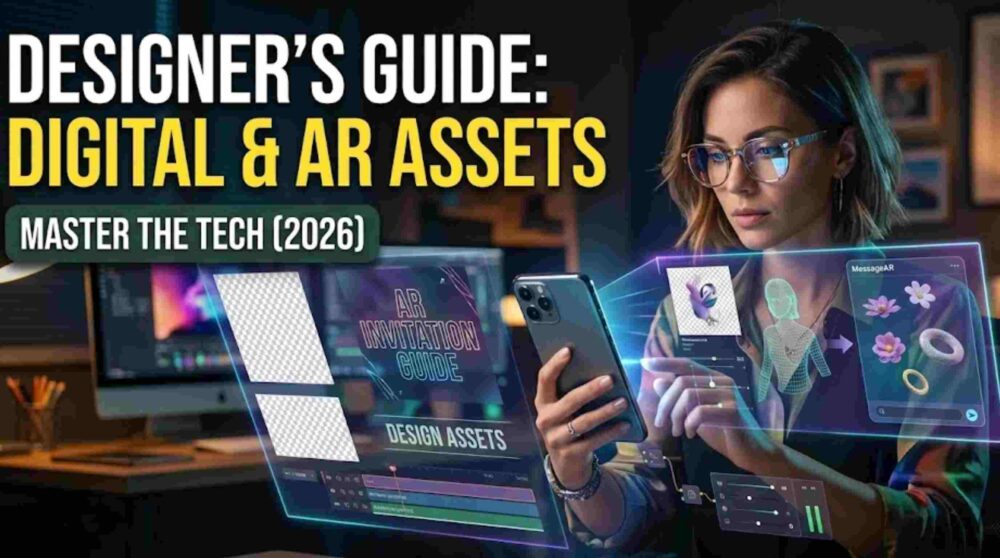
Designer’s Guide to Digital & AR Invitation Assets is a practical framework for creators who want to combine polished visual design with immersive storytelling in 2026. Today’s invitation designer is not simply exporting files. You are shaping a digital experience that must feel refined on mobile screens, work smoothly across messaging apps, and remain visually compelling inside augmented reality environments.
From resolution and compression to typography and AR-ready assets, this guide outlines the essential standards for designing premium digital invitation assets and AR invitation experiences for modern events.
1. Mastering the VIT Asset Framework
A strong digital invitation experience depends on assets that are built for the way people actually view them. In most cases, that means mobile-first layouts, vertical formats, and lightweight files that still look premium on modern displays.
The Video-Image-Text (VIT) framework remains one of the most effective ways to structure digital invitation delivery:
- Video creates the emotional first impression
- Image delivers the key event details in a saveable format
- Text handles links, RSVP instructions, and practical information
When these three elements are prepared correctly, the invitation feels more intentional, more polished, and easier for guests to engage with.
Video Export Settings for Digital Invitations
To keep video invitations smooth, high-quality, and easy to share across devices:
Resolution: 1080 x 1920 is the ideal vertical format for most mobile-first invitation workflows. It delivers sharp quality without creating unnecessarily heavy files.
Codec: H.265 (HEVC) is often a strong choice when you want better compression efficiency than older formats, especially for visually rich motion assets.
Bitrate: A moderate bitrate helps balance clarity with manageable file size. Very large exports may load slowly or become inconvenient to share on messaging platforms.
Frame Rate: 24fps is a strong option for a softer, more cinematic feel. For invitation design, this often appears more elegant than a hyper-smooth high-frame-rate look.
2. Building High-Quality Static Invitation Assets
Static design still plays a critical role in digital wedding invitations, event invites, and AR-triggered invitation cards. This is usually the asset guests save, forward, screenshot, or revisit later.
Recommended Design Approach
PNG is often useful for graphics with text, decorative overlays, or sharp-edged design elements where clarity matters.
JPG can work well for photo-led invitation designs where file size needs to stay lighter.
Color Profile: For digital-first invitations, work in screen-friendly colour spaces such as sRGB, and use wider-gamut workflows only when your export pipeline supports them properly. Designing for print-first output can cause digital colours to appear flatter or less accurate on screens.
The goal is simple: the invitation should remain crisp, readable, and visually premium on the guest’s phone.
3. Designing for AR Invitation Experiences
Designing AR invitation assets requires a different mindset from standard digital media. In a typical video, the background is fixed. In augmented reality, the guest’s real-world environment becomes part of the visual experience.
That means every asset must be considered not only for beauty, but also for tracking, performance, and screen clarity.
Working with Transparency
If your AR experience includes floating text, decorative particles, animated characters, or layered motion graphics, you may need formats that support transparency.
Depending on the workflow, designers often prepare AR-ready assets using export formats and animation systems that preserve alpha channels or allow lightweight overlay behaviour across compatible environments.
For web-based or mobile AR experiences, lightweight animated assets are often easier to deploy than large transparent video files.
Trigger Image Design
The trigger image is the printed or digital visual that starts the AR experience when scanned.
To improve recognition and tracking reliability:
- Use designs with enough contrast and visual distinction
- Avoid extremely minimal surfaces with little detail
- Add recognisable structure, pattern, or framing when needed
- Be careful with reflective print finishes that may interfere with camera detection
A beautifully designed trigger image should not only look elegant, but also support stable AR activation.
4. Typography for Mobile and OLED Displays
Typography is one of the most important elements in digital invitation design. A beautiful layout can still fail if the names, schedule, or venue information are difficult to read on a phone.
Better Type Pairing for Invitation Assets
A refined approach is to use:
- a high-contrast serif for names or headline moments
- a clean sans-serif for timings, venue details, RSVP instructions, and supporting text
This creates a premium editorial contrast while preserving readability.
Readability Principles That Matter
Letter Spacing: Slightly increasing tracking for all-caps subheads can help create a more polished, luxury-inspired look.
Hierarchy: Names, date, venue, and action links should be visually distinct so guests can scan the content quickly.
Touch-Friendly Sizing: Any tappable buttons, call-to-action areas, or linked design elements should be large enough to interact with comfortably on mobile devices.
A strong invitation should feel elegant at first glance and effortless to use at second glance.
5. The 2026 Aesthetic Direction: Refined Motion Over Excess
The visual language of premium digital invitations is moving toward restraint. Instead of loud transitions and crowded effects, the stronger direction is subtle movement, texture, and controlled elegance.
Motion Design Trends for Premium Invitations
Slow Zoom and Gentle Movement: A subtle scale shift or restrained camera movement often feels more premium than aggressive transitions.
Texture and Grain: Light film grain or delicate texture overlays can reduce the overly synthetic feel of ultra-clean digital video and add depth.
Balanced Colour Treatment: Warm neutrals, muted romantic palettes, and natural tones often translate beautifully across modern displays without feeling overprocessed.
This approach works especially well for luxury wedding invitations, premium event invites, and modern AR invitation campaigns where the goal is sophistication rather than visual noise.
6. Delivery Strategy for Digital Invitation Assets
Even the best-designed invitation can lose impact if it is shared poorly. Compression, file handling, and delivery method all affect how premium the final experience feels.
Best Practices for Sharing
For the main detail card, many designers prefer delivery methods that preserve text sharpness and layout quality as much as possible.
For videos, it is important to keep exports efficient enough for quick loading while still maintaining visual polish.
For AR-linked invitations, always think about the guest journey from first click to final interaction. The experience should feel seamless, not technical.
A polished invitation is not only about design quality. It is also about how reliably that design reaches the guest.
7. Why Digital and AR Invitation Design Matters in 2026
Digital invitations are no longer just a convenient alternative. They have become an important part of modern event branding, guest communication, and visual storytelling. Augmented reality builds on that by turning an invitation into something more memorable, interactive, and emotionally engaging.
For designers, this creates a new standard. You are no longer producing a single static graphic. You are building a complete invitation experience across motion, layout, readability, mobile usability, and immersive interaction.
When done well, digital invitation assets and AR invitation design help transform an ordinary message into a premium event moment.
Final Thoughts
The best digital and AR invitation assets combine beauty with usability. They are visually elegant, technically prepared, mobile-friendly, and designed with the guest experience in mind.
As expectations continue to rise in 2026, designers who understand compression, typography, motion, trigger-image behaviour, and cross-platform delivery will stand out. The future of invitation design belongs to creators who can merge aesthetics with interaction and turn digital communication into something that feels unforgettable.